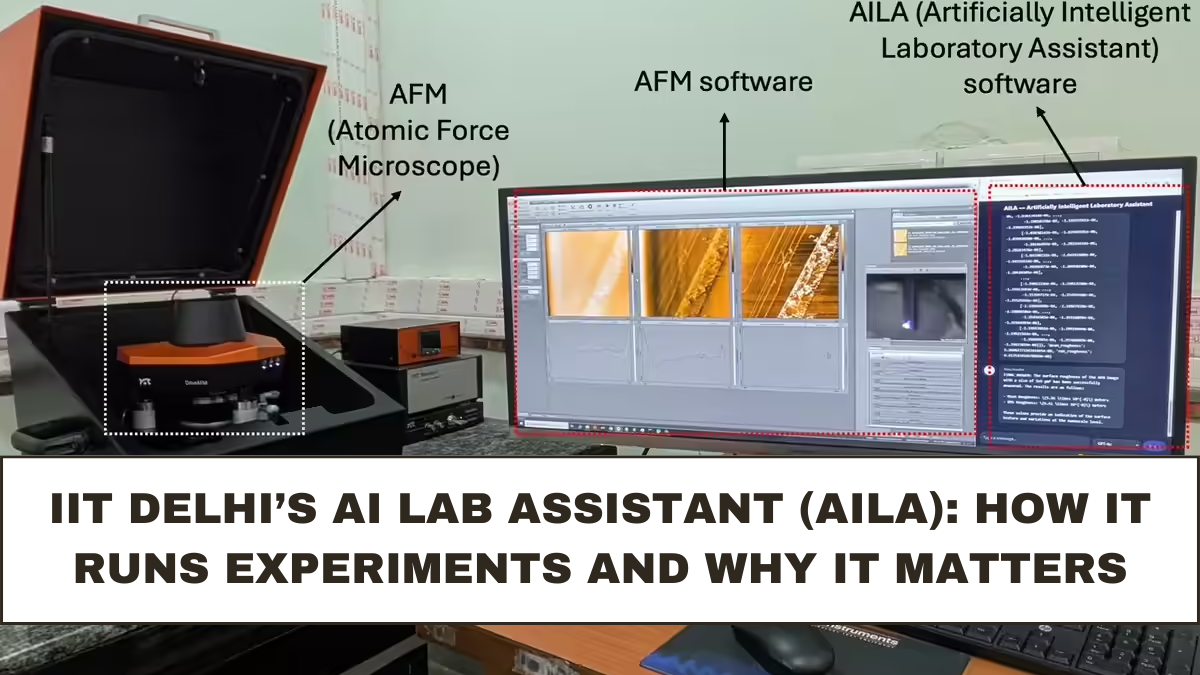
The iit delhi aila ai lab assistant has become one of the most significant AI research developments to emerge from India in recent times. Built to support scientific research, AILA is capable of planning, executing, and refining laboratory experiments with minimal human intervention. Its success has attracted international attention, including recognition in Nature Communications, highlighting India’s growing role in advanced AI-driven science.
Unlike traditional laboratory automation systems, the iit delhi aila ai lab assistant introduces intelligence into experimental workflows, enabling labs to operate faster, more accurately, and with improved reproducibility.
What Is AILA and Why Is It Important?
AILA, or AI Lab Assistant, is an intelligent research system developed at IIT Delhi to assist scientists in complex experimental environments. The iit delhi aila ai lab assistant is not limited to repetitive tasks. Instead, it understands objectives, adapts procedures, and learns from outcomes.
Its importance lies in its ability to:
• Reduce repetitive manual work
• Minimise human error in experiments
• Speed up scientific discovery
• Improve data consistency
• Enable true autonomous experiments
By supporting autonomous experiments, AILA allows researchers to dedicate more time to hypothesis building and result interpretation.
How AILA Conducts Autonomous Experiments
The defining feature of the iit delhi aila ai lab assistant is its ability to conduct autonomous experiments rather than following fixed instructions. Once researchers define a goal, AILA determines the sequence of steps required to achieve it.
Its experimental workflow includes:
• Designing experiment sequences
• Selecting appropriate variables
• Monitoring ongoing reactions
• Analysing intermediate results
• Adjusting parameters dynamically
This adaptive decision-making capability makes the iit delhi aila ai lab assistant fundamentally different from conventional lab robots.
The AI Technology Behind AILA
The iit delhi aila ai lab assistant is powered by a combination of machine learning, reasoning systems, and scientific knowledge bases. These components work together to ensure reliable performance in real lab environments.
Key technologies include:
• Machine learning models trained on lab data
• Knowledge graphs for protocols and materials
• Rule-based safety checks
• Feedback loops for learning
• Error detection and correction mechanisms
This layered architecture allows AILA to continuously improve with experience.
Why Nature Communications Recognition Matters
The publication of AILA-related research in Nature Communications marks a major milestone for Indian AI research. It validates the scientific rigor and global relevance of the iit delhi aila ai lab assistant.
This recognition shows that:
• Indian AI research meets global standards
• Autonomous lab systems are scientifically viable
• AI can accelerate experimental science
• Academic-industry collaboration is strengthening
Being featured in Nature Communications places AILA alongside leading international research efforts.
Impact on Scientific Research in India
The iit delhi aila ai lab assistant has the potential to transform how research is conducted across Indian institutions. By automating complex workflows, labs can achieve faster turnaround times and better accuracy.
Expected benefits include:
• Faster experimentation cycles
• Better reproducibility of results
• Lower operational costs
• Increased research output
• Improved collaboration across labs
The rise of autonomous experiments could significantly enhance India’s research competitiveness.
Use Cases Across Scientific Fields
While initially developed for controlled lab environments, the iit delhi aila ai lab assistant can be adapted for multiple scientific domains.
Potential applications include:
• Materials science
• Chemical synthesis
• Drug discovery
• Biotechnology research
• Environmental analysis
Each of these areas can benefit from intelligent experiment planning and execution.
Safety and Ethical Questions Around Autonomous Labs
The emergence of systems like the iit delhi aila ai lab assistant also raises important safety and ethical considerations. Autonomous systems must operate within strict boundaries.
Key concerns include:
• Ensuring human oversight
• Preventing unsafe experiment combinations
• Maintaining data integrity
• Avoiding misuse of automation
• Defining accountability
IIT Delhi researchers emphasise that AILA is designed with multiple safety layers to ensure responsible deployment.
How AILA Supports Researchers, Not Replaces Them
Despite its advanced capabilities, the iit delhi aila ai lab assistant is not intended to replace scientists. Instead, it functions as a collaborative tool.
AILA helps researchers by:
• Handling repetitive execution tasks
• Managing complex workflows
• Suggesting experiment optimisations
• Providing data-driven insights
• Supporting decision-making
Human expertise remains central to interpreting results and guiding research direction.
What This Means for the Future of AI in Science
The success of the iit delhi aila ai lab assistant signals a broader shift toward AI-assisted scientific discovery. As systems capable of autonomous experiments mature, research timelines could shorten dramatically.
Future developments may include:
• Fully autonomous research labs
• AI-driven hypothesis generation
• Faster innovation cycles
• Cross-disciplinary AI research tools
• Stronger global collaboration
AILA represents an early but powerful step toward this future.
Conclusion
The iit delhi aila ai lab assistant demonstrates how artificial intelligence can meaningfully enhance scientific research. By enabling autonomous experiments, improving reproducibility, and accelerating discovery, AILA sets a new benchmark for AI-powered laboratories. Its recognition in Nature Communications confirms the global relevance of this innovation and highlights India’s growing leadership in advanced AI research.
FAQs
What is IIT Delhi’s AILA AI lab assistant?
AILA is an AI system that helps run and optimise laboratory experiments autonomously.
How does AILA conduct autonomous experiments?
It plans, executes, monitors, and adjusts experiments based on real-time results.
Why is Nature Communications important here?
It validates the scientific credibility and global relevance of the research.
Does AILA replace human researchers?
No, it supports researchers by automating execution while humans guide decisions.
What fields can benefit from AILA?
Materials science, chemistry, biotechnology, and drug discovery are key areas.
Click here to know more.