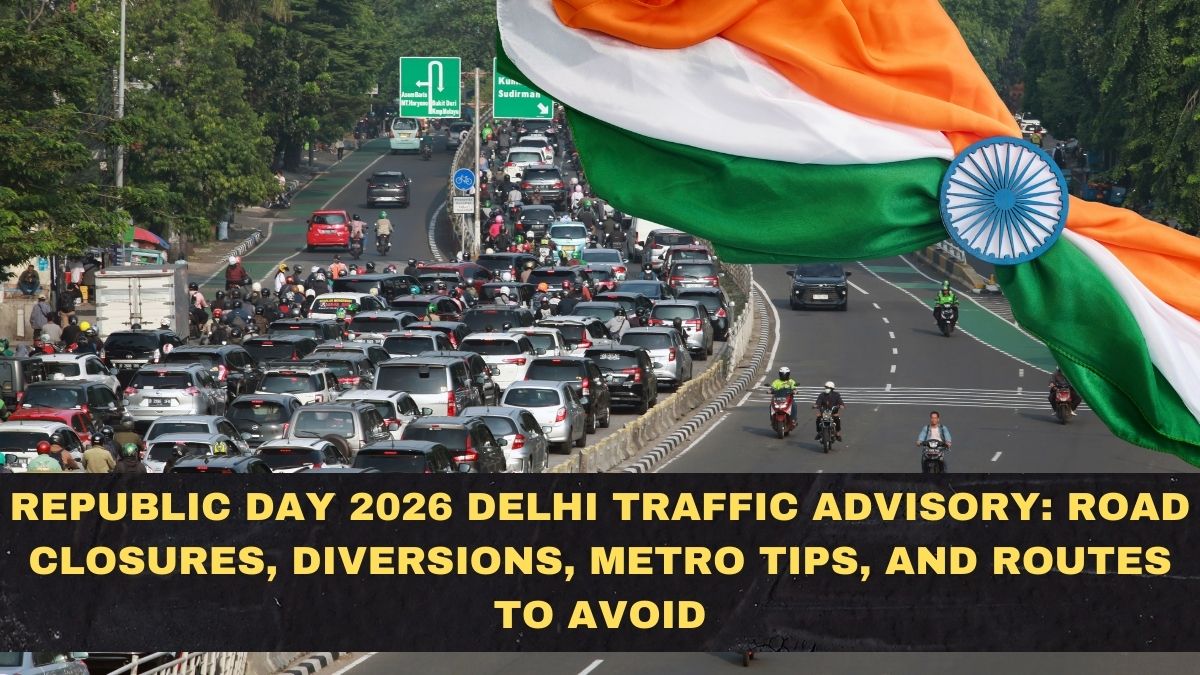
Republic Day in Delhi is not just a national celebration. It is one of the largest annual security and traffic-management exercises in the country. In 2026, the scale is even more intense because of higher crowd density, expanded security zones, and stricter movement controls across central and east Delhi. For commuters, office-goers, airport travelers, and NCR residents, this is not a symbolic inconvenience. It is a real logistical challenge that can easily derail an entire day if not planned correctly.
Search interest around the Republic Day 2026 Delhi traffic advisory spikes every year for a simple reason. People are tired of getting trapped in unannounced roadblocks, missing flights, reaching offices late, or being stuck for hours inside redirected traffic loops. This advisory is not about ceremonial pride. It is about practical survival inside a city that temporarily stops behaving like a normal city.
Why Delhi Traffic Gets Severely Restricted on Republic Day
Republic Day security protocols are among the strictest applied to any public event in India.
The reasons are structural, not symbolic.
They include:
-
High-profile national leadership presence
-
Foreign dignitaries attendance
-
Massive public gathering density
-
Military parade logistics
-
Aerial surveillance operations
-
Anti-sabotage perimeter zones
This creates layered security rings around central Delhi.
Each ring triggers:
-
Road closures
-
Vehicle restrictions
-
Diversions
-
Parking bans
-
Pedestrian movement controls
This is why even roads that are not directly on the parade route get affected.
Core Parade Zone and High-Restriction Areas
The highest restriction intensity always applies around the ceremonial parade corridor.
This typically includes:
-
Kartavya Path
-
Central Secretariat zone
-
India Gate surroundings
-
Vijay Chowk
-
Rajpath extension corridors
These areas experience:
-
Complete vehicle bans
-
Heavy police barricading
-
Entry only for authorized passes
-
Strict pedestrian screening
For ordinary commuters, this zone is effectively sealed for several hours.
Major Roads That Typically Face Closures or Heavy Diversions
While exact road lists are released closer to the event, historically the most affected corridors include:
-
Ring Road (central stretches)
-
Tilak Marg
-
Rajpath connecting roads
-
Rafi Marg
-
Janpath
-
Ashoka Road
-
Lodhi Road
-
Sikandra Road
-
Mathura Road stretches
Even if your destination is not in central Delhi, crossing these arteries becomes extremely slow or impossible.
Why Airport, Railway Station, and ISBT Routes Get Disrupted
One of the biggest pain points every year is airport and intercity terminal connectivity.
This happens because:
-
Many access roads overlap with restricted corridors
-
VIP movement temporarily freezes traffic
-
Security convoys block arterial roads
Travelers heading to:
-
IGI Airport
-
New Delhi Railway Station
-
Old Delhi Railway Station
-
Anand Vihar Terminal
-
Kashmere Gate ISBT
often face unpredictable delays.
That is why the Republic Day 2026 Delhi traffic advisory matters most for long-distance travelers.
Metro Services and Why They Become the Smartest Option
Delhi Metro becomes the most reliable transport mode on Republic Day.
But even Metro operations are modified.
Key patterns usually include:
-
Early morning entry restrictions at select stations
-
Temporary closure of stations near parade route
-
Exit-only or entry-only designations
-
Security frisking delays
However, compared to road transport, Metro remains far more predictable.
For central Delhi access, Metro is almost always the fastest option.
Parking Restrictions and Towing Zones
Parking becomes a nightmare during Republic Day.
Large zones across central and south Delhi are declared no-parking areas.
Vehicles parked in restricted zones are:
-
Towed without warning
-
Fined heavily
-
Released only after long verification
Common high-risk parking areas include:
-
Around India Gate
-
Near government offices
-
Near Metro station exits
-
Residential streets near parade routes
If your car is parked overnight near central Delhi, it is at serious risk.
How NCR Commuters Get Affected
Republic Day disruptions are not limited to Delhi.
They ripple outward into:
-
Noida
-
Gurugram
-
Ghaziabad
-
Faridabad
This happens because:
-
Border points get partially sealed
-
Traffic funnels into fewer open crossings
-
Police checkpoints slow intercity flow
Office-goers traveling from NCR into Delhi experience the worst delays.
Smart Commute Planning Tips That Actually Work
Most people rely on navigation apps alone.
That is a mistake.
On Republic Day, many police barricades are not reflected in real time.
The smarter strategy includes:
-
Leaving home earlier than normal
-
Avoiding central Delhi entirely
-
Using Metro wherever possible
-
Avoiding border crossings during peak hours
-
Keeping buffer time for airport or train travel
These adjustments reduce risk far more than blindly following app routes.
Why Google Maps Alone Is Not Enough on Republic Day
Navigation apps depend on live traffic data.
They do not understand:
-
Sudden security barricades
-
VIP convoy blocks
-
Temporary pedestrian-only corridors
This is why many drivers get trapped in dead-end diversions.
Relying exclusively on Google Maps during Republic Day is a strategic mistake.
What Time Windows Are Usually the Worst
The worst traffic congestion windows typically occur:
-
Early morning parade preparation phase
-
Parade start window
-
Post-parade dispersal phase
-
VIP departure phase
During these windows, even normally empty roads can freeze.
Avoiding travel entirely during these hours is the safest option.
Conclusion: Why Treating Republic Day Like a Normal Day Is a Mistake
Republic Day in Delhi is not just another holiday with light traffic. It is a high-security urban lockdown wrapped inside a celebration. Treating it like a normal commute day is the fastest way to end up late, stressed, stranded, or fined.
The Republic Day 2026 Delhi traffic advisory exists for one simple reason: to help people avoid predictable mistakes. If you plan your travel window, avoid central Delhi, use the Metro strategically, and leave earlier than usual, the day becomes manageable. If you ignore these realities, the city will punish you for it.
In 2026, traffic chaos on Republic Day is not bad luck. It is a planning failure.
FAQs
Why is traffic so restricted in Delhi on Republic Day?
Because of multi-layered security protocols, VIP movement, parade logistics, and massive crowd control measures.
Which areas are most affected by Republic Day traffic restrictions?
Central Delhi zones around Kartavya Path, India Gate, Vijay Chowk, and surrounding arterial roads.
Is Delhi Metro fully operational on Republic Day?
Yes, but some stations near the parade route may be temporarily closed or have restricted entry and exit.
Can I drive to the airport on Republic Day?
Yes, but expect heavy delays and route diversions. Metro is often the safer option.
Will Google Maps show all road closures accurately?
No. Many temporary barricades and security blocks are not reflected in real time.
What is the best way to avoid Republic Day traffic problems?
Avoid central Delhi, use the Metro, leave early, and build buffer time into all travel plans.