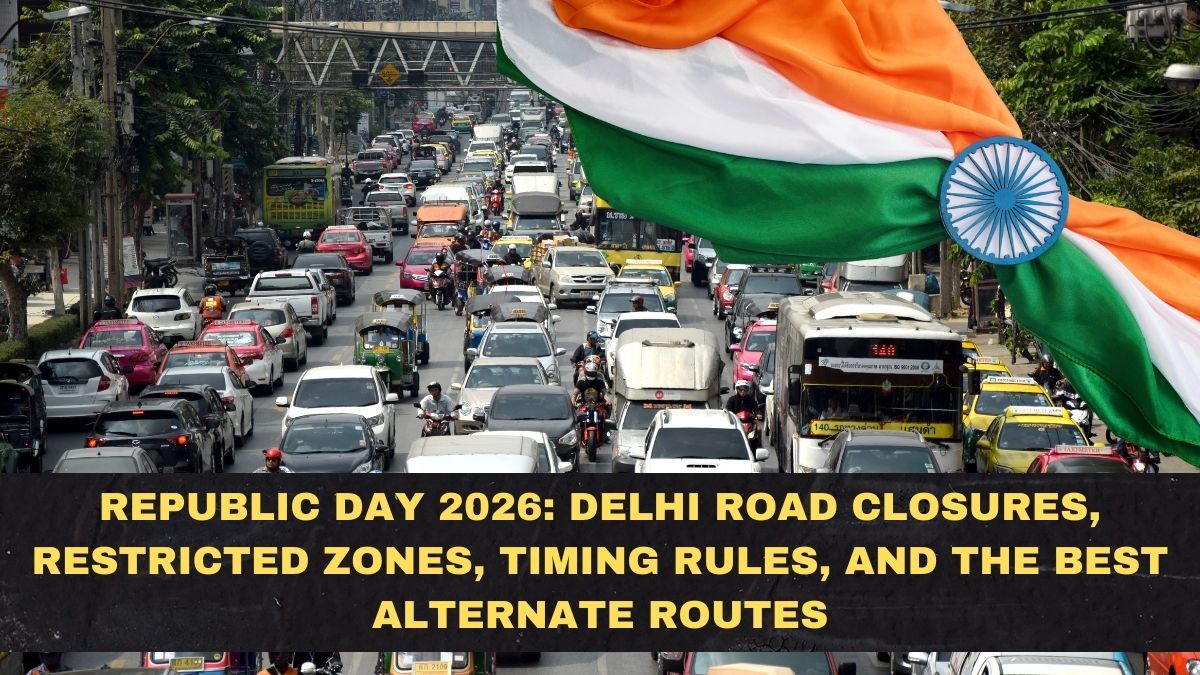
Every year, thousands of people in Delhi convince themselves that they can “just manage” Republic Day traffic like any other holiday. And every year, the city proves them wrong. Republic Day is not a normal traffic-disruption event. It is a multi-layered security lockdown that reshapes how Delhi physically functions for several hours. In 2026, the scale of restrictions is even tighter because of expanded security perimeters, higher surveillance coverage, and stricter movement controls.
Search interest around Republic Day 2026 Delhi road closures spikes sharply because people are tired of being caught off guard. Flights get missed. Office arrivals get delayed. Emergency errands become impossible. Cars get towed. Entire routes collapse into dead ends. This guide exists to explain not just which roads close, but why they close, how long they stay blocked, and how to plan alternate routes without trusting blind navigation apps.
Why Republic Day Road Closures Are So Extensive
Republic Day security is not symbolic theater. It is a real counter-terror and crowd-control operation.
The closures exist because:
-
The parade route must remain sterile and vehicle-free
-
VIP convoys require uncontested movement corridors
-
Emergency response lanes must stay open
-
Aerial surveillance zones require ground buffer areas
-
Crowd overflow zones need rapid isolation capacity
This creates layered rings of restrictions that go far beyond Kartavya Path.
That is why even roads far away from the main parade route get blocked.
Primary Parade Route Closure Zone
The highest-restriction zone covers the ceremonial corridor.
This zone is effectively sealed for all civilian vehicles.
It typically includes:
-
Kartavya Path
-
Vijay Chowk
-
India Gate circle
-
Rajpath extension corridors
-
Central Secretariat frontage roads
Inside this zone:
-
No private vehicles are allowed
-
No commercial traffic is allowed
-
No ride-hailing pickups or drop-offs work
-
Pedestrian movement is tightly controlled
For all practical purposes, this zone becomes inaccessible.
Secondary High-Restriction Corridors
These are the roads that quietly ruin commutes.
They are not parade roads, but they serve as security buffers.
Historically, these include:
-
Tilak Marg
-
Janpath
-
Rafi Marg
-
Ashoka Road
-
Sikandra Road
-
Lodhi Road
-
Bhairon Marg
-
Mathura Road (central stretches)
These roads usually experience:
-
Complete closure in early hours
-
Partial reopening post-parade
-
Sudden convoy blocks
-
Heavy police barricading
This is where most people get trapped.
Ring Road and Arterial Diversion Zones
Large sections of Ring Road and other arterial connectors are diverted to prevent traffic from entering central Delhi.
These diversions are designed to:
-
Funnel vehicles away from security zones
-
Prevent border-to-border transit through central areas
-
Maintain emergency corridors
Drivers often assume Ring Road will remain usable.
That assumption is wrong on Republic Day.
Delhi–NCR Border Crossing Restrictions
One of the most painful surprises every year is border disruption.
Key Delhi–NCR crossings are either partially sealed or slowed heavily.
This affects:
-
Noida–Delhi crossings
-
Gurugram–Delhi crossings
-
Ghaziabad–Delhi crossings
-
Faridabad–Delhi crossings
This happens because:
-
Vehicle screening increases
-
Convoy movements freeze traffic
-
Central Delhi restrictions ripple outward
Office-goers coming from NCR face the worst delays.
Parking Bans and Towing Hotspots
Road closures are only half the problem.
Parking bans create chaos.
Large areas are declared no-parking zones.
These typically include:
-
Streets around India Gate
-
Roads near government buildings
-
Areas near Metro exits
-
Residential pockets near barricaded roads
Vehicles parked in these zones are:
-
Towed without notice
-
Fined heavily
-
Released only after verification
If your car is parked anywhere near central Delhi overnight, it is at serious risk.
Why Road Closures Start So Early
Most people expect closures to begin near parade time.
That is a critical mistake.
Closures begin in the early morning hours.
This happens because:
-
Security sweeps must be completed
-
Barricades must be installed
-
Convoy corridors must be cleared
-
Emergency lanes must be established
By the time most people wake up, large parts of Delhi are already sealed.
Why Navigation Apps Fail on Republic Day
This is where most planning collapses.
Google Maps and similar apps rely on crowd-sourced traffic data.
They do not understand:
-
Police barricade placement
-
Temporary convoy halts
-
Pedestrian-only conversion zones
-
Sudden security escalations
This is why apps often route drivers into blocked roads.
Blindly following navigation apps on Republic Day is a strategic error.
Best Alternate Route Strategy That Actually Works
There is no single perfect alternate route.
But a reliable strategy exists.
It includes:
-
Avoiding central Delhi entirely
-
Using outer Ring Road corridors
-
Sticking to peripheral expressways
-
Crossing NCR borders early or late
-
Using Metro for central access
This strategy minimizes exposure to unpredictable barricades.
Worst Time Windows for Road Travel
The worst congestion windows usually occur during:
-
Early-morning security lockdown phase
-
Parade commencement window
-
Post-parade dispersal window
-
VIP departure window
During these phases, even minor roads freeze.
Avoiding travel entirely during these windows is the safest option.
Who Should Absolutely Not Drive on Republic Day
Some people should not drive at all.
This includes:
-
Airport travelers
-
Train passengers
-
Emergency errand runners
-
Out-station travelers
-
Delivery drivers
For these groups, Metro or rescheduling is almost always safer.
Conclusion: Why Ignoring Republic Day Road Closures Is Self-Sabotage
Republic Day 2026 Delhi road closures are not advisory theater. They are hard security controls enforced with zero flexibility. Ignoring them is not optimism. It is self-sabotage. The city does not “adjust” for your urgency, your meeting, your flight, or your personal inconvenience.
If you plan your routes around normal-day assumptions, you will lose hours of your life and possibly money through missed connections and fines. If you treat Republic Day like a special operational day with its own rules, you can move through the city with minimal damage.
In 2026, Republic Day traffic chaos is not bad luck. It is poor planning.
FAQs
Which roads are fully closed on Republic Day 2026 in Delhi?
Roads around Kartavya Path, India Gate, Vijay Chowk, and major central corridors are typically fully closed.
When do road closures usually start?
Closures begin in the early morning hours, well before the parade starts.
Are NCR border crossings affected?
Yes. Many border points are partially sealed or experience heavy delays.
Will Google Maps show all closures correctly?
No. Many police barricades and convoy blocks are not reflected in real time.
Is parking allowed near central Delhi on Republic Day?
No. Large zones are declared no-parking areas, and vehicles are towed aggressively.
What is the safest way to travel in Delhi on Republic Day?
Avoid central Delhi, use Metro for core access, leave early, and build buffer time into all travel plans.