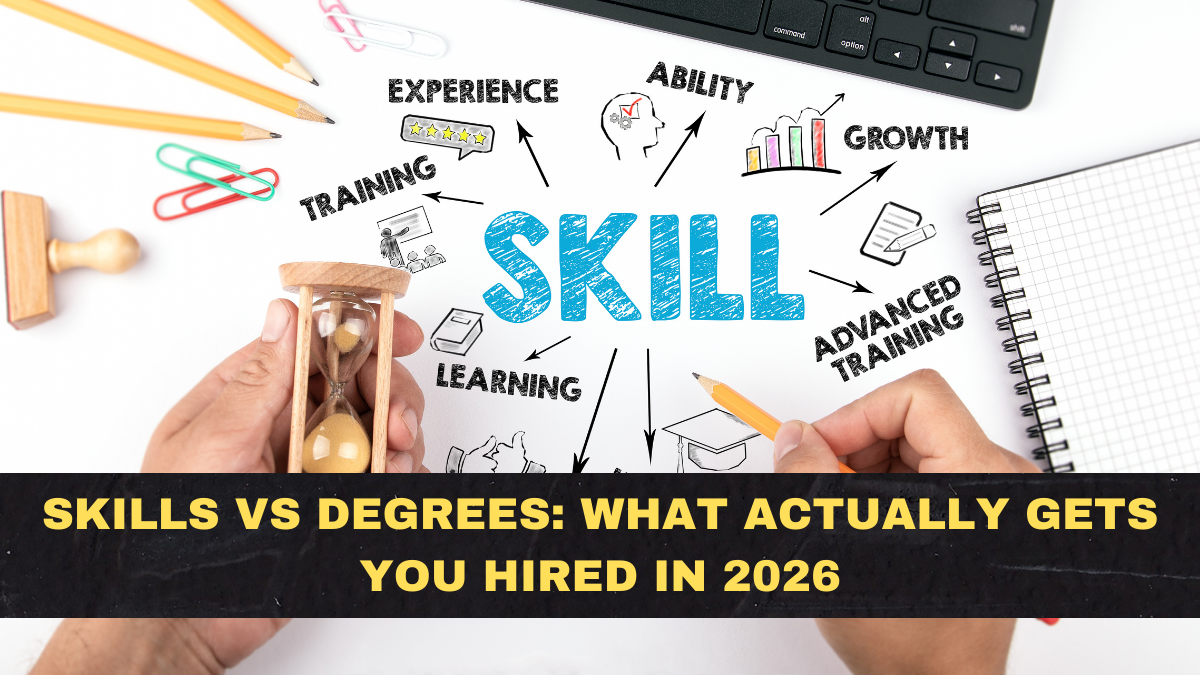
For years, Indian students were taught that a good degree was the ultimate key to employment. Marks, college names, and certificates dominated career conversations. In 2026, that belief is being challenged in ways that are uncomfortable but impossible to ignore. Employers are no longer hiring based on qualifications alone. They are hiring based on what people can actually do.
The debate around skills vs degree is no longer theoretical. It is playing out daily in interviews, hiring tests, and workplace performance reviews. Graduates with strong degrees but weak practical ability are struggling, while candidates with average education but solid skills are moving ahead. This shift is quietly reshaping how careers begin and grow in India.
Why Degrees Alone Are Losing Their Hiring Power
Degrees were once trusted signals of competence. Over time, mass enrollment and uneven education quality diluted that signal. Employers now see thousands of similar resumes with identical qualifications.
What they cannot easily find are candidates who can solve real problems from day one. Training fresh hires has become expensive and time-consuming, pushing companies to favor job-ready skills instead.
In 2026, a degree has become a baseline requirement in many fields, not a differentiator. The real competition begins after that baseline is crossed.
How Employers Actually Evaluate Candidates Today
Hiring processes have changed significantly. Interviews focus less on academic performance and more on applied thinking, communication, and adaptability.
Practical tests, assignments, and scenario-based questions are increasingly common. Employers want proof, not potential. They assess how candidates think, not just what they studied.
This is why the skills vs degree conversation matters. Skills provide visible evidence, while degrees often require assumptions.
Industries Where Skills Matter More Than Degrees
In several industries, skills have already overtaken degrees as the primary hiring filter. Technology roles prioritize coding ability, system understanding, and problem-solving over academic background.
Creative fields value portfolios and execution quality. Marketing, media, and design roles often reward results and creativity rather than formal education.
Even in business roles, analytical ability, communication, and decision-making skills are outweighing generic qualifications in 2026.
Why Students Still Overvalue Degrees
Despite market signals, students continue to prioritize degrees due to social conditioning. Families equate education with security and view skills as secondary or risky.
Schools and colleges reinforce this mindset by focusing heavily on exams and grades. Career counseling often ignores skill pathways entirely.
As a result, many graduates enter the job market underprepared, believing their degree alone will carry them forward.
The Cost of Ignoring Skill Development
Graduates who ignore skill-building face delayed employment, low starting salaries, and slower growth. Employers may hire them, but advancement remains limited.
This creates frustration and regret. Students feel misled after investing years in education that does not translate into opportunity.
In 2026, ignoring skills is no longer just a disadvantage; it is a career bottleneck.
Degrees Still Matter, But Differently
The rise of skills does not mean degrees are useless. Degrees still provide foundational knowledge, credibility, and access to certain roles.
However, their role has shifted. A degree now supports a career rather than defines it. Without skills layered on top, its value drops sharply.
The winning combination in 2026 is not skills versus degree, but skills plus degree.
How Students Can Build Skills Alongside Education
Skill development does not require abandoning formal education. Students can build skills through projects, internships, freelancing, and hands-on learning.
Online platforms, open-source contributions, and real-world problem-solving create proof of capability. These experiences matter more than certificates alone.
Consistency matters more than speed. Even small projects accumulated over time can change career trajectories.
Why Employers Trust Skills More Than Certificates
Certificates show completion, not competence. Skills demonstrate execution under real constraints.
Employers prefer evidence they can verify. A working project, a portfolio, or a solved case builds confidence far more effectively than marksheets.
In 2026, trust in hiring comes from observable ability, not assumptions based on education labels.
The Psychological Shift Students Must Make
Students must move away from passive learning toward ownership of their employability. Waiting for institutions to prepare them is no longer enough.
This shift requires courage. Skill-building involves trial, failure, and public output, which feels uncomfortable at first.
However, those who embrace this mindset gain control over their careers rather than depending on uncertain placement systems.
Conclusion: Skills Decide Outcomes, Degrees Set the Stage
The hiring market in India has quietly but decisively changed. Degrees still open doors, but skills decide who walks through them.
In 2026, the most employable candidates are those who combine structured education with real, usable ability. The skills vs degree debate is not about choosing one over the other.
It is about understanding that skills convert education into opportunity. Without them, even the best degree struggles to deliver results.