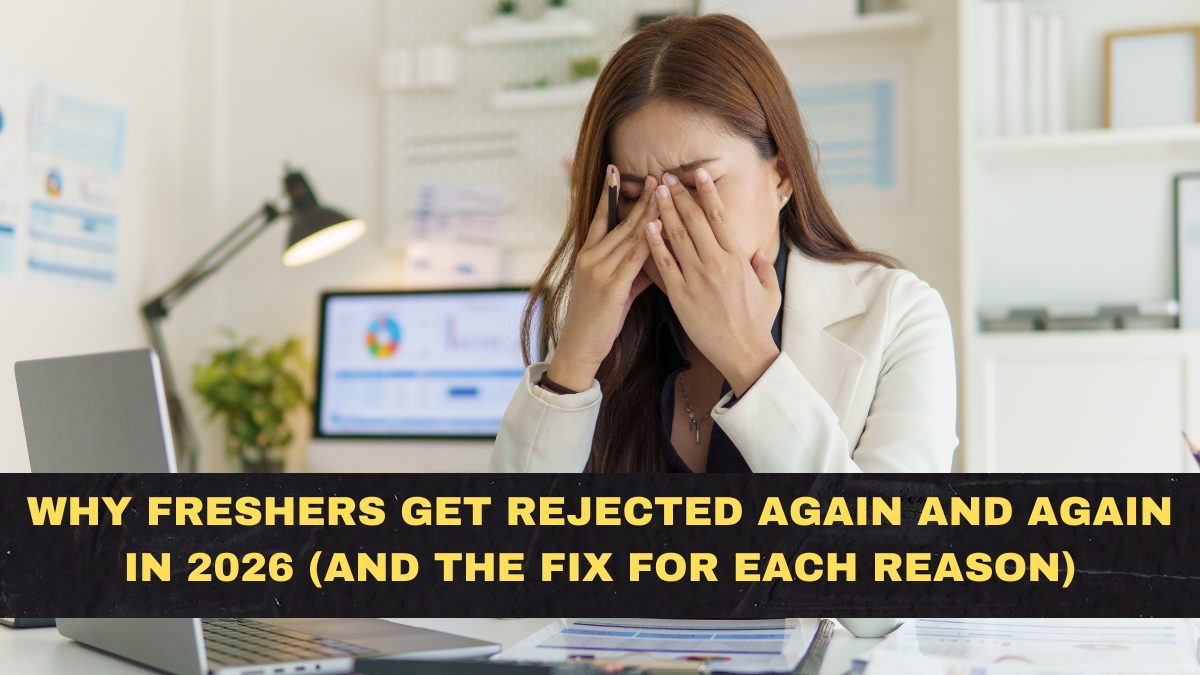
In 2026, fresher rejection in India has become so common that many students start believing something is fundamentally wrong with them. Applications go unanswered, interviews end politely, and rejection emails pile up without explanation. This repeated cycle damages confidence and creates the illusion that the job market is broken or biased beyond repair.
The uncomfortable truth is more practical. Most freshers are rejected for predictable, fixable reasons that have nothing to do with intelligence or effort. Hiring systems have changed, expectations are clearer, and tolerance for unprepared candidates is lower. Understanding why freshers get rejected repeatedly is the first step toward stopping the pattern instead of internalizing it as personal failure.
The Resume Looks Busy but Says Nothing Useful
One of the biggest reasons freshers get rejected is a resume that lists activity without impact. Many resumes are filled with generic skills, vague internships, and copied project descriptions that fail to show real capability.
Recruiters in 2026 scan resumes quickly, looking for proof of applied skills rather than course names or certifications. When everything looks theoretical, the resume blends into hundreds of similar profiles.
The fix is clarity. Each project or experience must show what problem was solved, how it was approached, and what outcome was achieved, even if the scale was small.
Lack of Job-Ready Skills Despite Education
Degrees and coursework do not automatically translate into employable skills. Many freshers assume that finishing a course means they are ready for industry, but employers often disagree.
In 2026, entry-level roles still expect practical ability. Candidates who cannot demonstrate hands-on familiarity with tools, workflows, or real scenarios are filtered out early.
The solution is targeted skill building. Freshers must identify the exact skills required for the roles they want and practice them through projects, not just certificates.
Applying Blindly Without Role Focus
Another major reason for rejection is unfocused job applications. Many freshers apply to dozens of roles across unrelated fields using the same resume.
This signals confusion rather than flexibility. Recruiters can easily spot when a resume is not tailored to the role being applied for.
In 2026, focused applications outperform mass applications. One clear role direction with aligned skills increases interview chances significantly.
Poor Interview Preparation and Shallow Answers
Even when freshers get interview calls, many lose opportunities due to weak preparation. Answers sound memorized, generic, or disconnected from real experience.
Interviewers are not expecting mastery, but they do expect honesty, curiosity, and logical thinking. When candidates cannot explain their own projects or decisions, trust drops immediately.
The fix is practice with intent. Freshers should rehearse explaining their work clearly, including mistakes and learnings, rather than trying to sound perfect.
Ignoring the ATS Reality
Applicant tracking systems filter resumes before humans ever see them. Many freshers are rejected simply because their resumes are unreadable by these systems.
Complex designs, missing keywords, and improper formatting reduce visibility. Candidates often underestimate how much this technical barrier matters.
In 2026, a clean, ATS-friendly resume structure with relevant keywords dramatically improves shortlisting chances.
No Proof of Initiative Outside College
Recruiters increasingly look for signals of initiative. Freshers who rely only on college curriculum appear passive compared to those who build independently.
Side projects, self-initiated learning, internships, and participation in competitions signal curiosity and responsibility. These factors often outweigh grades alone.
The fix is proactive effort. Even small independent projects can differentiate a fresher in a crowded market.
Weak Communication and Confidence Gaps
Communication is not about fluent English alone. It is about clarity of thought and the ability to explain ideas simply.
Many freshers struggle to articulate what they know, leading interviewers to doubt their understanding. This creates rejection even when skills exist.
Improving communication requires practice, feedback, and self-awareness rather than memorization.
Unrealistic Expectations About Entry-Level Roles
Some freshers reject roles that do not meet ideal salary or title expectations, then feel rejected when opportunities disappear.
In 2026, entry-level roles are learning platforms, not final destinations. Employers value candidates who show willingness to grow rather than entitlement.
Aligning expectations with market reality reduces frustration and increases acceptance.
Emotional Impact of Rejection and How It Worsens Outcomes
Repeated rejection affects behavior. Anxiety increases, answers become defensive, and confidence drops visibly during interviews.
This emotional spiral often becomes self-fulfilling. Candidates appear uncertain even when they are capable.
Breaking this cycle requires reframing rejection as feedback rather than judgment.
Conclusion: Rejection Is a Signal, Not a Verdict
Why freshers get rejected in 2026 is not a mystery. It is the result of misalignment between preparation and expectations. The good news is that alignment can be built.
Freshers who focus on skill proof, role clarity, and communication steadily reduce rejection rates. Progress may be slow initially, but it compounds quickly once fundamentals are corrected.
Rejection does not mean you are not good enough. It means your readiness is not visible yet. Making it visible is a skill, and skills can be learned.
FAQs
Is rejection normal for freshers in 2026?
Yes, rejection is common due to high competition, but repeated rejection usually signals fixable gaps.
How many rejections are too many?
There is no fixed number, but if rejections repeat without interviews, resume and role focus need review.
Do grades matter for fresher jobs?
Grades matter less than practical skills and project experience in most private-sector roles.
Should freshers apply to many roles at once?
Focused applications perform better than mass applications with a generic resume.
How can freshers improve interview performance?
By practicing clear explanations of their own work and understanding fundamentals deeply.
Does rejection mean I chose the wrong career?
Not necessarily. It often means preparation needs adjustment, not a complete career change.