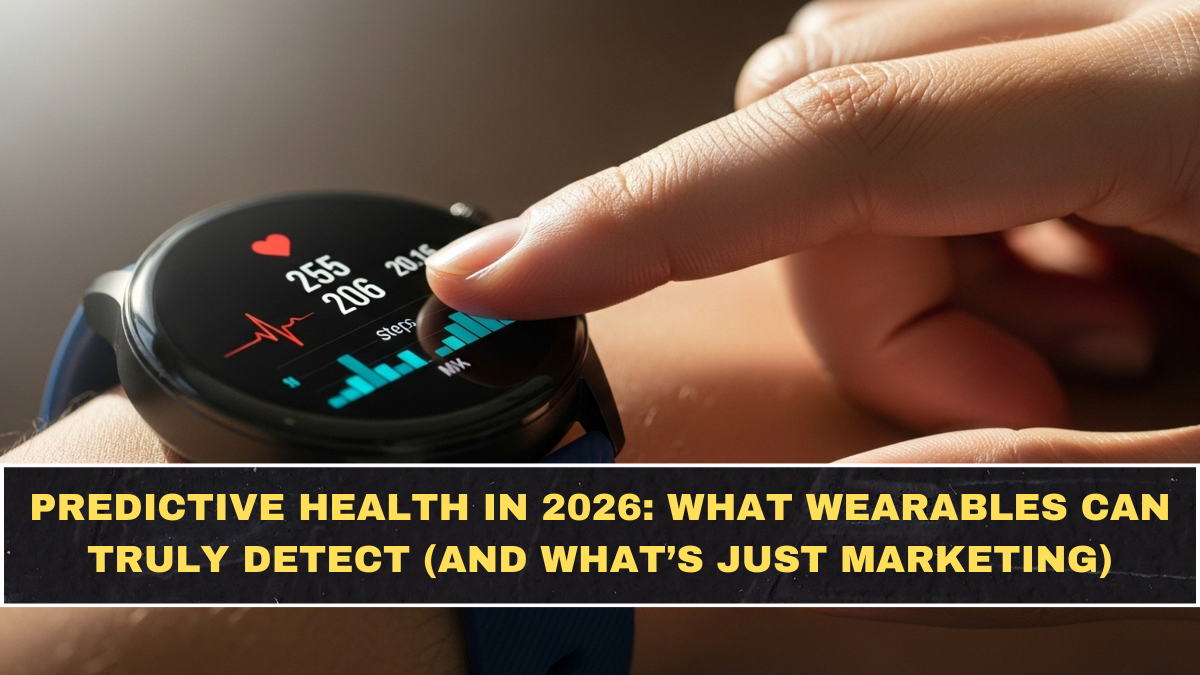
Predictive health technology in 2026 sits at an uncomfortable intersection of real progress and aggressive marketing. Wearables now collect more data than ever before, tracking heart activity, sleep patterns, movement, stress signals, and recovery trends continuously. This flood of information has created the impression that devices can predict illness before it happens, leading many users to expect early warnings for almost everything.
The reality is more nuanced. Predictive health tech is useful, but not magical. It works best when it identifies patterns and deviations rather than diagnosing conditions. Understanding what wearables can genuinely detect, and where claims drift into marketing exaggeration, is critical for using these tools responsibly in 2026.
What Predictive Health Actually Means in 2026
Predictive health does not mean predicting specific diseases with certainty. In practical terms, it means detecting trends, risks, and early warning signals based on continuous data rather than single measurements. Wearables excel at noticing changes over time, not making clinical judgments.
In 2026, predictive insights are generated by comparing your current data against your own historical baseline. This is a major shift from older models that relied on population averages. The device learns what is normal for you and flags deviations that may warrant attention.
This approach is powerful when used correctly, but it requires users to interpret insights as signals, not diagnoses.
Health Signals Wearables Can Reliably Detect
Certain signals are well within the capability of modern wearables. Changes in resting heart rate, heart rate variability, sleep duration, and sleep consistency are among the most reliable indicators. When tracked continuously, these metrics can reflect stress, fatigue, illness onset, or recovery issues.
Activity patterns also provide useful signals. Sudden drops in movement, unusual exertion levels, or prolonged inactivity can highlight lifestyle shifts that affect health. Some wearables can also detect irregular heart rhythms with reasonable accuracy, prompting users to seek medical evaluation.
These detections are valuable because they highlight trends early, not because they replace medical testing.
Where Predictive Health Claims Get Overstated
Marketing often stretches predictive health claims beyond what data supports. Wearables cannot reliably predict complex conditions like diabetes progression, mental health disorders, or infections without additional clinical input.
Many apps use vague language such as “risk detection” or “health forecasting” without clarifying limitations. This creates unrealistic expectations and unnecessary anxiety when normal fluctuations trigger alerts.
In 2026, the biggest risk is not inaccurate data, but overinterpretation. Users may treat probabilistic signals as definitive conclusions, leading to stress or inappropriate self-diagnosis.
The Role of Sleep and Recovery Data
Sleep has become the backbone of predictive health insights. Wearables track duration, timing, and consistency rather than precise sleep stages, which are harder to measure accurately outside clinical settings.
Recovery scores combine sleep, heart metrics, and activity levels to estimate readiness for exertion. These scores are useful for managing fatigue, training load, and burnout risk when interpreted contextually.
However, recovery data is influenced by many factors including stress, alcohol, illness, and routine changes. Treating recovery scores as commands rather than guidance often leads to frustration.
How Preventive Health Insights Actually Help Users
Predictive health tech works best when it nudges behavior rather than issues alarms. Subtle prompts to rest more, move gently, or adjust routines help users maintain consistency.
Users who benefit most are those who look for long-term patterns rather than daily perfection. Over weeks and months, trends become clearer and more actionable.
In 2026, the most effective preventive health use cases involve habit awareness, not constant correction.
Data Accuracy vs Interpretation Accuracy
Most modern wearables are reasonably accurate at measuring raw signals like heart rate and movement. The bigger challenge lies in interpretation layers built on top of this data.
Algorithms simplify complex biological processes into scores and labels. While useful, these abstractions hide uncertainty and context.
Users who understand that metrics are proxies, not truths, make better decisions and experience less anxiety.
Privacy Considerations in Predictive Health Apps
Predictive health data is deeply personal. In 2026, many apps process data locally, but some still rely on cloud analysis and third-party integrations.
Users should be aware of what data is stored, shared, or used for research and product improvement. Health insights are valuable, but so is control over personal information.
Privacy-conscious use involves reviewing permissions, disabling unnecessary sharing, and understanding how long data is retained.
Who Should Rely on Predictive Health Tools
Predictive health tools are most helpful for people managing stress, fitness routines, sleep consistency, or chronic lifestyle issues. They provide feedback loops that encourage small adjustments over time.
They are less suitable for users seeking certainty or medical diagnosis. Anyone with symptoms or health concerns should treat wearable insights as supplementary, not authoritative.
In 2026, predictive health is best viewed as a coaching aid, not a diagnostic engine.
Conclusion: Useful Signals, Not Crystal Balls
Predictive health in 2026 offers meaningful insight when expectations are grounded. Wearables can detect trends, highlight deviations, and support preventive habits, but they cannot predict illness with certainty.
The value lies in long-term awareness rather than instant answers. Users who treat insights as context rather than commands gain clarity instead of anxiety.
In a world increasingly obsessed with optimization, the healthiest approach is balance. Predictive health works best when it supports human judgment, not replaces it.
FAQs
What is predictive health technology?
It refers to systems that analyze continuous health data to identify trends and early warning signals rather than diagnose conditions.
Can wearables predict diseases accurately?
No, wearables can detect patterns and deviations but cannot reliably predict specific diseases without medical evaluation.
Which health metrics are most reliable?
Resting heart rate, heart rate variability, sleep duration, and activity trends are among the most consistent signals.
Why do health apps sometimes cause anxiety?
Over-alerting and unclear explanations can make normal fluctuations feel like problems.
Is predictive health data medically valid?
It is useful for awareness and trend tracking but should not replace professional medical advice.
How should users get the most benefit from wearables?
By focusing on long-term patterns, maintaining realistic expectations, and using insights to guide habits rather than obsess over daily scores.