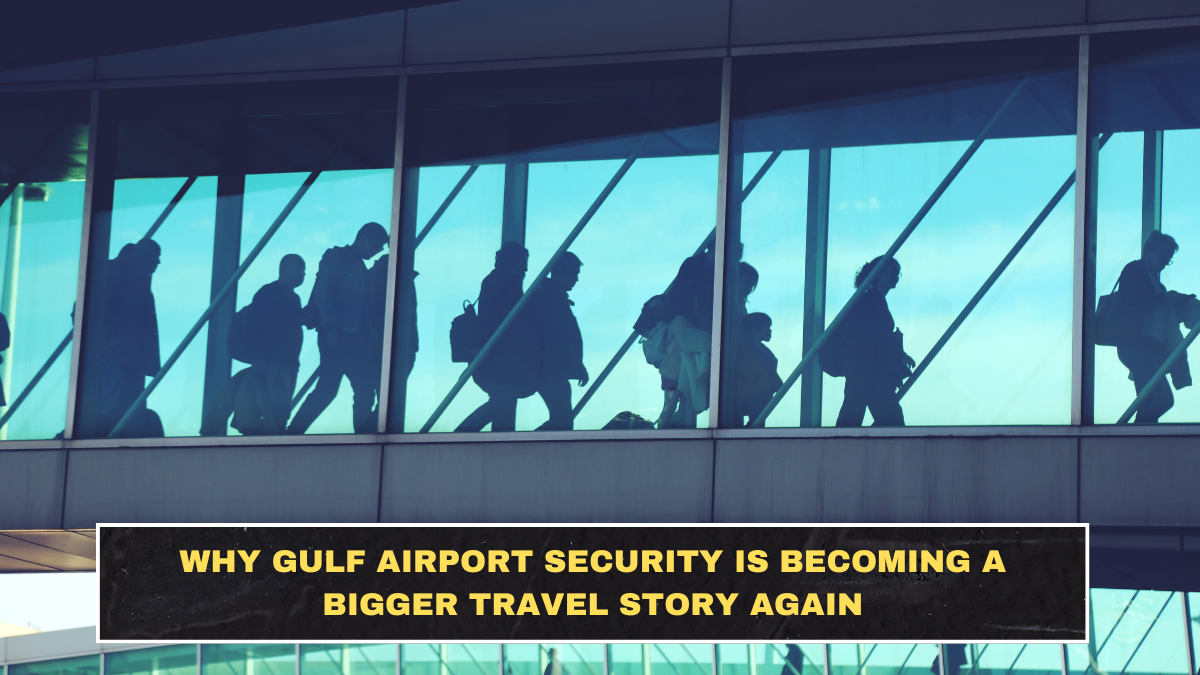
Gulf airport security is becoming a bigger story because this is no longer just about delayed departures. The Iran war has disrupted major aviation hubs, squeezed flight corridors, and forced airlines to treat Gulf operations as a live risk-management problem. Reuters reported on March 31 that global air travel was still severely disrupted after the conflict forced closures at major Middle Eastern hubs including Dubai, Doha, and Abu Dhabi. That matters because these are not small regional airports. They are some of the world’s most important transit gateways.
Why the risk picture has changed
The risk is broader than one airport or one country. Reuters reported that the UAE briefly closed its airspace on March 17 in response to missile and drone threats from Iran, after a drone caused a fire near Dubai airport. That single detail tells you the story clearly: the concern is not only about border politics or airline scheduling, but also about direct threats to aviation infrastructure and nearby flight paths.
Why airlines are rerouting so aggressively
Airlines are rerouting because open airspace has become narrower and more crowded. Reuters reported that Europe’s aviation regulator, EASA, warned that the widening Middle East conflict is squeezing traditional routes between Asia and Europe and pushing traffic into tighter corridors over places such as Azerbaijan and Central Asia. EASA renewed its advisory to avoid airspace over Iran, Israel, and parts of the Gulf until April 10. When regulators issue guidance like that, carriers do not treat it as optional background noise.
What this means for passengers right now
The practical effect is simple: fewer flights, more schedule changes, and longer disruption windows than travelers expect. Reuters reported that many carriers have extended cancellations deep into spring or beyond. Examples include:
- Lufthansa Group suspending flights to Dubai until May 31 and to Abu Dhabi until October 24.
- British Airways extending cancellations to Bahrain and Dubai until May 31.
- Singapore Airlines suspending Singapore-Dubai flights until May 31.
- Wizz Air suspending Dubai and Abu Dhabi flights from mainland Europe until mid-September.
This is the part many readers underestimate. Even if airports reopen, airlines still need aircraft repositioning, crew reassignment, and fresh clearance to rebuild schedules safely. Reuters noted that returning to normal is not immediate even after restrictions ease.
Why airport security fears are now tied to airspace management
The aviation problem is not just “Can planes land safely?” It is also “Can the surrounding airspace remain manageable?” Reuters reported that EASA sees growing safety risks from concentrated traffic, drone threats, and GPS-related disruption in a conflict-heavy environment. In other words, even when airports stay open, the sky around them can still become riskier and more congested.
What the current disruption looks like
| Risk area | Current evidence | Why it matters |
|---|---|---|
| Hub disruption | Dubai, Doha, and Abu Dhabi were among major hubs affected | Global connections get hit, not just regional travel |
| Airspace closures | UAE briefly shut airspace on March 17 | Shows direct operational security risk |
| Regulator warnings | EASA advisory runs through April 10 | Airlines face formal pressure to avoid risky zones |
| Flight suspensions | Multiple carriers suspended Gulf services into May or later | Travelers should expect prolonged instability |
| Corridor squeeze | Traffic shifting into tighter routes over Central Asia | Raises congestion and operational complexity |
The table makes the real point obvious: Gulf airport security is now part of a larger network-risk story. Airport safety, corridor congestion, airline planning, and travel costs are all connected.
What travelers should do next
Travelers should focus on facts, not reassurance slogans. The smart steps are:
- check the airline’s latest advisory before going to the airport
- avoid tight onward connections through Gulf hubs
- expect schedule changes even on “operating” routes
- watch regulator notices, not just airline marketing updates
Conclusion
Gulf airport security is becoming a bigger travel story again because the conflict has turned key aviation hubs into part of a wider security and routing problem. Airports do not need to be fully shut for disruption to become serious. Narrower corridors, drone threats, temporary airspace closures, and extended airline suspensions are already enough to reshape travel plans across the region. The real mistake would be pretending this is just another short-lived airline wobble. It is a structural aviation-risk story until the security picture genuinely stabilizes.
FAQs
Why are Gulf airports under more scrutiny now?
Because the conflict has brought missile, drone, and airspace-security concerns much closer to major Gulf aviation hubs.
Are Dubai and Abu Dhabi airports closed now?
Reuters reported severe disruption and earlier closures, but operations have partially resumed in some cases with reduced or adjusted schedules, depending on the airline.
Why are airlines canceling flights for so long?
Because even after immediate threats ease, carriers still need safe routes, regulator clearance, aircraft repositioning, and stable schedules before restoring normal service.
What is EASA warning about?
EASA warned that squeezed flight corridors, heavier traffic concentration, and drone-related risks are increasing aviation safety pressure.