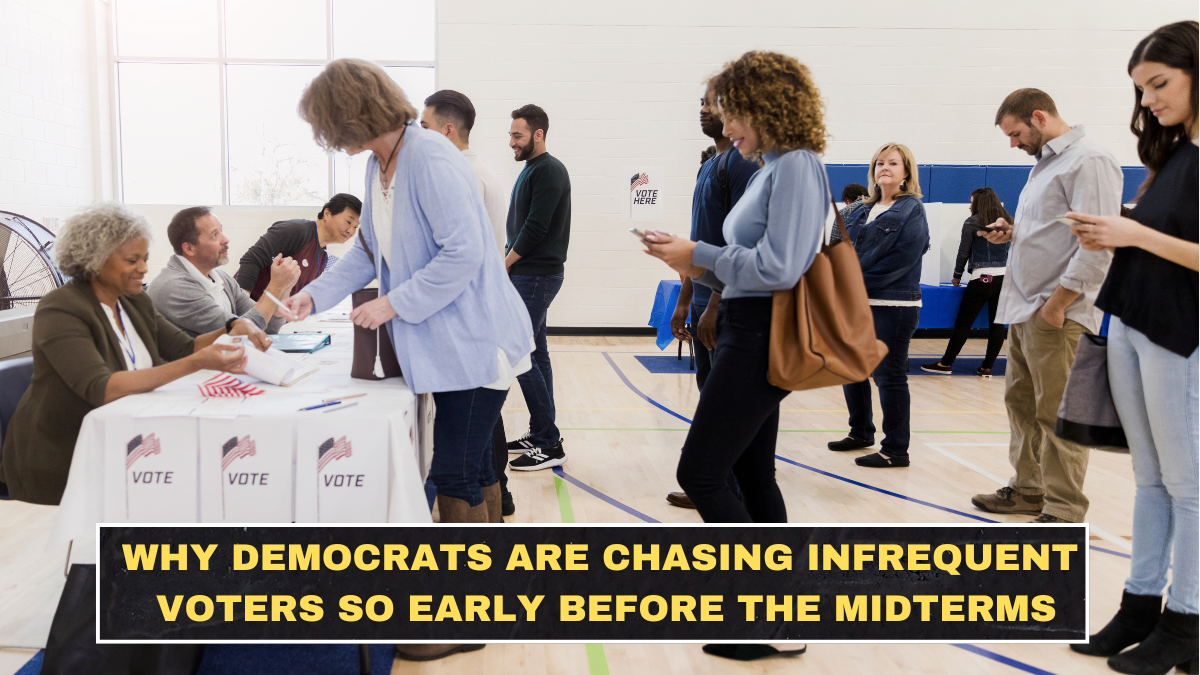
National Democrats are starting early because they do not think 2026 will be won by vibes, social posts, or automatic anti-incumbent backlash. Reuters reported on February 4 that the Democratic National Committee launched a new outreach effort called Local Listeners aimed at reaching more than 1 million infrequent voters in competitive states well ahead of the November 2026 midterms. The target group is specific: people who voted in 2020, when Joe Biden won, but did not vote in 2024, when Donald Trump returned to office. That is the real story here. Democrats are not just trying to persuade swing voters. They are trying to recover missing voters from their own coalition.
Why infrequent voters matter so much
Infrequent voters matter because close elections are often decided by people who usually sit out. Reuters reported that Democrats need to flip only three Republican-held House seats to win a majority in the 435-seat chamber. That is a tiny margin by national-election standards. If you only need three seats, turnout problems become more dangerous than message problems in some districts. That also explains why the DNC is not waiting until late summer. They are acting as if a small turnout hole could cost them the House.
What Democrats are actually doing
The outreach plan is larger than a symbolic launch. Reuters reported that:
- more than 2,000 volunteers had already signed up
- the program planned 250,000+ phone conversations
- the DNC expected 50+ in-person grassroots events
- the effort also included voter-registration work in competitive districts
The “listening first” message is not just branding. It is an admission that Democrats think some previous supporters tuned them out or stopped believing they were worth showing up for. If a party is investing this early in listening campaigns, it usually means it knows trust erosion is real.
Why the timing says a lot about Democratic anxiety
Starting this early tells you Democrats do not feel safe. They may see opportunity, but they also see weakness. Reuters’ November 2025/Ipsos polling found Democrats were more energized than Republicans for the 2026 elections, with 44% of Democrats saying they were enthusiastic about voting versus 26% of Republicans. That sounds encouraging for Democrats, but enthusiasm alone is not turnout, especially among less reliable voters. A campaign can have energized core voters and still lose if drop-off voters stay home.
Why this strategy makes sense in 2026
The logic is blunt:
- Trump is back in office, which can motivate opposition voters
- Democrats are closer to taking the House than the Senate
- low-propensity voters are often easier to lose than to replace
- early contact gives campaigns time to test messages before panic season
Reuters reported that the DNC wants these conversations to help identify the issues that matter most to voters and shape messaging for Democratic candidates. That means this is both an outreach project and a research project. They are not only trying to mobilize people. They are trying to figure out what those people will actually respond to.
The numbers behind the strategy
| Metric | Reuters-reported figure | Why it matters |
|---|---|---|
| Infrequent voters targeted | 1 million+ | Shows the scale of the turnout problem Democrats want to solve |
| Volunteers signed up | 2,000+ | Indicates the program is not just theoretical |
| Planned phone conversations | 250,000+ | Suggests a real national contact effort |
| Planned grassroots events | 50+ | Shows field organizing is part of the model |
| House seats Democrats need to flip | 3 | Explains why small turnout gains could matter a lot |
The table makes the point clearly: this is a narrow-margin strategy, not a broad fantasy campaign. Democrats are chasing voters who already proved they can vote, but also proved they can disappear.
What this says about the midterm map
The House is the obvious target because it is mathematically reachable. Reuters reported that the Senate is a much steeper climb for Democrats, so the practical path is to maximize turnout in competitive House districts first. That is not glamorous, but it is rational. Parties talk about national momentum; they win or lose through district-level turnout.
What could still go wrong
This strategy can fail if Democrats mistake contact for conversion. Calling people is not the same as giving them a reason to vote. Another problem is that the voters they want back may be economically frustrated, politically detached, or disappointed with both parties. Reuters’ polling also showed the cost of living remained the top issue for voters, which means generic anti-Trump messaging may not be enough.
Conclusion
Democrats are chasing infrequent voters early because they think the 2026 midterms could be decided by people who left their coalition in 2024. The numbers explain the urgency: more than a million target voters, a three-seat House margin, and a national program launching months before most voters are paying attention. That is not confidence. That is strategic realism mixed with fear. And frankly, it should be. Parties that wait too long to rebuild turnout usually discover the damage only when it is too late.
FAQs
What is the Democrats’ new voter outreach program called?
Reuters reported that the Democratic National Committee launched a program called Local Listeners to reach infrequent voters ahead of the 2026 midterms.
Who are Democrats targeting?
The program targets likely Democratic voters who cast ballots in 2020 but did not vote in 2024.
Why are infrequent voters so important in 2026?
Because Democrats need to flip only three House seats to regain control, so even modest turnout gains in close districts could matter.
Does early outreach mean Democrats are worried?
Yes. That is the reasonable reading. Launching a million-voter effort this early suggests Democrats see turnout weakness as a real threat, not a minor issue. This last point is an inference based on the scale and timing of the program.