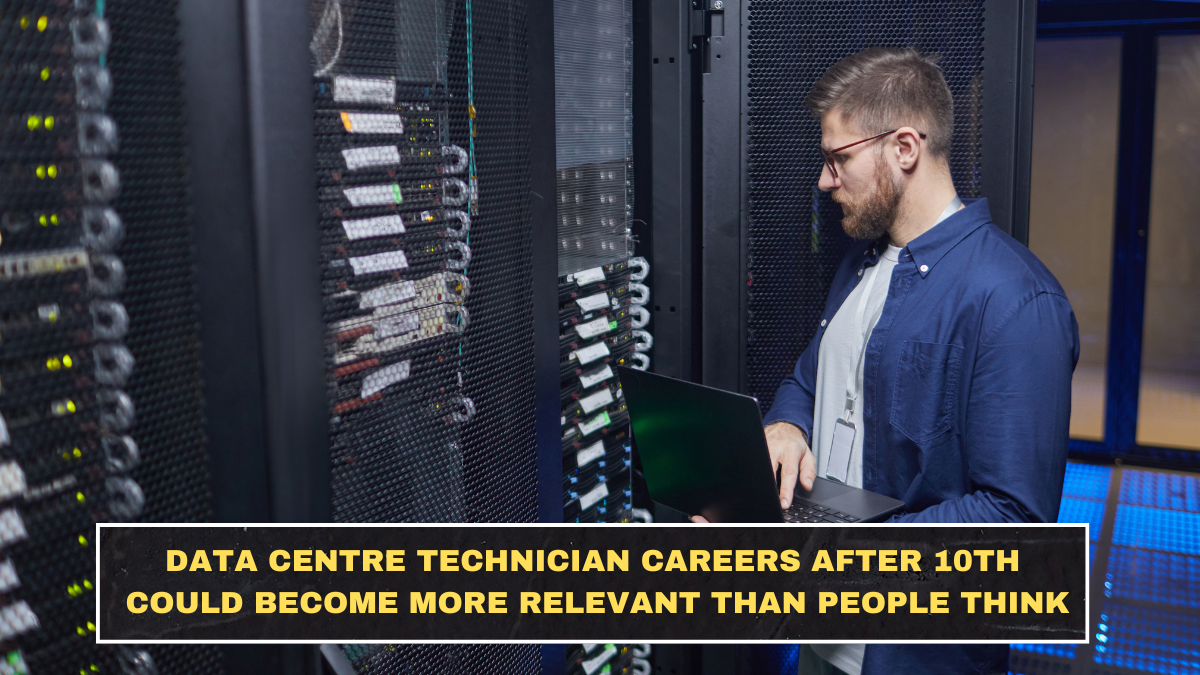
Most students hear about AI jobs and imagine only coding, data science, or software engineering. That is narrow thinking. The AI boom also needs physical infrastructure: servers, cooling, power systems, cabling, network hardware, and secure facilities. That is where data centre technician careers start becoming relevant. India’s data centre capacity reportedly rose from about 375 MW in 2020 to around 1,500 MW by 2025, driven by cloud services, AI, digital platforms, and high-performance computing. Another IBEF update said demand in India was expected to exceed 450 MW of IT capacity in 2025, with long-term stock projected to keep climbing toward 2030.
This does not mean data centres will become mass employers for every student. They will not. But they do create stable technical roles around infrastructure, maintenance, electrical systems, cooling, networking, and security support. Industry reporting in February 2026 also said hiring demand is rising for electrical, cooling, network, and cybersecurity skills in data centres, especially as AI workloads expand.
Why Data Centre Careers Matter More in the AI Boom
People keep repeating that AI will create only software jobs. That is lazy analysis. Every AI model, cloud application, streaming platform, and enterprise system depends on infrastructure that has to be installed, monitored, cooled, powered, and protected. The World Economic Forum’s Future of Jobs Report 2025 says employers expect rising demand for technology-related roles and for skills such as networks and cybersecurity, which fits directly with data-centre-linked work.
India’s market is also becoming more serious, not experimental. IBEF reported in May 2025 that India could surpass 4,500 MW of data centre capacity by 2030, backed by major investment commitments, with Mumbai and Hyderabad expected to remain major hubs. That tells you this is not a tiny niche anymore.
What a Data Centre Technician Actually Does
A data centre technician is not just “someone who works with computers.” The work usually includes supporting physical and digital infrastructure.
| Work area | What it involves | Why it matters |
|---|---|---|
| Hardware support | Server racks, cabling, equipment checks | Keeps systems physically operational |
| Power systems support | UPS, backup systems, electrical basics | Data centres cannot afford downtime |
| Cooling support | Temperature control, HVAC coordination | Heat management is critical |
| Network support | Basic connectivity checks, patching, troubleshooting | Data movement depends on stable networking |
| Monitoring and maintenance | Routine inspections, alerts, equipment health | Prevents failure before it becomes serious |
| Security and process discipline | Access control, procedures, escalation | Data centres run on strict reliability rules |
Is This a Good Career After 10th?
It can be a smart path for students who prefer practical technical work over vague academic theory. It makes the most sense for students interested in:
- hardware and systems
- electrical or cooling-related work
- networking basics
- disciplined, process-driven environments
The mistake would be assuming this is an “easy shortcut.” It is not. Data centres value reliability, technical basics, and careful execution. A student after 10th would usually need to build toward this through a diploma or technical training in electrical, electronics, computer hardware, networking, HVAC, or infrastructure support.
Best Courses That Can Lead Toward This Path
Students usually do better by building a foundation first instead of hunting for a rare “data centre” course immediately.
| Course after 10th | Why it fits data centre work |
|---|---|
| Diploma in Electrical Engineering | Power systems and backup infrastructure matter heavily |
| Diploma in Electronics | Useful for equipment, controls, and troubleshooting |
| Diploma in Computer Engineering | Builds hardware and system support base |
| Hardware and Networking course | Good for rack, cabling, and support roles |
| Refrigeration and AC / HVAC | Cooling is a serious part of data centre operations |
| Cybersecurity / network basics | Useful as infrastructure grows more security-heavy |
This matters because data centre growth is not only about servers. Cooling is now a major sub-sector too. Market analysis published in January 2026 estimated the India data centre cooling market at about USD 558 million in 2025 and projected strong long-term growth, which reinforces how important thermal management roles are in this field.
What Students Should Not Get Wrong
Do not confuse “relevant” with “instant high salary.” Data centres are growing, but entry-level roles still depend on skill, location, and training quality. Also, do not chase course titles blindly. A strong electrical, electronics, hardware, networking, or HVAC foundation is usually more valuable than a flashy label with poor labs and no practical training.
This is the blunt truth: students who ignore infrastructure careers because they are not glamorous are often ignoring how digital systems actually work. AI hype gets attention. Infrastructure keeps the whole thing alive.
Conclusion
Data centre technician careers after 10th could become more relevant because the AI boom is increasing demand not only for software talent but also for infrastructure talent. India’s data centre capacity has already expanded sharply, more growth is projected through 2030, and the supporting skill areas include power, cooling, hardware, networking, and security.
For the right student, this is a practical path. Not glamorous. Not overhyped. Just useful, technical, and likely to matter more than many people realize.
FAQs
Can I become a data centre technician directly after 10th?
Usually not directly. Most students need a diploma or technical training first in electrical, electronics, hardware, networking, or HVAC before entering this kind of role.
Is data centre work only for coders?
No. Many roles are tied to hardware, cooling, electrical systems, monitoring, and infrastructure support rather than programming.
Which diploma is best for data centre careers after 10th?
Electrical, electronics, computer engineering, hardware-networking, and HVAC-related courses are usually the most relevant starting points.
Will data centre jobs grow in India?
The sector looks set to grow as India expands cloud, AI, and digital infrastructure capacity, with major increases already reported and more planned toward 2030.