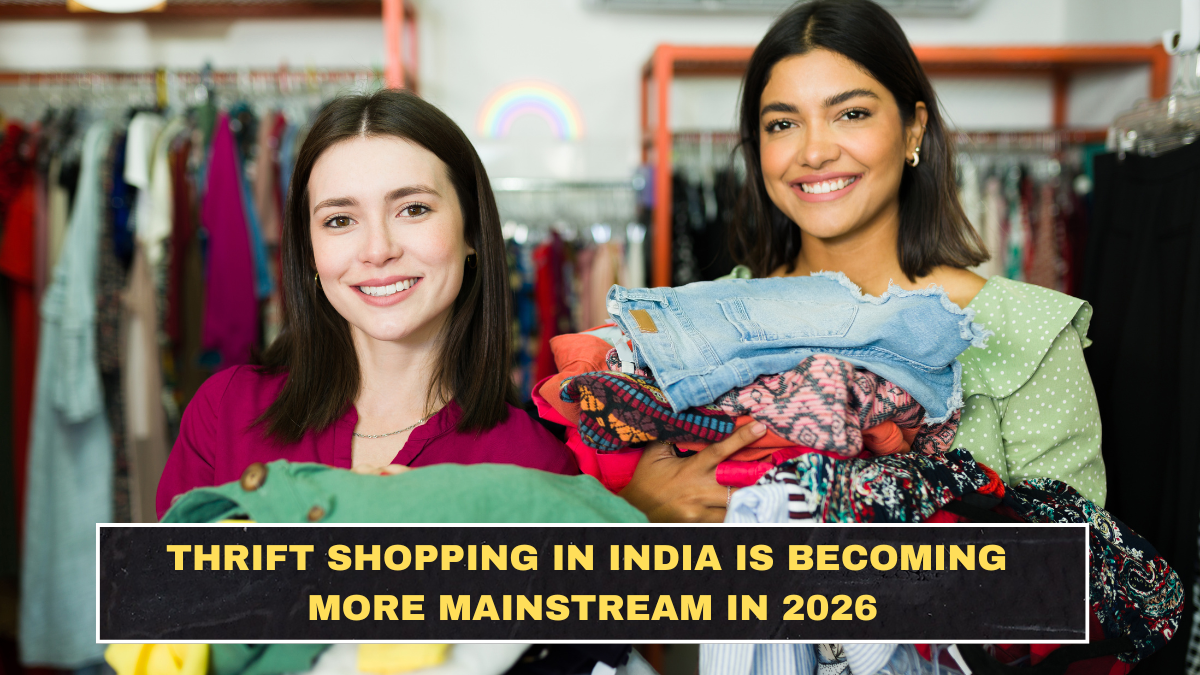
Thrift shopping in India is moving out of the niche corner and into regular consumer behavior. That does not mean every shopper is suddenly obsessed with pre-loved fashion. It means the social resistance is weakening, the platforms are improving, and younger buyers are treating thrift as a normal way to get style at a lower price. The smarter reading is not “people are buying used clothes because they have to.” It is that many now buy thrift because it feels practical, expressive, and easier to access online.
The market data backs that up. UnivDatos estimates India’s second-hand apparel market at about $3.5 billion in 2024 and projects roughly 13.2% annual growth through 2033. Credence Research gives a similar direction, valuing the market at about $3.0 billion in 2023 and projecting it to reach more than $9.1 billion by 2032. The exact starting number varies by methodology, but both estimates point to the same conclusion: resale fashion in India is already meaningful, and it is still growing at a double-digit pace.
Why younger consumers are pushing the trend
Young consumers are doing most of the cultural work here. Outlook Money reported in January 2026 that younger buyers are clearly leading thrift-market expansion, driven by affordability, environmental awareness, and curated offerings from online resale platforms and thrift stores. That matters because when Gen Z and younger millennials adopt a shopping behavior, they do not just buy differently. They also normalize that behavior through social media, peer influence, and content-led discovery. That is how a fringe habit starts becoming mainstream.
India’s thrift economy is also being shaped by social commerce, not just by formal marketplaces. Sumvaad’s 2026 analysis noted that Instagram, WhatsApp, and peer marketplaces have lowered entry barriers for thrift businesses, while younger consumers increasingly want affordability without giving up style. That is the key shift. Thrift is not being sold only as “cheap clothing.” It is being sold as smarter value, more unique style, and lower-risk experimentation. That framing makes resale much easier for younger shoppers to accept publicly.
| Thrift shopping signals in India | Latest indicator |
|---|---|
| India second-hand apparel market, 2024 | ~$3.5 billion |
| Forecast CAGR through 2033 | ~13.2% |
| Alternate market estimate, 2023 | ~$3.0 billion |
| Alternate projected market size, 2032 | ~$9.1 billion |
Why thrift feels more normal now
Part of this is cultural, and part of it is digital convenience. Homegrown’s 2025 piece on Indian thrift culture described how reuse traditions such as hand-me-downs and mending already existed in Indian households, but digital-era curation has turned those habits into a more visible fashion economy. In other words, thrift did not appear from nowhere. What changed is presentation. Pre-owned clothing is now styled, photographed, branded, and sold in a way that feels more aspirational than embarrassing. That visual shift matters more than people admit.
There is also a global backdrop making thrift feel more legitimate. The Guardian reported in April 2026 that global secondhand clothes sales are forecast to hit $289 billion this year, with Gen Z and millennials expected to drive 70% of market growth, based on the annual ThredUp resale report and GlobalData research. India is not identical to the West, but it is clearly moving in the same broad direction: younger consumers are making resale look less like compromise and more like normal shopping.
| Why thrift is becoming mainstream | What it means |
|---|---|
| Lower prices | Buyers can try more styles without full-price risk |
| Social-media curation | Pre-loved fashion looks more discoverable and desirable |
| Younger consumer adoption | Cultural resistance falls faster |
| Digital resale channels | Buying thrift feels easier and more trustworthy |
What shoppers are really looking for
The lazy assumption is that thrift shoppers only care about saving money. That is incomplete. Price matters, obviously, but thrift also appeals because it offers access to branded pieces, vintage items, one-off finds, and more experimentation without a large spend. Sumvaad’s analysis makes that point clearly by noting that young consumers want affordability without sacrificing style. This is why thrift can grow even when fast fashion remains available. It serves a different mindset: value plus individuality.
That said, the market still has friction. Trust, condition quality, hygiene concerns, inconsistent sizing, and return limitations all slow adoption. So no, thrift is not “mainstream” in the sense that it has fully replaced conventional apparel buying. It is mainstream in the sense that it is becoming socially accepted and commercially relevant enough to sit alongside regular retail, especially for younger digital-first buyers. Anyone pretending the market is fully mature is overselling it. But anyone dismissing it as marginal is behind the trend.
Conclusion
Thrift shopping in India is becoming more mainstream in 2026 because younger consumers are making resale more normal, more visible, and more desirable. The market is already worth billions of dollars by current estimates, and the category is growing at a double-digit pace. More importantly, thrift is no longer framed only as a necessity purchase. It is increasingly seen as smart value, affordable style, and a practical alternative to paying full retail for every fashion buy. That is why the trend has traction, and why it is unlikely to stay niche.
FAQs
Is thrift shopping really growing in India?
Yes. Market estimates place India’s second-hand apparel market at roughly $3.5 billion in 2024, with projected growth of about 13.2% through 2033.
Who is driving thrift shopping in India?
Younger consumers are leading the shift, especially Gen Z and younger millennials, helped by affordability, digital resale platforms, and changing attitudes toward pre-owned fashion.
Why is thrift becoming more accepted?
Because resale is now being presented as smart value and curated style, not just necessity buying. Social platforms and better online presentation have made thrift feel more normal.
Is thrift shopping only about saving money?
No. Lower prices matter, but shoppers also use thrift for unique pieces, branded finds, and lower-risk style experimentation.