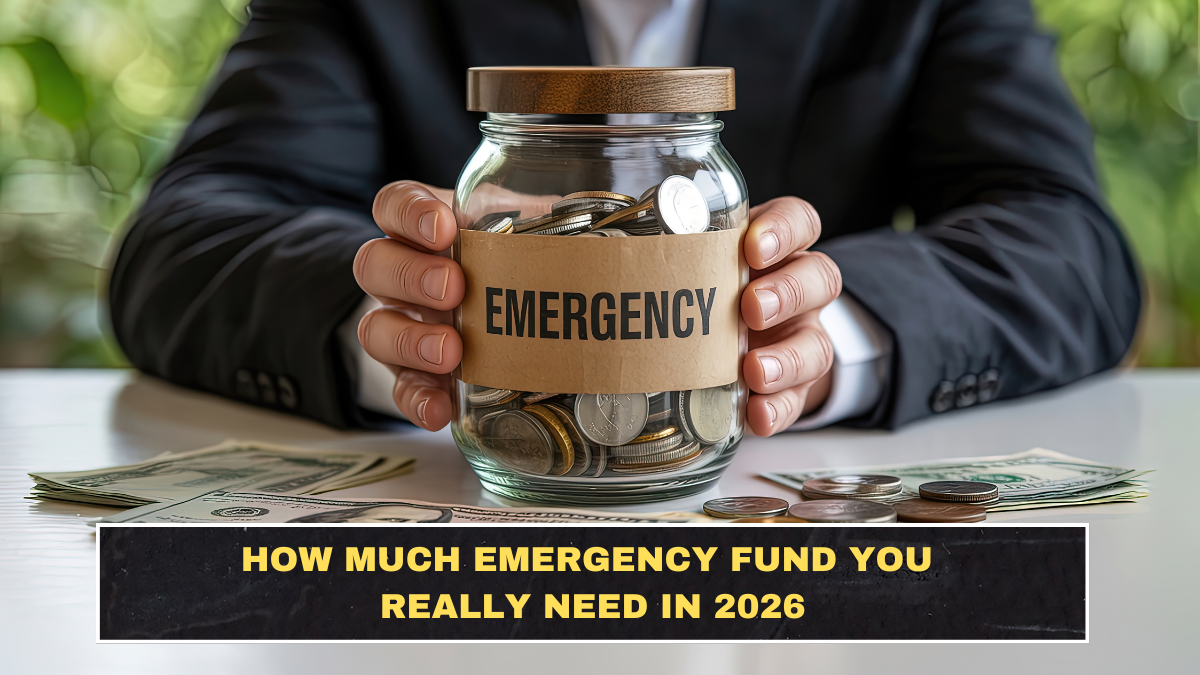
Emergency funds matter more in 2026 because household risk is still real even when panic headlines come and go. The U.S. labor market has looked stable on the surface, but Reuters described it in April 2026 as a fragile “no-hire” economy with weak hiring momentum, while the Federal Reserve’s latest household survey showed only 55% of adults had savings equal to three months of expenses. That means millions of people are still one job shock or one major bill away from trouble.
The lazy answer is “save as much as possible.” That is useless. A better answer is to base your target on essential monthly expenses, not full lifestyle spending. Fidelity’s guidance still points to 3 to 6 months of essential expenses, and the CFPB says the right number depends on your situation and past emergency patterns.
How much emergency fund should most people aim for in 2026?
For most people, the realistic target is still 3 to 6 months of essential expenses, not total income and not every optional expense in your current lifestyle. Essential expenses usually mean rent or mortgage, groceries, utilities, insurance, transport, medicines, and minimum debt payments. Fidelity says 3 to 6 months is the general benchmark, while the CFPB stresses that even a small amount improves financial security.
A blunt way to think about it is this: if losing your income for 90 days would wreck you, then 3 months is the minimum serious target. If your job is unstable, your income varies, or you support dependents, 6 months is safer. That is not fearmongering. It is basic risk management in a year when hiring still looks uneven.
Which target fits different situations best?
| Situation | Better target in 2026 | Why |
|---|---|---|
| Stable salaried job, low debt | 3 months | Lower income risk and easier recovery |
| Single income household | 4 to 6 months | One disruption hits the whole home |
| Freelance or variable income | 6 months or more | Cash flow is less predictable |
| High medical or family obligations | 6 months | Fixed risks are higher |
| Starting from zero | First ₹/$/£1,000, then 3 months | Small buffers still reduce damage |
This is where many people fool themselves. They hear “3 to 6 months” and do nothing because the full number feels too big. Fidelity explicitly suggests starting with $1,000 first, then building toward the larger target. That is the correct approach because a small cushion is still far better than no cushion.
Why does the old advice still matter in 2026?
Because the problem has not gone away. Bankrate’s 2026 emergency savings report said 81% of Americans did not increase their emergency savings in the past year, and fewer than half said they had enough liquidity or access to funds to cover a $1,000 emergency expense. That tells you the gap is not theoretical. It is current.
At the same time, inflation and living-cost pressure still make rebuilding harder. The Federal Reserve reported that the share of adults with three months of emergency savings in 2024 was below the 2021 high, and inflation remained a top financial concern, especially food and groceries. So yes, the traditional advice still matters, but reaching it now takes more discipline than people want to admit.
How can you reach that number faster?
Start by calculating only essential monthly expenses. If essentials are ₹50,000 a month, then a 3-month fund is ₹150,000 and a 6-month fund is ₹300,000. That is your real target range. Do not use total salary as the shortcut because that often inflates the number and makes the goal feel impossible. The more accurate your essential-expense number is, the more likely you are to build the fund properly.
Then automate it. The CFPB recommends automatic transfers, and Fidelity recommends treating emergency savings like a bill. This is boring advice because it works. People who rely on leftover money usually save leftovers, which means almost nothing.
Where should an emergency fund be kept?
It should stay liquid and boring. Fidelity recommends an account that preserves liquidity, and Bankrate says high-yield savings accounts and money market accounts are among the best places to keep emergency savings. This is not money for stock-market experiments or long lock-in periods. The whole point is fast access when things go wrong.
What is the real bottom line in 2026?
Most people in 2026 should aim for 3 to 6 months of essential expenses, with 6 months being smarter for variable income, dependents, or higher risk. If that feels too large, start with a first buffer of $1,000 or the local equivalent and build from there. The dangerous mindset is waiting for a “perfect time” to save. The data already shows too many households are underprepared.
FAQs
Is 3 months of savings enough in 2026?
For some people, yes, especially if income is stable and expenses are lower. But for freelancers, single-income households, or families with more obligations, 6 months is safer.
Should I save $1,000 first or go straight to 3 months?
Start with $1,000 first if you have little or no cushion. Fidelity specifically recommends that as the first step before building toward 3 to 6 months of essential expenses.
What counts as emergency fund expenses?
Housing, groceries, utilities, insurance, transport, medicines, and minimum debt payments usually count. Optional shopping, travel, and lifestyle extras do not.
Where should I keep my emergency fund?
Usually in a high-yield savings account or similar liquid account where the money is easy to access and not exposed to market risk.