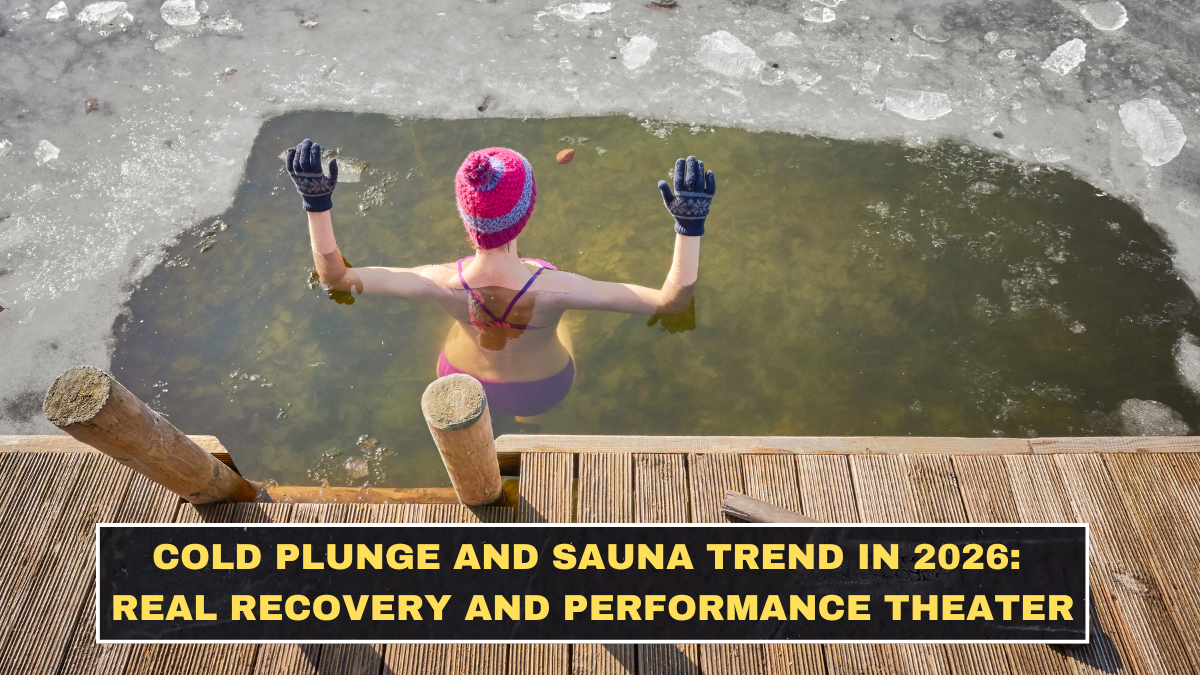
This trend is not imaginary. The business side alone shows real momentum. Grand View Research says the global cold plunge tub market was about $354.6 million in 2025 and projects it could reach $659.9 million by 2033, while its sauna market report estimates the sauna market at about $954.3 million in 2025 with projected growth to $1.56 billion by 2033. Global Wellness Institute also says 2026 hydrothermal wellness spaces are expanding around multi-step heat, cold, water, and rest rituals rather than simple one-off sessions.
The reason is obvious. Contrast therapy looks disciplined, expensive, and serious. It also gives people something they can feel immediately: heat stress, cold shock, alertness, and relief. That makes it perfect for social media, fitness culture, and premium wellness businesses. The problem is that strong sensations are not the same thing as strong evidence. A practice can feel intense and still be oversold.
What does the evidence support for cold water immersion?
Cold water immersion has better evidence for short-term recovery than for broad lifestyle miracle claims. A 2025 systematic review and meta-analysis in PLOS One found time-dependent effects on inflammation, stress, immunity, sleep quality, and quality of life, but it also stressed that the evidence base is limited by small study sizes and weak diversity. Another 2025 review of randomized trials reported moderate-to-strong evidence for reducing short-term muscle soreness and muscle damage, while effects on performance and inflammation remained unclear.
That means the honest takeaway is narrower than influencer claims. Cold plunges may help you feel better after hard training, and they may support short-term stress or wellbeing effects, but they are not proven cure-alls for metabolism, immunity, mental toughness, and longevity all at once. The science does not justify that kind of grandstanding.
What does the evidence support for sauna use?
Sauna has a stronger long-term observational evidence base than cold plunges, especially around cardiovascular health. Reviews published in 2025 describe proposed benefits including improved vascular function, lower blood pressure, and better cardiac performance. Older but still heavily cited prospective data also found that more frequent sauna bathing was associated with lower risk of sudden cardiac death and cardiovascular mortality, though that does not prove sauna alone caused the benefit.
That distinction matters. Sauna looks promising, especially as part of a healthy routine, but observational associations are not a license for lazy thinking. If someone sleeps badly, drinks heavily, skips exercise, and then sits in a sauna three times a week, the sauna is not going to rescue the rest of the mess. At best, it is an adjunct, not a substitute for basic health habits.
Is contrast therapy itself proven, or mostly inferred?
This is where the trend outruns the data. There is far more evidence on cold exposure and sauna separately than on strict heat-cold alternation as a combined protocol. Older review evidence on contrast baths found only weak support for improvements in superficial blood flow and skin temperature, with evidence limitations preventing strong conclusions. In other words, the idea that alternating hot and cold is automatically superior to using one method alone is still not firmly established.
That does not mean contrast therapy is useless. It means a lot of the hype is built on stitching together separate literatures and then pretending the full ritual has been proven at the same level. It has not. The strongest evidence today supports specific use cases like short-term soreness relief from cold water immersion and cardiovascular or relaxation-related benefits associated with regular sauna use. The dramatic “nervous system reset” language is often more branding than settled science.
What is real recovery, and what is just performance theater?
| Claim | Evidence status | Reality check |
|---|---|---|
| Cold plunge reduces post-exercise soreness | Fairly supported | Useful for short-term recovery, especially after hard training |
| Sauna supports relaxation and cardiovascular health | Promising to strong | Most credible when used regularly and safely |
| Hot-cold contrast is clearly superior to either alone | Weak to limited | Often assumed, not firmly proven |
| Cold plunge boosts every aspect of health | Overstated | Evidence is narrower than marketing suggests |
| Sauna and cold make you “elite” or more disciplined | Performance theater | Feeling intense is not the same as getting better outcomes |
This is the table most buyers need. The category is not fake, but it is full of inflated claims. Recovery tools are supposed to support training and wellbeing, not become costumes people wear to look optimized.
Who should be careful with this trend?
People with cardiovascular issues, blood pressure instability, or other medical conditions should not treat this like harmless spa content. The American Lung Association warns that switching between sauna heat and cold plunge can raise blood pressure or trigger shock responses in some people, and older medical literature also advises caution for those prone to low blood pressure after sauna use. That is the part trend content conveniently downplays.
There is also a simpler warning: discomfort itself is addictive for some people. They start confusing suffering with effectiveness. That is how a useful recovery tool turns into ego theater. If your routine is built around posting the plunge more than benefiting from it, you are not recovering. You are performing wellness. That is not science. It is branding with cold water.
Conclusion
Cold plunge and sauna routines are trending in 2026 because they fit perfectly into modern wellness culture: intense, photogenic, premium, and easy to package as self-improvement. The evidence does support some real benefits. Cold water immersion can help with short-term soreness and some wellbeing outcomes, while sauna use has more credible long-term associations with cardiovascular and relaxation benefits.
But contrast therapy as a full hot-cold ritual is still more proven by culture than by hard evidence. That does not make it useless. It makes it limited. Use it if it helps you recover, relax, or stay consistent. Just do not pretend a plunge tub and a sauna are a shortcut to health, discipline, or longevity. That is the kind of self-deception the wellness industry profits from every year.
FAQs
Does cold plunge therapy really help recovery?
It can help with short-term muscle soreness and perceived recovery, especially after demanding exercise, but the evidence is much stronger for that narrow use than for giant all-purpose health claims.
Is sauna better supported by evidence than cold plunge?
In general, yes. Sauna has a broader observational evidence base, especially around cardiovascular outcomes, while cold plunge evidence is stronger for short-term recovery and more limited for big lifestyle claims.
Is contrast therapy clearly better than using sauna or cold alone?
Not based on current evidence. There is much more data on heat and cold separately than on alternating them as a combined protocol, and older contrast-bath review evidence was weak.
Who should avoid jumping into this trend casually?
Anyone with heart issues, blood pressure problems, or other medical risks should be cautious and get proper advice first, because sudden heat-cold changes are not risk-free.