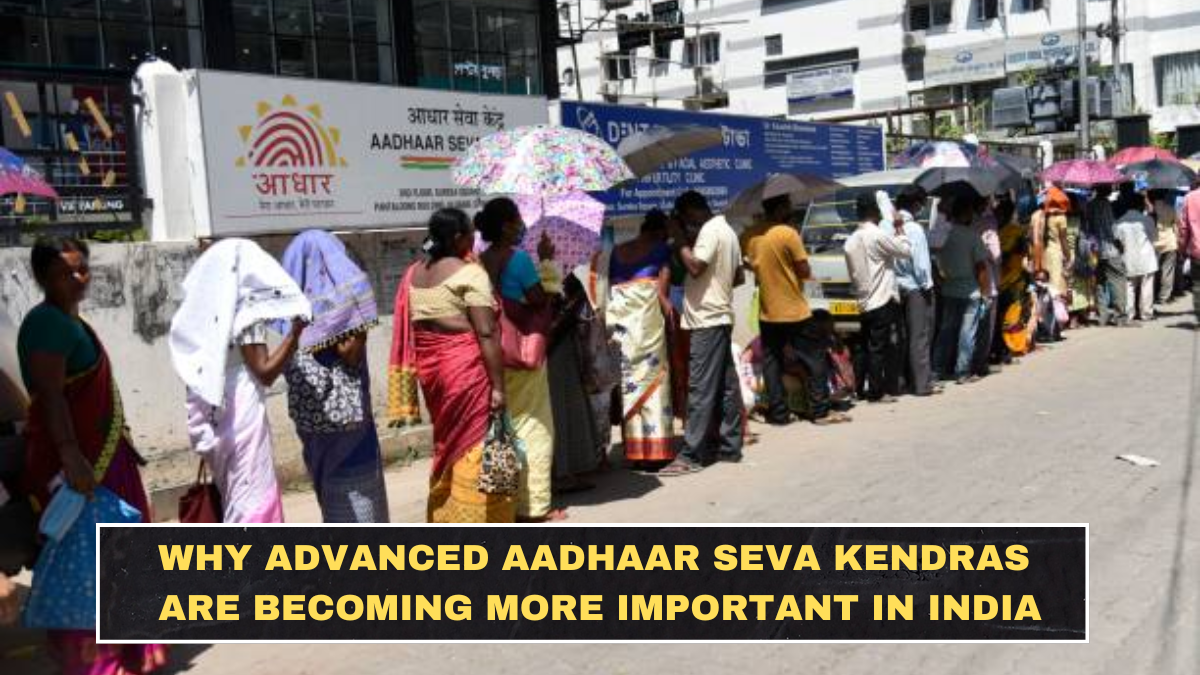
Most people think Aadhaar infrastructure is just a backend database plus an app. That is shallow thinking. For millions of residents, the real Aadhaar experience still happens physically, at a centre, in front of a person, with documents, biometrics, queues, and service quality deciding whether the process feels smooth or painful.
That is why advanced Aadhaar Seva Kendras matter. UIDAI’s latest service pages describe ASKs as single-stop centres for enrolment and updates, open seven days a week from 9:30 a.m. to 5:30 p.m., with wheelchair-friendly access and special provisions for elderly and specially abled residents. In March 2026, the government also inaugurated an Advanced Aadhaar Seva Kendra in Ranchi, saying it had advanced technological features and improved infrastructure for faster, more transparent, and resident-friendly service.
The important point is not the building itself. It is what these centres represent: Aadhaar is becoming more dependent on reliable, visible, citizen-facing service infrastructure. If digital public systems want trust, they cannot work only for tech-savvy users sitting comfortably online. They also have to work for the person who needs help in the real world.
What an Aadhaar Seva Kendra Actually Does
An Aadhaar Seva Kendra is not just for new enrolment. UIDAI says these centres handle a wide range of services, including new Aadhaar enrolment for all age groups, demographic updates, biometric updates, mandatory biometric updates for children at ages 5 and 15, document updates, and find-and-print services.
That range matters because Aadhaar has moved far beyond first-time enrolment. Today, a lot of traffic comes from updates, corrections, re-verification, and child biometric requirements. In other words, Aadhaar is no longer a one-time process for many families. It is recurring identity maintenance, and ASKs are where that work gets done.
The practical functions usually include:
- new enrolment
- mobile number and email updates
- name, address, gender, and date-of-birth changes
- photo, fingerprint, and iris updates
- child mandatory biometric updates
- document refresh and print support
Why “Advanced” Centres Matter More Now
The word “advanced” can sound like government branding fluff. Sometimes it is. But the Ranchi inauguration note specifically said the new advanced centre was developed with improved infrastructure and advanced technological features to make services faster, more transparent, and more resident-friendly. That is not meaningless. In Aadhaar services, speed, transparency, and ease matter because even small delays can affect benefits, exams, authentication, and everyday documentation needs.
This is also happening alongside network expansion. In January 2026, PIB said Tamil Nadu was expected to have 30 Aadhaar Seva Kendras operational by September 2026. Separate inaugurations in Mysuru, Bengaluru, Madurai, and other cities show UIDAI is still building physical service capacity, not shrinking it.
That tells you something important. Even in a country pushing digital governance aggressively, physical identity-service points are still critical. The smarter government view seems to be that digital systems need strong physical support, not that physical service can simply disappear.
What These Centres Improve for Residents
For ordinary residents, a better Aadhaar centre means fewer avoidable problems. If the centre is better designed, better staffed, easier to reach, and equipped to handle multiple services efficiently, the user experience improves in ways that actually matter.
The biggest gains usually come from:
- better accessibility for elderly and disabled residents
- more predictable service hours
- cleaner, more organised enrolment and update flow
- better handling of biometric and document-heavy cases
- more confidence for people who struggle with self-service digital processes
This is where a lot of commentary misses the point. People love to talk about digital public infrastructure as if apps alone solve everything. They do not. The system is only as trustworthy as its weakest citizen-facing step. When that step involves identity correction or biometric capture, centre quality becomes a governance issue, not just an operational detail.
| Area | What advanced ASKs improve | Why it matters |
|---|---|---|
| Service delivery | Faster and more transparent processing | Reduces friction in enrolment and updates. |
| Accessibility | Wheelchair-friendly access and support for elderly/specially abled | Makes Aadhaar services usable for more people. |
| Availability | Open all 7 days, fixed public timings | Helps working families and reduces uncertainty. |
| Service scope | Enrolment, updates, biometrics, child MBU, print services | One-stop model reduces repeated visits. |
| Capacity growth | More centres opening in multiple cities and states | Expands reach and reduces overload risk. |
Why This Matters for Digital Public Infrastructure
Aadhaar sits at the center of a lot of verification and identity-linked processes. That means its service network is not just about convenience. It is part of India’s digital public infrastructure in a very literal sense.
If people cannot easily enrol, update details, refresh biometrics, or correct errors, then the reliability of the larger ecosystem weakens. A digital identity system is only strong when residents can access correction and support mechanisms without confusion or humiliation. Better ASKs help preserve that reliability.
This is especially relevant now because usage is not static. Children need mandatory biometric updates at 5 and 15, adults update mobile numbers and addresses, and residents frequently need print and correction support. That creates recurring demand. So improving the centres is not optional polish. It is necessary maintenance for a national identity infrastructure.
The Limitation People Should Not Ignore
Here is the uncomfortable truth: one advanced centre does not fix the entire network. A new facility in Ranchi or a new rollout in Tamil Nadu is a positive sign, but it does not automatically mean all residents everywhere will get the same level of quality.
That is the real test. Expansion must be matched by consistency. A state-of-the-art centre is useful, but people judge the system by the centre they personally visit, not by the press release they read. So the long-term question is not whether advanced ASKs are good. They obviously are. The real question is whether UIDAI can make high-quality service normal, not exceptional.
Conclusion
Advanced Aadhaar Seva Kendras are becoming more important in India because Aadhaar is not just a digital database. It is a living service system that depends on accurate enrolment, updates, biometrics, accessibility, and user trust. Official UIDAI and PIB material shows these centres are being expanded and upgraded to offer faster, more transparent, and more resident-friendly services.
The blunt reality is this: digital public infrastructure fails when physical support is weak. Better Aadhaar Seva Kendras reduce that risk. They make identity services more usable for ordinary residents, especially the elderly, children, and people who cannot manage everything online. That is why these centres matter more than many people realize.
FAQs
What is an Aadhaar Seva Kendra?
UIDAI describes an Aadhaar Seva Kendra as a single-stop destination for Aadhaar enrolment and update services in a state-of-the-art environment.
What services are available at Aadhaar Seva Kendras?
These centres provide new enrolment, demographic updates, biometric updates, mandatory child biometric updates, document updates, and find-and-print services.
Why are advanced Aadhaar Seva Kendras important?
They improve service quality, transparency, accessibility, and speed, which matters because Aadhaar is used widely for identity-linked services and corrections.
Are Aadhaar Seva Kendras open every day?
UIDAI’s current ASK page says they are open all 7 days of the week from 9:30 a.m. to 5:30 p.m. IST.