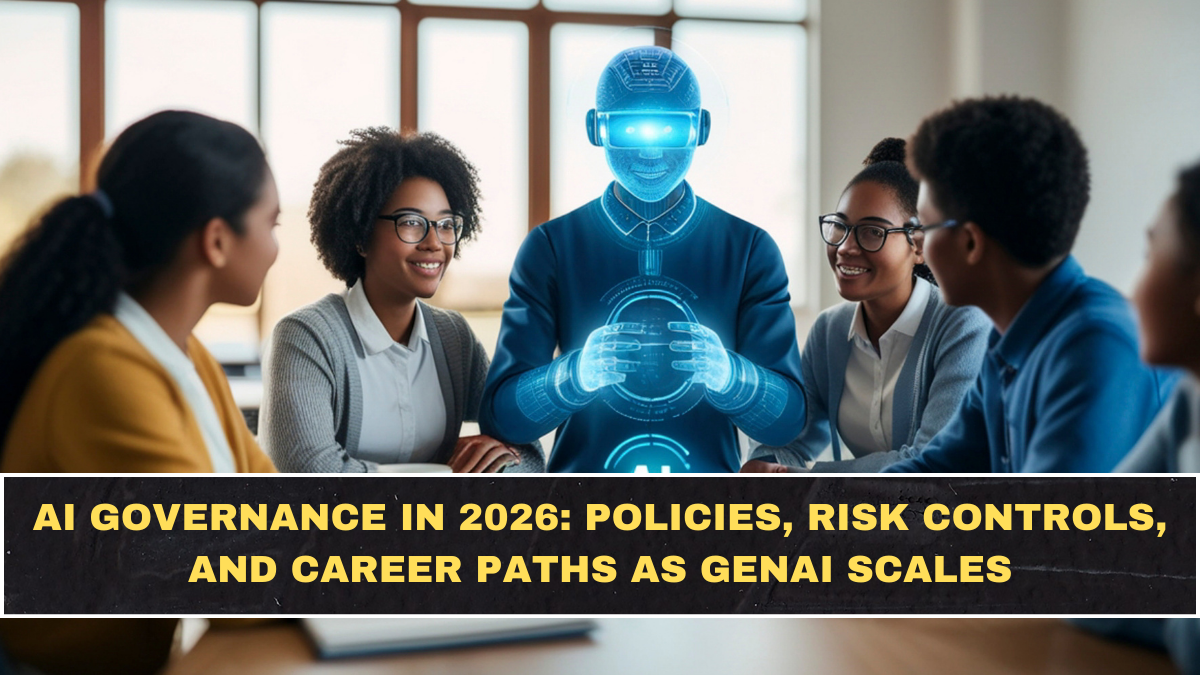
AI governance has shifted from a theoretical discussion to an operational necessity in 2026. As GenAI systems move deeper into business processes, organizations are realizing that power without control creates risk faster than value. In India, this realization is especially strong because AI systems increasingly interact with regulated domains like finance, healthcare, education, and public services. Governance is no longer about slowing innovation; it is about making innovation survivable.
What makes AI governance different from traditional compliance is its dynamic nature. Models change behavior, data evolves, and use cases expand rapidly. In this environment, static rules fail quickly. AI governance in 2026 focuses on living policies, continuous oversight, and shared accountability between technical and business teams.

What AI Governance Actually Means in 2026
AI governance refers to the frameworks, processes, and controls used to manage how AI systems are designed, deployed, monitored, and retired. It is not limited to ethics statements or policy documents.
In practice, governance defines what an AI system is allowed to do, what data it can access, how decisions are logged, and how failures are handled. It also clarifies ownership, escalation paths, and accountability.
In 2026, governance is embedded into workflows rather than applied as an afterthought. Systems are built with governance in mind from day one.
Why AI Governance Is Becoming Non-Negotiable
The push for AI governance is driven by real incidents, not theory. Organizations have seen AI systems produce biased outputs, leak sensitive information, or act unpredictably when scaled.
As GenAI systems gain autonomy through tools and agents, the potential impact of failure increases. A single misconfigured system can affect thousands of users or decisions instantly.
In India’s enterprise and public-sector environments, this risk profile makes governance essential for continued adoption rather than optional oversight.
Core Components of Modern AI Governance
Modern AI governance includes policy definition, risk assessment, and continuous monitoring. Policies define acceptable use, prohibited actions, and escalation triggers.
Risk controls include access restrictions, audit logs, evaluation thresholds, and fallback mechanisms. These controls are designed to limit damage when systems behave unexpectedly.
Documentation ties everything together. Clear records allow teams to explain why decisions were made and how risks were addressed.
Governance Without Killing Innovation
A common fear is that governance slows teams down. Poorly designed governance does. Good governance enables faster, safer experimentation.
By setting clear boundaries, teams know where they can move quickly and where caution is required. This reduces rework and late-stage blockers.
In 2026, the best governance frameworks are collaborative rather than punitive, helping teams innovate responsibly rather than avoid innovation altogether.
AI Governance Roles Emerging in India
AI governance careers are emerging across enterprises, GCCs, consulting firms, and regulated industries. Titles vary, but responsibilities are consistent.
Roles include AI governance specialists, AI risk managers, responsible AI leads, and compliance-focused product managers. These professionals bridge legal, technical, and business perspectives.
In India, demand is growing because global companies expect local teams to meet international governance standards.
Skills Required for AI Governance Careers
AI governance professionals need hybrid skills. They must understand AI system behavior well enough to assess risk without needing to build models themselves.
Policy writing, risk analysis, and stakeholder communication are core skills. Familiarity with data protection, audit processes, and system architecture is also valuable.
In 2026, the strongest candidates can translate technical risks into business language and actionable controls.
How to Build Credible Experience in AI Governance
Experience in AI governance is built through involvement, not certificates alone. Participating in AI projects and documenting risk decisions is a strong starting point.
Candidates can build sample governance frameworks, risk assessments, or evaluation plans for hypothetical systems. Clear reasoning matters more than scale.
In India’s hiring market, portfolios that demonstrate judgment and structure stand out quickly.
Common Mistakes in AI Governance
One common mistake is treating governance as paperwork rather than practice. Policies that are not enforced or monitored provide false confidence.
Another mistake is copying generic frameworks without adapting them to actual system behavior. Governance must reflect reality to be effective.
In 2026, governance failures are often failures of execution, not intention.
Where AI Governance Fits Long-Term
AI governance is becoming a permanent function rather than a temporary trend. As systems grow more autonomous, oversight requirements increase rather than decrease.
Professionals in this space often move into leadership roles because they understand both risk and value. Governance expertise builds trust across organizations.
In India, this path offers stability and influence as AI adoption deepens.
Conclusion: Governance Is the Price of Scalable AI
AI governance in 2026 is not about restricting progress. It is about ensuring that progress does not collapse under its own weight. As GenAI systems scale, governance becomes the foundation that allows organizations to deploy confidently.
For professionals willing to build structure, manage risk, and enable responsible innovation, AI governance offers a meaningful and durable career path. The future of AI belongs not just to those who build it, but to those who make it safe to use.
FAQs
What is AI governance?
AI governance is the set of policies, controls, and processes that guide how AI systems are built, used, and monitored responsibly.
Why is AI governance important in 2026?
Because GenAI systems are widely deployed and can cause large-scale impact if unmanaged or misused.
Are AI governance jobs available in India?
Yes, especially in enterprises, GCCs, consulting firms, and regulated industries adopting GenAI.
Do AI governance roles require coding skills?
Coding helps but is not mandatory. Understanding system behavior and risk matters more.
How can someone enter an AI governance career?
By gaining exposure to AI projects, learning risk assessment, and building documented governance frameworks.
Is AI governance a long-term career path?
Yes, because oversight and risk management grow more important as AI systems become more powerful.