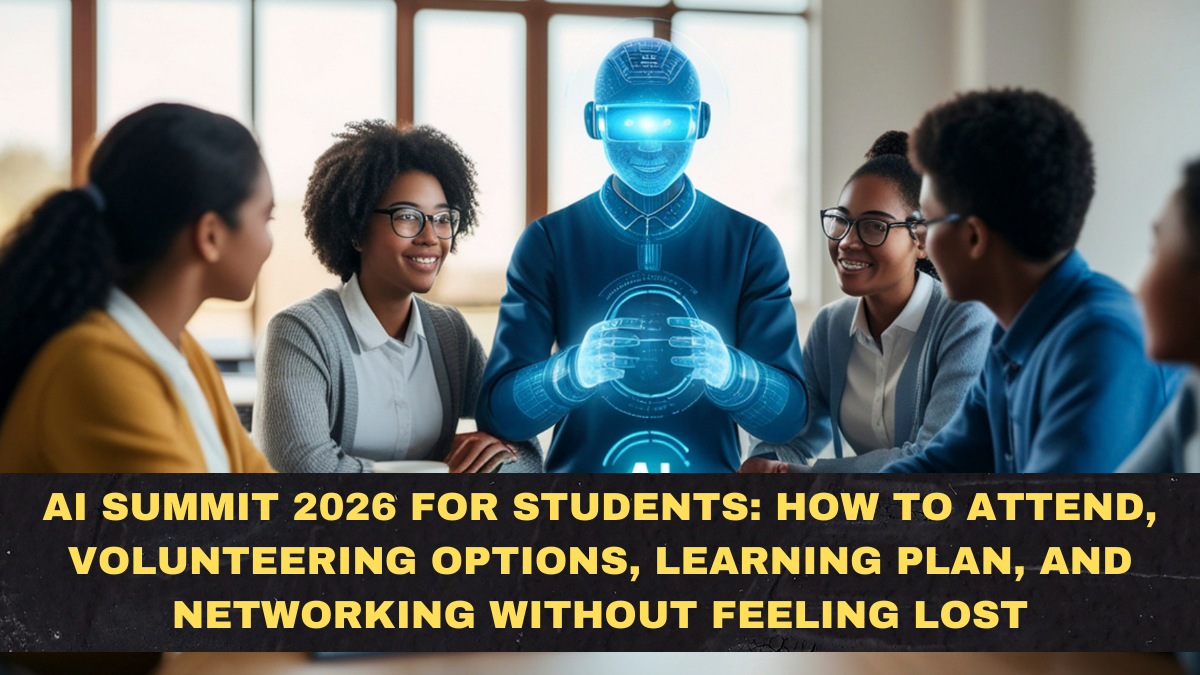
For most students, an AI summit looks intimidating from the outside. Thousands of professionals, founders, researchers, and policy people walking around in suits, talking in jargon, and exchanging business cards. The natural assumption is that these events are “not for students yet” and that you should wait until you have a job, a startup, or a serious research profile. In 2026, that assumption is not just wrong. It is actively damaging to your career timeline.
AI summits have quietly become one of the highest-leverage environments for students who want early access to learning, internships, mentors, and industry exposure. The gap between what students think these events are for and what they are actually useful for is massive. Most students either don’t attend at all or attend in a confused, passive way that wastes the opportunity.
This guide breaks down exactly how students can use AI Summit 2026 strategically. It explains how to attend even with budget constraints, how volunteering actually works, how to build a simple learning plan for the event, and how to network without feeling awkward, fake, or completely lost.

Why AI Summits Are Secretly Career Accelerators for Students
The biggest hidden advantage of AI summits is proximity. You are suddenly in the same physical space as hiring managers, startup founders, senior engineers, researchers, and policymakers. No online course, LinkedIn message, or cold email gives you that level of access density.
In 2026, companies hire differently than they did a decade ago. They are no longer relying only on campus placements or formal recruitment pipelines. They are watching who shows up, who asks intelligent questions, who builds side projects, and who demonstrates genuine curiosity about the field.
When you attend an AI summit as a student, you are quietly inserting yourself into that informal hiring radar much earlier than your peers.
Who Should Actually Attend AI Summit 2026 as a Student
You do not need to be a machine learning expert to attend an AI summit. That belief keeps thousands of capable students out of rooms they absolutely belong in.
If you are studying computer science, data science, engineering, mathematics, business, design, law, policy, or even journalism, you already have a valid reason to be there. AI is no longer a narrow technical niche. It is a cross-disciplinary force touching every serious industry.
In 2026, the most valuable students at AI events are not just coders. They are people who understand how AI intersects with business, ethics, regulation, user experience, storytelling, and society.
How Student Passes and Discounts Actually Work
Most large AI summits quietly offer discounted student passes, but they are rarely advertised aggressively. The pricing logic is simple. Organizers want young attendees to fill seats, create energy, and build long-term loyalty to the event brand.
In practice, student passes are usually limited in quantity and tied to verification requirements such as college email IDs or student ID uploads. They often sell out early because budget-conscious students jump on them quickly.
If you are serious about attending AI Summit 2026, your first operational move should be checking student pricing and registering early. Waiting until the last moment almost always means paying full price or missing out entirely.
How Volunteering at AI Summits Actually Works
Volunteering is the most underused hack for students at major conferences.
Organizers need large volunteer teams to manage registrations, session rooms, speaker coordination, and attendee flow. In exchange, volunteers usually get free access to the event, certificates, food, and sometimes backstage exposure to speakers.
The real value is not the certificate. It is the access.
Volunteers are constantly interacting with speakers, organizers, and senior attendees. That exposure creates natural conversation opportunities that normal attendees rarely get.
In 2026, volunteering is not a “poor student” option. It is a strategic access pass.
What Volunteering Looks Like Day to Day
Most students imagine volunteering as boring logistics work.
The reality is more interesting.
You might be assigned to manage a workshop room, escort speakers, handle registrations, coordinate stage transitions, or support demo zones. All of these roles put you in direct proximity to high-value people and conversations.
If you volunteer intelligently, you can still attend key sessions, talk to speakers during breaks, and build connections while technically “working” the event.
This dual role makes volunteering one of the highest ROI paths for students.
Why You Need a Learning Plan Before Attending
This is where most students waste the event.
They show up without a plan, wander between sessions randomly, and leave with vague inspiration instead of concrete learning.
An AI summit schedule is information overload. You cannot absorb everything. You must filter intentionally.
Your learning plan should answer three questions.
What topics do I want to understand better?
What roles or career paths am I curious about?
Which speakers or companies do I want exposure to?
This filter turns chaos into structure.
How to Choose Which Sessions to Attend
Do not choose sessions based only on big names or hype titles.
Choose sessions based on relevance to your future direction.
If you are interested in AI product roles, attend product, UX, and deployment talks. If you are interested in research, attend technical and academic sessions. If you are interested in startups, attend founder panels and demo showcases.
In 2026, your job is not to consume content. It is to reduce uncertainty about your own career path.
Networking Without Feeling Fake or Cringe
This is the part students fear the most.
Here is the truth.
You are not expected to impress anyone as a student. You are expected to be curious, respectful, and honest.
Your only job in conversations is to ask intelligent questions and listen properly.
You do not need a pitch. You do not need to pretend to be a founder or expert.
You need a simple intro like:
“I’m a student learning about AI and I’m trying to understand how people actually enter this field.”
That line alone opens better conversations than any fake confidence script.
How to Turn Casual Conversations Into Real Opportunities
Most conversations die because nobody follows up properly.
If you have a good interaction with someone, ask for permission to connect on LinkedIn or email.
Do not treat it like a business transaction. Treat it like a continuation of a useful conversation.
Within two days, send a short message reminding them who you are and what you discussed.
This simple behavior turns random chats into long-term professional relationships.
What Recruiters and Founders Actually Notice About Students
Here is a reality check.
Nobody is judging your GPA or college brand at an AI summit.
They are judging three things.
Your curiosity level.
Your communication clarity.
Your seriousness about learning.
If you ask thoughtful questions, show genuine interest, and demonstrate that you are building skills or projects, you already stand out from 90 percent of student attendees.
In 2026, attitude beats credentials in early-career hiring.
Why Most Students Leave AI Summits With Nothing
This is uncomfortable but true.
Most students treat summits like motivational events.
They listen passively, take photos, post stories, and go home.
They do not talk to anyone important. They do not follow up. They do not build on what they learned.
That is why nothing changes for them afterward.
The event itself is not the opportunity. Your behavior inside it is.
Conclusion: Treat AI Summit 2026 Like a Career Tool, Not a Field Trip
AI Summit 2026 is not a spectator sport for students.
It is a compressed career accelerator hiding in plain sight.
If you attend with a learning plan, use volunteering strategically, talk to people intelligently, and follow up properly, this single event can outperform years of passive online learning.
In 2026, the students who win are not the smartest ones.
They are the ones who show up early, prepare intentionally, and act like professionals before anyone gives them a job title.
FAQs
Can students with no AI background attend AI Summit 2026?
Yes. Many sessions are beginner-friendly and cross-disciplinary, and curiosity matters more than technical depth.
Is volunteering better than buying a student pass?
Often yes, because it gives you free access and closer proximity to speakers and organizers.
Do companies actually hire students they meet at summits?
Yes. Many internships and entry-level roles begin through informal summit conversations.
How should a student prepare before attending?
By defining learning goals, shortlisting sessions, and preparing a simple self-introduction.
Is networking awkward as a student?
Only if you try to impress. Honest curiosity works better than fake confidence.
What is the biggest mistake students make at AI summits?
Attending passively without talking to people or following up afterward.