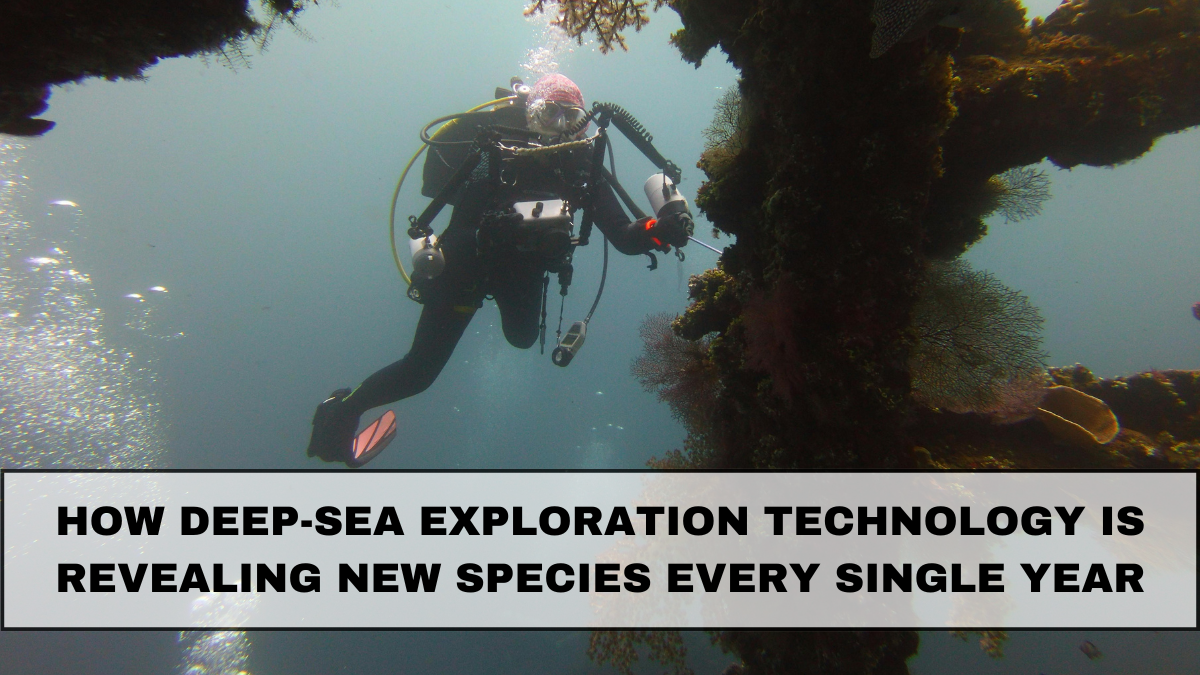
The deep ocean remains one of the least explored environments on the planet, filled with mysteries, extreme pressure, freezing temperatures and complete darkness. Yet thanks to rapid advancements in deep-sea exploration technology, scientists are now uncovering new marine species every single year. From bioluminescent fish and microscopic organisms to giant tube worms and never-before-seen jellyfish, the ocean continues to reveal its secrets at an accelerating pace. This progress is possible because cutting-edge tech is transforming how researchers explore, map and analyse the underwater world.

The Technology Powering Today’s Deep-Sea Discoveries
The transformation in deep-sea research is driven by several breakthrough technologies that make underwater exploration safer, more precise and more efficient.
One major advancement is the rise of Autonomous Underwater Vehicles (AUVs). These free-swimming robots navigate the ocean depths without human control, capturing images, collecting samples and mapping terrain that divers or submarines cannot reach.
Alongside AUVs, Remotely Operated Vehicles (ROVs) have become essential tools. These tethered robotic machines are controlled from the surface, allowing scientists to operate high-definition cameras, robotic arms and sampling equipment in some of the harshest environments on Earth.
Another major development is the use of advanced multi-beam sonar mapping. Modern sonar systems generate incredibly detailed 3D maps of the seafloor, revealing structures such as deep trenches, undersea volcanoes, hydrothermal vents and canyons that often host previously unknown life forms.
Finally, AI-powered imaging and data analysis tools are revolutionising species identification. Algorithms can now scan vast amounts of footage, detect unusual organisms and even recognise species based on movement patterns or body shape. This dramatically speeds up the discovery process, allowing scientists to analyse thousands of hours of recordings in a fraction of the time.
What Makes the Deep Sea a Hotspot for New Species
The deep sea is Earth’s most extreme habitat, which is exactly why it shelters countless undiscovered organisms. Conditions in these depths differ drastically from the surface world. Sunlight cannot penetrate these waters, temperatures are near freezing, and pressure is intense enough to crush most known life forms. Yet evolution has allowed unique species to thrive here.
Many deep-sea creatures rely on bioluminescence, glowing in the dark to communicate, attract prey or defend themselves. Others have developed translucent bodies, massive eyes or completely new survival strategies. Since these species have adapted to isolated, extreme environments, they often exist nowhere else on the planet.
Moreover, the deep sea is incredibly vast. With more than half of the Earth’s surface lying under waters deeper than 3,000 metres, the sheer scale ensures that even modern technology has only touched a small percentage of this environment. This means the potential for discovering new species remains enormous.
Recent Discoveries Made Possible by New Technology
The past few years have brought remarkable discoveries, each made possible by advancements in deep-sea exploration technology. AUVs have captured footage of jellyfish with umbrella-shaped bodies glowing in multiple colours. ROVs have uncovered ancient-looking fish that resemble fossils. AI analysis has helped scientists identify new species of soft corals, crustaceans and mysterious microorganisms around hydrothermal vents.
One of the most exciting areas of discovery is the midnight zone—a depth where light disappears entirely. Here, researchers have identified glowing sharks, giant squid and ethereal creatures with ribbon-like bodies. In the deepest trenches, such as the Mariana Trench, scientists have found snailfish, bizarre transparent species and bacteria that survive in unimaginable pressure.
Every new discovery helps researchers understand how life evolves in isolation, how ecosystems function without sunlight and how organisms adapt to extremes that were once believed incompatible with life.
Why Deep-Sea Discoveries Matter for the Future
The continuous identification of new marine species has implications far beyond scientific curiosity. Many deep-sea organisms possess biochemical properties that could lead to breakthroughs in medicine, biotechnology and environmental science. Certain bacteria found near hydrothermal vents have enzymes capable of working under extreme heat, which could revolutionise industrial processes.
Deep-sea species also provide crucial clues about climate change. By understanding how ecosystems respond to shifting temperatures, ocean acidification and changing currents, scientists can better predict global environmental outcomes.
Furthermore, as deep-sea mining and industrial activity grow, the documentation of marine biodiversity becomes urgent. Without sufficient research, vulnerable species might vanish before they are even discovered.
How Technology Will Shape the Future of Exploration
The next decade promises even more innovation. Future deep-sea missions will use fleets of interconnected AUVs working together like swarms. AI will become even more capable, identifying species in real time. Ultra-light, pressure-resistant materials will allow robots to dive deeper than ever before. And satellite-connected sensors will allow scientists worldwide to track ocean conditions instantly.
All of these upgrades will accelerate the discovery of new species and unlock even more secrets hidden beneath the waves.
Conclusion
From robotic explorers to AI mapping, deep-sea exploration technology is rapidly transforming our ability to study Earth’s most mysterious ecosystem. With every new dive and every new piece of data, scientists uncover species that reshape our knowledge of life on the planet. As technology continues to advance, the deep ocean will remain one of the richest frontiers for future discovery.
FAQs
What is deep-sea exploration technology?
It refers to tools like AUVs, ROVs, sonar mapping and AI imaging systems that help scientists study the deep ocean safely and accurately.
Why are new marine species discovered every year?
Because more of the ocean is being explored than ever before, and extreme environments often host organisms that have never been seen or documented.
How deep can modern exploration vehicles go?
Many ROVs can reach depths of 6,000 metres, and specialised submersibles can go even deeper into the trenches.
Why is deep-sea research important?
It reveals new species, supports scientific innovation, helps understand climate change and protects fragile ecosystems from exploitation.