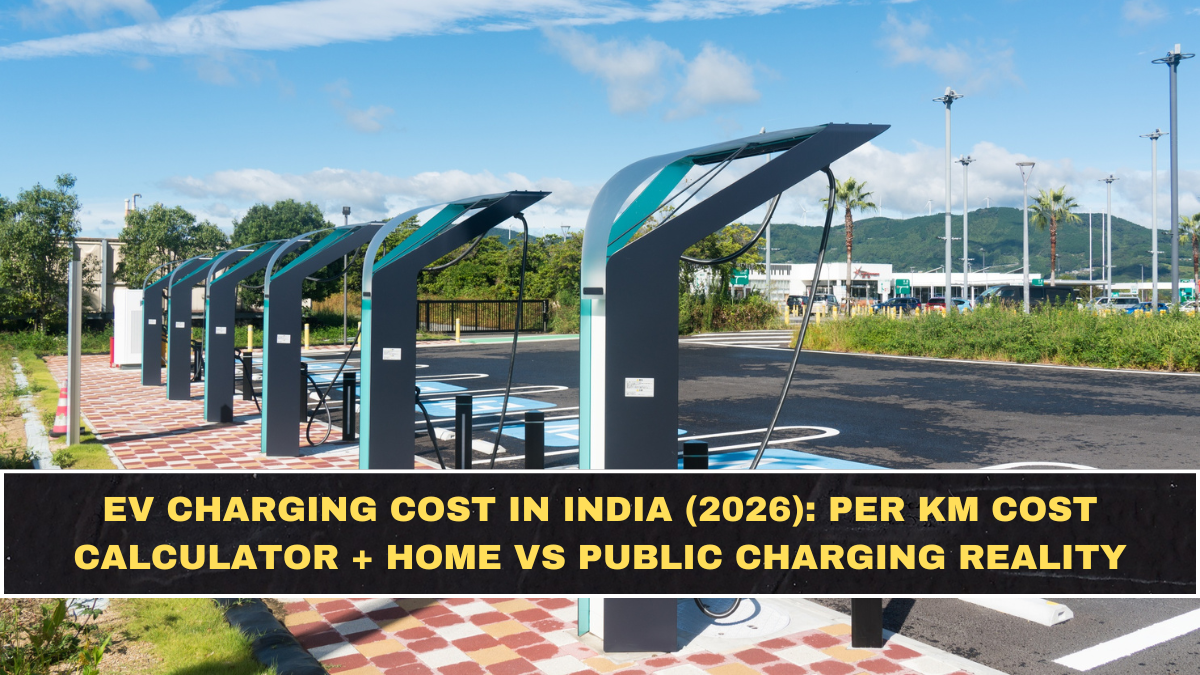
As electric vehicles become more common on Indian roads in 2026, one question dominates every buyer conversation: how much does it really cost to run an EV? While sticker prices still influence decisions, day-to-day running cost is where EVs quietly change the ownership equation. This is why interest in an EV charging cost calculator India 2026 per km cost home vs public has surged among first-time and repeat EV buyers alike.
Unlike petrol or diesel, EV running costs are not fixed or uniform. They depend heavily on where and how you charge. The EV charging cost calculator India 2026 per km cost home vs public helps buyers move past vague assumptions and understand the real numbers behind electricity tariffs, battery efficiency, and charging habits. In 2026, clarity here often determines whether an EV feels economical or unexpectedly expensive.
How EV Charging Costs Are Calculated in India
At its core, EV charging cost is a simple relationship between electricity price and vehicle efficiency. Electricity is measured in units, while EV consumption is measured in kilowatt-hours per kilometer. Multiplying the two gives the cost per kilometer.
The EV charging cost calculator India 2026 per km cost home vs public becomes useful because electricity prices vary widely across states, cities, and charging setups. Home electricity tariffs are usually much lower than public charging rates, and this difference directly impacts long-term ownership costs. In 2026, informed buyers always calculate running cost based on their charging scenario, not national averages.
Home Charging Cost Per Km in 2026
Home charging remains the cheapest and most predictable way to run an EV in India. Most residential electricity tariffs fall into a moderate range, making overnight charging economical and stress-free. For daily commuters, this is where EVs deliver their strongest financial advantage.
Using an EV charging cost calculator India 2026 per km cost home vs public, buyers can see that home charging typically results in significantly lower per-kilometer costs compared to petrol. This advantage becomes even clearer for users with consistent daily driving patterns. In 2026, home charging is not just a convenience feature, but the foundation of affordable EV ownership.
Public Charging Cost Per Km Reality
Public charging tells a very different story. Fast chargers and commercial charging stations charge higher rates to cover infrastructure, maintenance, and demand-based pricing. While public charging is essential for longer trips and emergencies, relying on it regularly changes the cost equation.
The EV charging cost calculator India 2026 per km cost home vs public shows that frequent public charging can narrow the cost gap between EVs and petrol cars. In some cases, fast charging costs approach traditional fuel expenses on a per-kilometer basis. This does not make EVs unviable, but it highlights the importance of charging strategy in 2026.
Home vs Public Charging: The Cost Gap Explained
The difference between home and public charging is not marginal; it is structural. Home charging benefits from residential tariffs and off-peak usage, while public charging reflects commercial pricing and higher energy delivery costs.
When using an EV charging cost calculator India 2026 per km cost home vs public, buyers quickly realize that EV savings are maximized when home charging covers most daily usage. Public charging should ideally remain supplementary rather than primary. In 2026, EV owners who understand this distinction enjoy predictable costs, while those who ignore it often feel disappointed.
Impact of Driving Style and Efficiency
Charging cost is also influenced by how efficiently the vehicle is driven. Aggressive acceleration, high speeds, and heavy air-conditioning usage increase energy consumption. Smooth driving and regenerative braking can significantly improve efficiency.
The EV charging cost calculator India 2026 per km cost home vs public works best when paired with realistic efficiency assumptions. Overestimating efficiency leads to unrealistic expectations, while conservative estimates provide a safer ownership forecast. In 2026, experienced EV users plan costs based on real-world behavior, not brochure figures.
Monthly and Annual Running Cost Perspective
Looking at per-kilometer cost is useful, but monthly and annual views provide better clarity. Regular commuters quickly see how EV savings compound over time, especially when home charging dominates.
Using an EV charging cost calculator India 2026 per km cost home vs public, buyers can estimate annual electricity expenses and compare them with historical fuel spending. This comparison often reveals that even moderate EV usage leads to noticeable savings in 2026, provided charging habits remain disciplined.
Common Mistakes Buyers Make While Estimating EV Costs
A common mistake is assuming all EV charging is cheap. Another is ignoring public charging dependency during long trips or apartment living. Buyers also forget to factor in seasonal electricity consumption patterns that affect tariffs.
The EV charging cost calculator India 2026 per km cost home vs public helps avoid these mistakes by forcing realistic inputs. Informed buyers treat charging as a system, not a single number, which leads to more satisfying ownership experiences.
Conclusion: The Smart Way to Use an EV Charging Cost Calculator in 2026
In 2026, EV affordability depends less on the vehicle itself and more on how it is charged. Home charging delivers clear savings, while public charging adds flexibility at a higher cost. Understanding this balance is essential for any EV buyer.
The EV charging cost calculator India 2026 per km cost home vs public is not just a calculation tool, but a decision-making framework. Buyers who use it honestly gain control over their expenses and avoid unpleasant surprises.
Electric vehicles remain a financially sensible choice in 2026, but only when charging realities are understood and planned for with clarity and discipline.
FAQs
How much does it cost per km to charge an EV at home in India in 2026?
Home charging generally results in low per-kilometer costs, depending on electricity tariff and vehicle efficiency.
Is public charging expensive compared to home charging?
Yes, public charging is significantly costlier and should ideally be used occasionally rather than daily.
Does fast charging increase running cost?
Fast charging usually costs more per unit and can increase overall running expenses if used frequently.
Can EV running costs match petrol cars if public charging is used often?
In some cases, heavy reliance on public fast chargers can reduce the cost advantage of EVs.
Is an EV charging cost calculator reliable for planning expenses?
Yes, if realistic inputs are used, it provides a practical view of expected running costs.