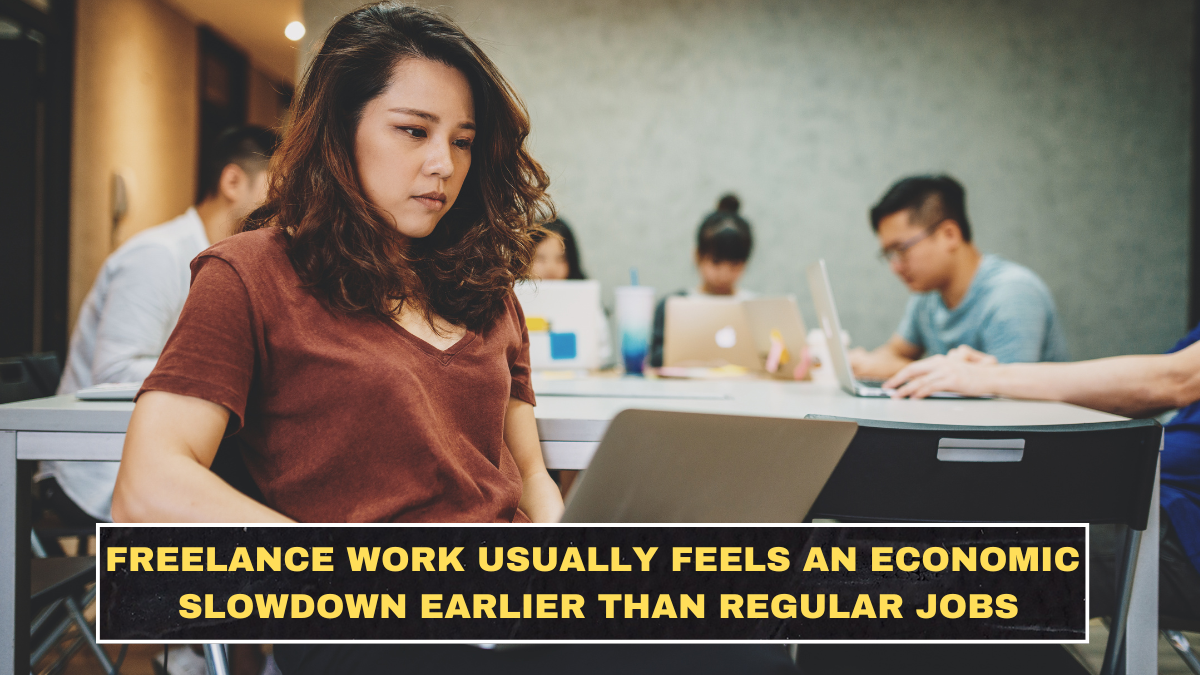
Freelancers are often the first to notice an economic slowdown because clients cut flexible spending before they cut core payroll. That is the ugly truth. In India’s current services slowdown, Reuters reported that client budgets remain cautious, discretionary spending is weak, and deal cycles have lengthened. Those are exactly the conditions that hit freelance and project-based work first.
This is not because freelance work has no demand. In fact, gig and freelance work remains huge. Upwork’s 2024 market overview said 64 million Americans did some kind of freelance work in 2023, while World Bank data suggests the online gig economy accounts for up to 12% of the global labor force. The point is different: freelance demand can remain large overall while becoming more unstable during slower business periods.
What changes first when the economy slows
Clients rarely say, “The economy is bad, so we’re cutting freelancers.” They show it through behavior instead.
- smaller project scopes
- slower approvals
- more negotiation on pricing
- delayed start dates
- shorter retainers
- more “cost optimization” language
Reuters’ April 2026 reporting on Indian IT said client budgets had not increased materially, discretionary spending remained weak, and firms were seeing longer deal cycles. That report was about IT services companies, but the same pattern usually hits freelancers even earlier because project-based work is easier to pause than permanent hiring. That last part is an inference, but it is a grounded one.
Why freelancers feel it earlier than regular jobs
A business facing uncertainty usually cuts optional work first. Freelancers often sit inside that optional layer, especially in marketing, content, design, consulting support, and experimental tech work. Upwork’s 2026 10-K also makes clear that marketplace demand depends on client demand across short-term and longer-term projects. So when client demand softens, freelance flow can become uneven even if the market itself stays active.
That is why freelancers feel the slowdown as patchy income rather than one clean event. Salaried employees may keep their jobs for a while. Freelancers may still get work too, but they start seeing more unstable pipelines, slower closes, and clients trying to squeeze more output from less budget.
What an economic slowdown looks like in freelance work
| Early signal | What it usually means | Effect on freelancers |
|---|---|---|
| Client budgets stay flat | Buyers turn cautious | More price pressure |
| Deal cycles get longer | Decisions are delayed | More unpaid waiting time |
| Discretionary spend weakens | Non-essential projects get paused | Fewer nice-to-have projects |
| Cost optimization becomes priority | Clients want cheaper outcomes | Scope cuts or lower rates |
| Hiring slows at firms | Companies avoid fixed costs | Some may use freelancers, but often more selectively |
This is why slowdowns are confusing for freelancers. Some companies replace hiring with contractors, but many others simply cut non-core projects. So the market does not go dead. It becomes harsher and less predictable. Reuters showed this logic in Indian IT as clients cut discretionary spending and deferred projects, while earlier Reuters reporting also linked weak demand to slower hiring and headcount pressure.
Which freelancers usually get hit first
Freelancers tied to discretionary business spending tend to feel pain first.
- content and branding work tied to expansion
- experimental marketing campaigns
- design refresh projects
- non-urgent consulting tasks
- long-shot product experiments
By contrast, work linked to revenue protection, customer support, operations, compliance, and direct cost savings often holds up better. That is not a guaranteed rule, but it is how cautious clients usually behave when budgets tighten. Reuters’ 2026 IT coverage also said spending was shifting toward cost optimisation and AI-led projects, while discretionary spending stayed weak.
What freelancers should watch instead of fooling themselves
The first warning signs are not dramatic recession headlines. They are pipeline behavior.
- more clients asking for discounts
- more ghosting after discovery calls
- projects getting split into smaller phases
- late approvals after “internal review”
- clients choosing cheaper, narrower deliverables
If you ignore those signs and keep pretending the market is normal, that is on you. A slowdown usually does not arrive as one big crash in freelance work. It arrives as more friction, less certainty, and weaker client commitment.
Conclusion
Freelance work usually feels an economic slowdown earlier than regular jobs because clients cut flexible, discretionary spending before they touch core payroll. In 2026, the evidence already points to cautious budgets, slower deal cycles, and weaker discretionary spending in services. For freelancers, that often means smaller projects, delayed decisions, and more income volatility before broader job-market pain becomes obvious.
FAQs
Why do freelancers feel a slowdown before salaried workers?
Because project-based and discretionary spending is easier for clients to pause than full-time payroll.
Does a slowdown mean freelance work disappears?
No. It usually becomes more selective, lower-budget, and slower to close rather than disappearing entirely.
What are the first signs of trouble for freelancers?
Longer decision cycles, smaller project scopes, pricing pressure, and delayed starts are common early signs.
Which freelance services hold up better in a slowdown?
Work tied to cost savings, operations, support, or direct business outcomes usually holds up better than purely discretionary projects. This is an inference based on where spending is staying stronger versus where it is being cut.
Click here to know more