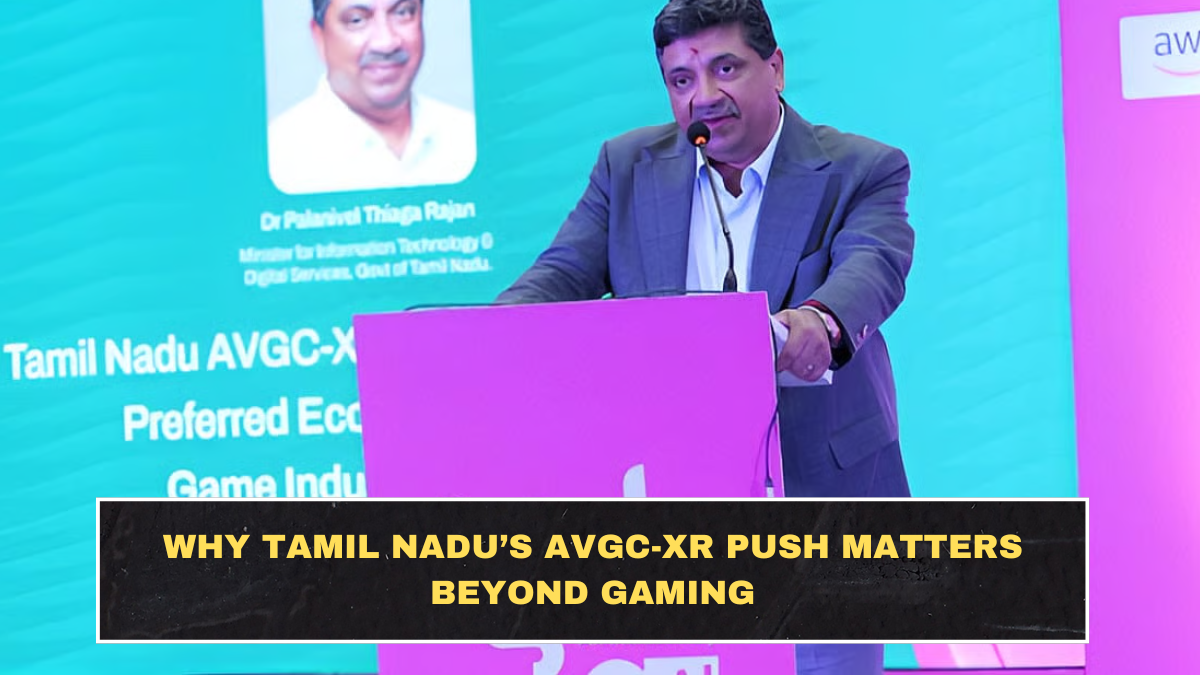
Most people see “AVGC-XR” and think this is just a gaming story. That is too narrow. Tamil Nadu’s 2026 AVGC-XR policy is aimed at animation, visual effects, gaming, comics, and extended reality together, which means it is really about building a broader creative-tech economy. The state’s ambition is not small either. According to reporting on the policy, Tamil Nadu wants to capture 20% of India’s AVGC market, 20% of the export market, and create more than two lakh jobs by 2030. That makes this an industry-building policy, not a niche startup announcement.
The timing also matters. At the national level, the Union Budget 2026–27 said India’s AVGC sector is projected to require nearly 2 million professionals by 2030, and it backed this with support for AVGC Content Creator Labs in 15,000 secondary schools and 500 colleges. When both a state government and the Union government are pushing the same sector at the same time, that usually means the opportunity is being treated as strategic rather than speculative.
What Tamil Nadu Is Actually Trying to Build
Tamil Nadu is not starting from nothing. Chennai already has a known base in film, post-production, and VFX-related work. Reporting on the policy says the city has boutique studios, medium and small firms, and talent linked to both domestic productions and global projects. The problem is not the absence of skill. The problem is scale, fragmentation, and the lack of major anchor studios that can attract bigger investment and create a multiplier effect. That is why the policy matters: it is trying to convert scattered capability into a larger organized ecosystem.
That is also why this policy goes beyond gaming. The state is trying to improve infrastructure, skilling, competitiveness, and innovation across the AVGC-XR stack, not just fund game developers. Reporting quotes industry experts saying common facilities can lower entry barriers for smaller firms, and that better infrastructure could help mid-sized studios compete for larger work. In simple terms, Tamil Nadu is trying to move from “good talent, small scale” to “good talent, larger commercial engine.”
Why the Jobs Story Matters More Than the Hype
The employment angle is the real reason this policy is important. The Union Budget’s estimate of nearly 2 million AVGC professionals needed by 2030 shows why states want a piece of this sector. The Ministry of Information and Broadcasting has also described AVGC as a major employment engine for the digital generation, with projections of nearly 20 lakh direct and indirect jobs over the next decade. Tamil Nadu’s own target of more than two lakh jobs by 2030 fits directly into that national jobs narrative.
But this is where the hype needs to be cut down. Not all AVGC jobs are equally safe or equally valuable. Reporting from Chennai says AI is already disrupting repetitive creative work, especially lower-end VFX tasks like rotoscoping, paint, matchmove, matte extraction, edge detection, and basic cleanups. That means Tamil Nadu’s policy is not just about creating any jobs. It has to help studios and workers move toward higher-value work such as advanced compositing, simulations, environment creation, pipeline engineering, and real-time virtual production. Otherwise the headline job targets will sound good but age badly.
Table: What Tamil Nadu’s AVGC-XR Push Is Really About
| Area | What the current signals show | Why it matters |
|---|---|---|
| Market ambition | Tamil Nadu wants 20% of India’s AVGC market and export market by 2030 | Shows the policy is built for scale, not symbolism. |
| Jobs | State target is over 2 lakh jobs; India-wide need is nearly 2 million professionals by 2030 | Makes AVGC-XR a real employment strategy. |
| Existing base | Chennai already has VFX, post-production, and creative talent | The state is building on an existing advantage. |
| Policy focus | Infrastructure, skilling, innovation, and anchor studios | This is ecosystem policy, not just subsidies. |
| AI risk | Lower-end repetitive VFX work is increasingly exposed | Workers and firms need to move up the value chain. |
| Beyond entertainment | AVGC-XR work can support robotics, synthetic data, XR devices, and digital twins | The opportunity is wider than film or gaming alone. |
Why It Matters Beyond Entertainment
This is the part most surface-level articles miss. AVGC-XR is not useful only for movies, OTT, and games. Reporting on the Tamil Nadu policy says industry participants increasingly see AVGC-XR work serving non-entertainment uses too, including photorealistic synthetic data for autonomous vehicles, robotics, XR devices, machine learning systems, and digital twins for manufacturing and enterprise clients. That matters because it widens the business case. If the sector depended only on entertainment demand, it would be more fragile. Once it connects to industrial and technology use cases, the growth story becomes broader and harder to ignore.
That is also why Tamil Nadu’s move matters competitively. States such as Karnataka, Maharashtra, and Telangana already have stronger visibility in parts of this space, and reporting says Tamil Nadu is trying to catch up if execution is right. So this is not just about local branding. It is part of an inter-state race to attract studios, talent, contracts, and technology-linked creative work.
What Could Still Go Wrong
The obvious risk is execution. Big policies are easy to announce and much harder to deliver. The Chennai reporting makes this point directly: Tamil Nadu needs not just infrastructure and incentives, but actual production pipelines, co-productions, global contracts, and work flowing into the system. Without that, the policy risks becoming another glossy framework with weak commercial impact.
The second risk is AI transition. Experts quoted in the coverage say the policy does not do enough yet to help smaller and mid-sized firms adapt to AI-led disruption. That is a serious blind spot. If smaller studios do not get help upgrading skills, tools, and project mix, the industry could still grow at the top while weaker players get squeezed underneath. That would make the policy look better on paper than on the ground.
Conclusion
Tamil Nadu’s AVGC-XR push matters beyond gaming because it is really a bet on creative technology, jobs, exports, and future-facing digital work. The state wants a major share of India’s AVGC market by 2030, while the national government is already projecting demand for nearly 2 million professionals in the sector. That combination makes this a serious industrial story, not a trendy sidebar.
The harder truth is that the opportunity is real, but so is the pressure. Tamil Nadu can benefit from its existing VFX and post-production base, but only if it scales faster, attracts anchor studios, and helps workers move toward higher-skill work that AI cannot cheapen as easily. So yes, the policy matters beyond gaming. The real question is whether execution will be strong enough to make that ambition real.
FAQs
What does AVGC-XR mean?
AVGC-XR stands for Animation, Visual Effects, Gaming, Comics, and Extended Reality. It covers a wider creative-tech sector than gaming alone.
What is Tamil Nadu trying to achieve with this policy?
According to reporting on the 2026 policy, Tamil Nadu wants to capture 20% of India’s AVGC market, 20% of the export market, and create more than two lakh jobs by 2030.
Why is this policy important for jobs?
Because India’s AVGC sector is projected to require nearly 2 million professionals by 2030, and Tamil Nadu wants to turn its creative base into a large employment engine within that national growth.
Is AI a threat to this sector?
Yes, especially for repetitive lower-end VFX work. But higher-value areas such as advanced compositing, simulations, pipeline engineering, and real-time production are expected to remain more resilient.