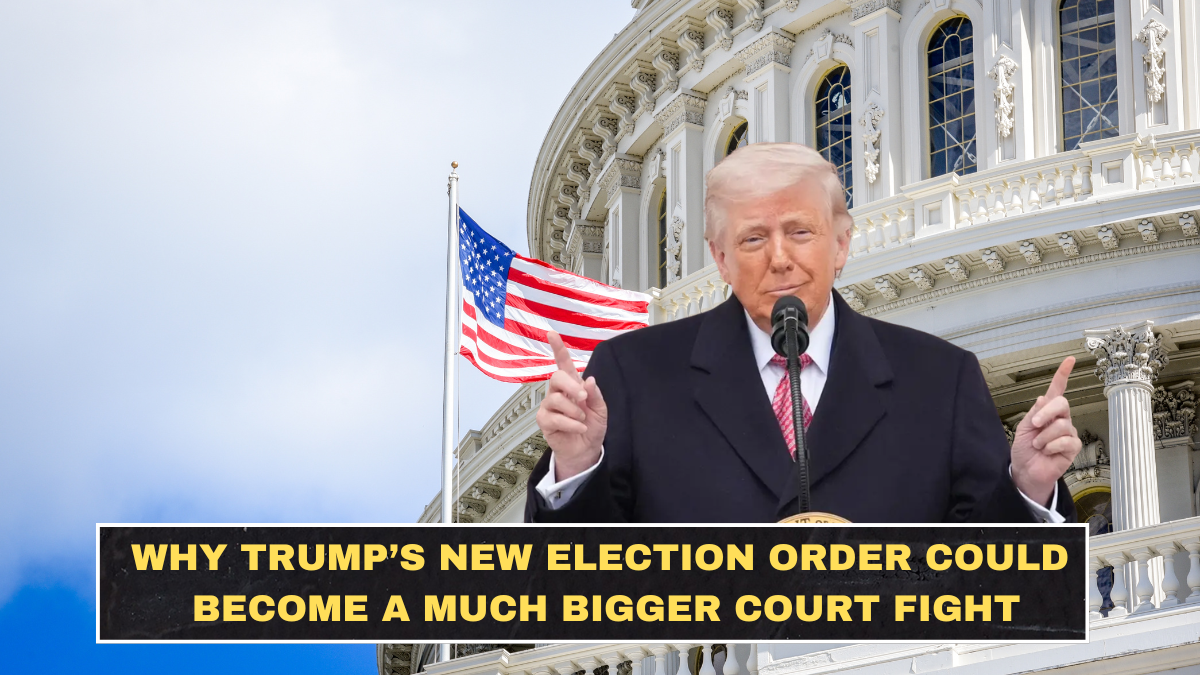
President Donald Trump’s new election order matters because it tries to change how mail voting is handled nationwide without Congress rewriting federal election law or states voluntarily changing their systems. Reuters reported on March 31 that the order tightens mail-ballot rules, tells federal agencies to help states verify eligible voters using national data, and aims to build a list of confirmed U.S. citizens eligible to vote in each state. That is why the backlash was immediate: this is not a symbolic document. It is a direct attempt to reshape election administration ahead of the 2026 midterms.
What the order actually tries to do
According to Reuters, the order says absentee ballots should be sent only to voters on each state’s approved mail-voting list and should include secure tracking barcodes. It also directs federal agencies to support voter-verification efforts using national data. The administration’s goal is to tighten election controls around mail voting and citizenship verification, which Trump has made a central political issue for months.
Why critics are alarmed
The backlash is not just partisan noise. Reuters reported that voting-rights groups, legal experts, and Democratic officials quickly denounced the order as unconstitutional. California Governor Gavin Newsom said the state would sue, and NAACP President Derrick Johnson also criticized the directive. The core complaint is simple: states, not the White House, run elections, and an executive order cannot just override state election law because a president wants tighter rules.
The biggest legal problem
The main weakness is presidential authority. Reuters has already noted in earlier reporting on Trump’s voting push that legal experts said he does not have the power to order states to change election systems by executive action. That matters because election administration in the U.S. is heavily decentralized, with states and local officials controlling registration, mail-ballot procedures, and vote counting. So the court fight is likely to focus less on whether stricter voting rules are good or bad, and more on whether a president can impose them this way at all.
Why this is tied to Trump’s wider election agenda
This order did not come out of nowhere. Reuters reported that Trump has also been pressing Congress to pass the SAVE America Act, which would require proof of U.S. citizenship and photo ID for voting. That bill faces serious resistance in the Senate, so the executive order looks like an attempt to move part of that agenda through executive power instead. That is exactly why critics see it as both a legal test case and a political escalation ahead of November 2026.
What the order means in practice
Here is the practical issue:
- states that rely heavily on mail voting could face pressure to change procedures
- legal uncertainty could disrupt election planning months before voting
- lawsuits could freeze parts of the order before they take effect
- the fight could reach higher federal courts quickly
That is why this story is bigger than one executive order headline. Even if parts of the directive are blocked, the legal battle itself could shape how states prepare for the midterms.
The key facts at a glance
| Issue | What Reuters reported | Why it matters |
|---|---|---|
| Mail-ballot change | Ballots sent only to approved state mail-voting lists | Could affect how states distribute absentee ballots |
| Tracking requirement | Secure barcodes required on absentee ballots | Adds federal-style operational demands |
| Citizenship verification | Federal agencies told to help verify eligible voters | Raises authority and data-use questions |
| Immediate backlash | Rights groups and Democratic officials threatened lawsuits | Court fight is likely and fast |
| Political context | Tied to Trump’s broader proof-of-citizenship push | Shows this is part of a larger election strategy |
The table makes the real point obvious: this is not merely about election messaging. It is about whether the White House can force structural changes into a state-run system.
What happens next
The next phase is almost certainly litigation. Reuters reported Trump said he was not worried about court challenges, but that confidence does not change the legal reality. Opponents are likely to argue that the order violates constitutional principles and federal election structure by trying to override powers reserved to states. Courts may also look closely at whether federal agencies can lawfully compile and use citizenship data in the way the order envisions.
Why this could become a much bigger fight
The real danger for the administration is not only losing in court. It is that the case could produce a broader ruling limiting presidential power over elections. The real danger for critics is the opposite: even a partial win for Trump could encourage future presidents to push deeper into election administration by executive action. That is why this fight matters beyond 2026. It is partly about mail ballots, but more fundamentally it is about who gets to control the rules of American elections. This final point is an inference based on the order’s scope and the legal objections already reported.
Conclusion
Trump’s new election order is drawing backlash because it tries to do through executive power what usually requires legislation, state cooperation, or both. The immediate legal threats are not surprising. The order touches mail voting, voter verification, and state election control all at once, which makes it politically explosive and legally vulnerable. The court fight now looks less like a side effect and more like the main event.
FAQs
What does Trump’s new election order do?
Reuters reported that it tightens mail-voting rules, requires secure tracking barcodes for absentee ballots, and directs federal agencies to help states verify eligible voters using national data.
Why are critics calling it unconstitutional?
Because election administration is largely controlled by states, and critics argue a president cannot unilaterally rewrite those rules by executive order.
Is this connected to Trump’s proof-of-citizenship push?
Yes. Reuters linked the order to Trump’s broader support for the SAVE America Act, which also targets citizenship verification in voting.
Will the order definitely take effect?
Not necessarily. Lawsuits are already being threatened, and courts could block some or all of the order before the 2026 midterms.