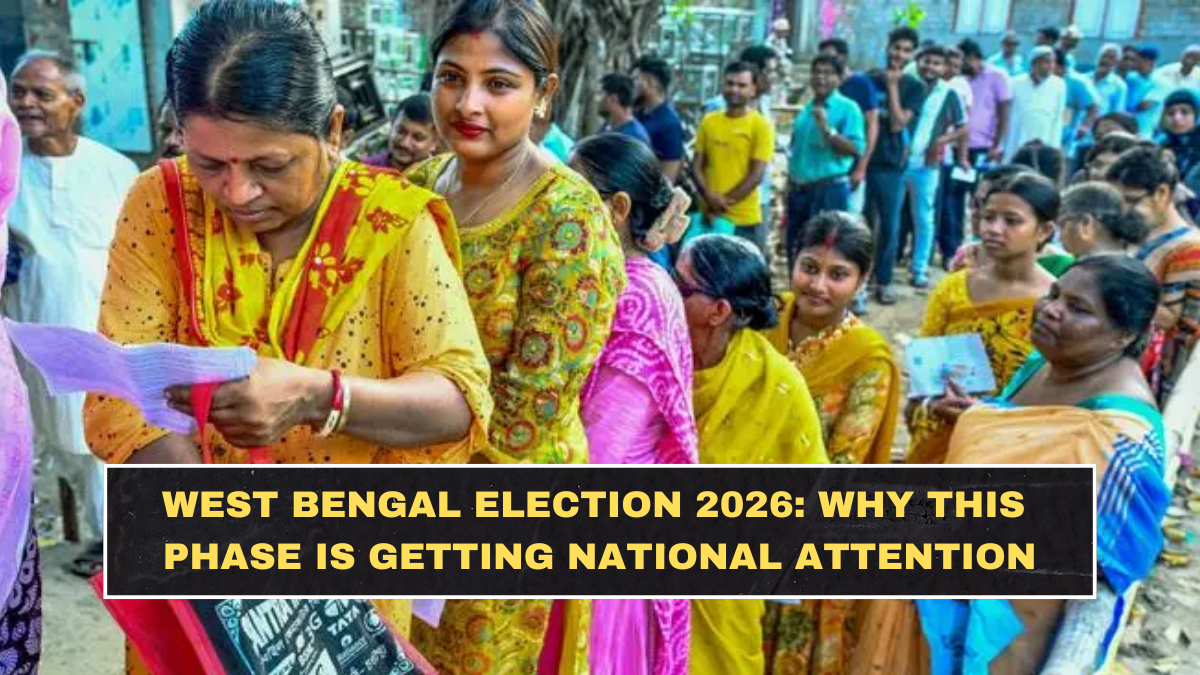
West Bengal Election 2026 is getting national attention because the first phase saw extremely high voter participation across 152 constituencies. Reports said voter turnout crossed 91% to 92% in the opening phase, making it one of the highest turnout moments in the state’s recent election history. When a state as politically important as Bengal records such heavy voting, national parties immediately start reading it as a possible signal of public mood.
But let’s be clear: high turnout does not automatically mean anti-incumbency or pro-incumbency. That is lazy political reading. It only confirms that voters are highly engaged, and both the ruling party and opposition will try to claim the same number in their favour. The real picture becomes clearer only when turnout is studied seat by seat, region by region, and compared with past voting patterns.

What Happened In The First Phase Of Voting?
The first phase covered 152 of West Bengal’s 294 Assembly constituencies. Around 3.6 crore voters were expected to vote across 16 districts, including politically important areas such as Nandigram, Darjeeling, Siliguri, Jalpaiguri and Cooch Behar. These are not small symbolic seats; many of them carry strong political and regional importance.
The high turnout became the biggest headline because it showed unusually strong voter mobilisation. Some reports placed turnout at around 91.35%, while others reported figures above 92% as later updates came in. That gap usually happens because polling data is updated after final booth reports are compiled. For readers, the main point is simple: Bengal’s first phase saw massive participation.
| Key Detail | West Bengal Election 2026 Phase 1 |
|---|---|
| Total Assembly seats in West Bengal | 294 |
| Seats voting in Phase 1 | 152 |
| Districts covered | 16 |
| Expected voters | Around 3.6 crore |
| Reported turnout range | Around 91% to 92%+ |
| Important areas | Nandigram, Darjeeling, Siliguri, Jalpaiguri, Cooch Behar |
| Next major phase | Phase 2 voting scheduled after Phase 1 |
Why Does High Voter Turnout Matter So Much?
High voter turnout matters because it shows that people are not passive. They are willing to stand in queues, travel, adjust work, and vote despite heat, local pressure or political tension. In a state like West Bengal, where elections are often emotionally charged, turnout becomes more than a number. It becomes a signal of mobilisation.
However, interpreting turnout requires discipline. A higher turnout can mean anger, enthusiasm, fear, loyalty, local mobilisation, candidate popularity or even strong party machinery. Anyone saying “high turnout means this party will win” is oversimplifying. The smarter way is to compare turnout with previous elections, booth-level patterns and which side managed to bring voters out more effectively.
Which Seats And Regions Are Being Watched Closely?
Nandigram remains one of the most watched seats because of its symbolic weight in Bengal politics. It has become a seat that national media follows closely, not just local voters. North Bengal areas like Darjeeling, Siliguri, Jalpaiguri and Cooch Behar are also important because they often show different political behaviour compared with south Bengal.
The Durgapur-Asansol belt, parts of Midnapore and other industrial or semi-urban regions also matter because they reflect worker concerns, urban pressure, jobs, local governance and party organisation. Bengal elections are not decided by one type of voter. Rural seats, border areas, tea belt regions, urban centres and minority-heavy pockets can all behave differently.
What Are The Main Issues Voters Are Watching?
Voters are watching a mix of welfare, law and order, jobs, corruption claims, local development and identity-based politics. In Bengal, welfare schemes have often played a major role in shaping voter loyalty, especially among women and rural households. At the same time, the opposition is focusing on governance, political violence, corruption allegations and employment concerns.
The uncomfortable truth is that many voters do not vote on one single issue. A household may like a welfare scheme but still be unhappy about jobs. A young voter may want change, while an older family member may prefer stability. That is why Bengal’s election mood is hard to read from speeches alone. Ground-level turnout and booth-level shifts matter more.
Why Are National Leaders Focusing So Much On Bengal?
National leaders are focusing on Bengal because the state has 294 Assembly seats and major political importance in eastern India. For the BJP, Bengal is one of the biggest states where expanding power would carry national meaning. For the Trinamool Congress, holding Bengal is about protecting its strongest political base and proving that it can still resist national-level pressure.
That is why rallies, speeches and claims are becoming aggressive. After Phase 1, both sides tried to read the high turnout in their own favour. This is expected, but voters should not confuse campaign claims with results. Political parties spin turnout numbers because they want to create momentum before the next phase. The result will decide the truth, not the speeches.
What Could Decide The Final Result?
The final result could depend on turnout conversion, women voters, rural consolidation, minority vote patterns, youth anger, local candidate strength and how much anti-incumbency exists seat by seat. Bengal elections are usually not clean one-factor contests. They are layered, emotional and heavily local.
The biggest factor may be whether high turnout is evenly spread or concentrated in areas where one party has stronger organisation. If turnout rises in opposition-friendly booths, it can hurt the ruling party. If turnout rises in ruling-party strongholds, it can strengthen the incumbent. Without booth-level data, claiming certainty is just political noise.
What Should Voters And Readers Track Next?
Readers should track turnout in the next phase, candidate-wise contests, violence reports, women voter participation and changes in party messaging. If one party suddenly changes campaign tone after Phase 1, that can reveal what its internal numbers are suggesting. Public claims are often loud, but campaign behaviour tells a more honest story.
People should also watch whether the election discussion stays focused on local issues or shifts fully into national narratives. Bengal voters often respond strongly to local pride, welfare access, cultural identity and booth-level leadership. National speeches matter, but local networks often decide whether voters actually reach the polling booth.
Conclusion?
West Bengal Election 2026 is getting national attention because Phase 1 produced massive voter turnout across 152 seats. The numbers suggest strong public participation, but they do not automatically prove which side is winning. High turnout is a signal, not a result. Anyone pretending otherwise is selling political guesswork.
The real story will unfold through the next phases, regional voting patterns and final counting. For now, Bengal has made one thing clear: voters are highly engaged, the contest is intense, and every party will try to turn turnout into a psychological advantage. The smarter reader should ignore loud claims and watch the data carefully.
FAQs
How Many Seats Voted In West Bengal Election 2026 Phase 1?
A total of 152 Assembly constituencies voted in the first phase of West Bengal Election 2026. These seats were spread across 16 districts and included several politically important regions.
What Was The Voter Turnout In West Bengal Phase 1?
Reports placed the turnout around 91% to more than 92% after polling updates. Final turnout figures can vary slightly as booth-level data is updated after voting ends.
Does High Voter Turnout Mean The Ruling Party Will Lose?
No, high turnout does not automatically mean the ruling party will lose. It can signal anger, enthusiasm, mobilisation or loyalty. The meaning depends on which regions and voter groups turned out in larger numbers.
Which Areas Are Important In West Bengal Election 2026?
Nandigram, Darjeeling, Siliguri, Jalpaiguri, Cooch Behar, Midnapore and the Durgapur-Asansol belt are among the areas drawing attention. Different regions can vote for very different reasons.