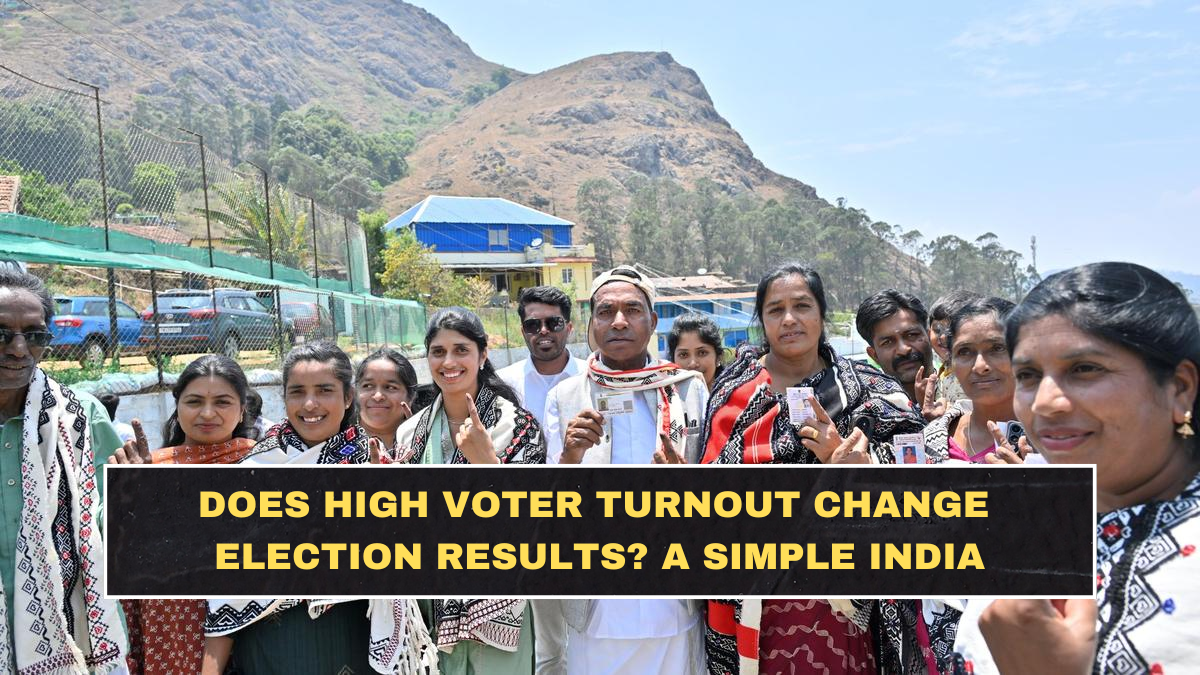
Election turnout means the percentage of eligible registered voters who actually vote in an election. If a constituency has 1,00,000 registered voters and 75,000 people vote, the turnout is 75%. It sounds simple, but the political meaning behind turnout can be complicated because the same number can be interpreted in many ways.
In India, turnout becomes a major headline during state and national elections because political parties try to read public mood from voting percentage. The Election Commission of India tracks turnout through official systems, including estimated polling percentage updates during the day and final statistical reports after elections. That makes turnout useful, but not magical. It is a signal, not a result.
Does High Voter Turnout Always Mean Anti-Incumbency?
No, high voter turnout does not always mean anti-incumbency. This is one of the most repeated but weakest assumptions in Indian election discussions. Many people believe that when more voters come out, they must be angry with the ruling party. That can happen, but it is not a rule.
Research by Milan Vaishnav and Johnathan Guy found that the common belief linking higher turnout with anti-incumbency in Indian state elections is not clearly supported by data. Their analysis of major Indian states showed no statistically meaningful relationship between rising turnout and incumbent performance. In plain language, high turnout can hurt a ruling party, help a ruling party, or mean something else entirely.
| Turnout Situation | Possible Meaning | What It Does Not Prove Alone |
|---|---|---|
| High turnout in ruling-party strongholds | Strong mobilisation by incumbent | Guaranteed ruling-party win |
| High turnout in opposition-heavy areas | Anti-incumbency or opposition energy | Guaranteed regime change |
| High women voter turnout | Welfare, safety, local issues may matter | One-party advantage by default |
| High youth turnout | Jobs, exams, anger or aspiration | Automatic anti-incumbency |
| Low turnout in cities | Voter apathy or migration | No political mood at all |
| Sudden turnout jump | Strong booth mobilisation | Wave without seat-level proof |
Why Do Parties Spin Turnout Numbers So Aggressively?
Political parties spin turnout numbers because perception matters before results. If turnout is high, the opposition may claim voters came out for change. The ruling party may claim voters came out to support welfare, stability and continuity. Both sides can use the same turnout number to tell opposite stories.
This is why voters and readers should be careful. Campaign claims are not neutral analysis. Parties are trying to create momentum, influence undecided voters in later phases, and energise workers. The serious way to read turnout is to ask where the increase happened, which communities voted more, and whether the rise came from areas where one party is already strong.
What Did Recent Indian Elections Show About High Turnout?
Recent elections show why turnout must be read carefully. In West Bengal’s 2026 Assembly election phase, reports said turnout crossed 92% across 152 constituencies, the highest since the 2011 election that removed the Left Front government. That sounds politically dramatic, but it still does not automatically reveal which party benefits from it.
Tamil Nadu also recorded very high polling, with reports saying the state saw around 84.80% turnout after voting ended. The Election Commission described the polling percentages in West Bengal and Tamil Nadu as historically high, according to reports. But again, high turnout tells us voters were engaged. It does not tell us the final seat conversion until counting is done.
Why Can Turnout Percentage Mislead Readers?
Turnout percentage can mislead readers because it hides the actual number of voters, changes in voter lists and constituency-level differences. A jump from 60% to 80% looks massive, but if the total registered voter base has changed, the actual vote increase may be smaller than expected. That is why serious analysis compares both turnout percentage and votes polled.
Another blind spot is statewide averaging. A state may report 80% turnout, but one region may vote at 90% while a major city votes at 60%. Those differences matter more than the headline number. Elections are won seat by seat, not by statewide emotional commentary. If you ignore booth-level and constituency-level patterns, your analysis becomes guesswork.
What Factors Can Increase Voter Turnout?
Turnout can increase because of anger, enthusiasm, fear, welfare support, local candidate appeal, party mobilisation, identity issues or even weather conditions. In some places, voters travel long distances because they feel their vote matters. In others, turnout rises because parties run stronger booth-level operations.
For example, reports from Darjeeling during the 2026 West Bengal voting said voters travelled from different parts of India to cast their votes, partly due to concerns around electoral roll issues and democratic participation. That shows turnout can rise for very specific local reasons that may not fit a simple national political narrative.
How Should A Normal Voter Read High Turnout?
A normal voter should read high turnout as a sign of strong participation, not a final prediction. The first question should be: compared with which election? A 75% turnout may be high for one urban seat but low for one rural seat. Context matters more than the raw number.
The second question should be: who voted more this time? If women’s turnout rises sharply, welfare schemes, household economy and safety may become more important. If youth turnout rises, jobs and education may be stronger themes. If rural turnout rises but urban turnout stays weak, the final result may look different from social media sentiment.
Can Low Turnout Also Change Results?
Yes, low turnout can also change results because committed voter bases become more powerful when casual voters stay home. In a low-turnout election, a disciplined party organisation can benefit because its loyal voters still reach the booth. That is why low turnout does not automatically mean people are happy or unhappy. It may simply mean poor mobilisation, heat, migration, urban apathy or weak candidate excitement.
This is especially important in cities, where many people complain online but do not vote. That gap creates a political distortion. Parties do not win from online noise; they win from votes cast inside booths. If a group is angry but does not vote, its anger has no direct electoral value.
Conclusion?
High voter turnout can change an election result, but it does not automatically reveal the direction of change. The common claim that high turnout always means anti-incumbency is too lazy for Indian politics. Data and past elections show that turnout can help the ruling party, the opposition, or simply reflect stronger participation.
The smarter way to read turnout is to study actual votes, regional patterns, women’s participation, youth turnout, booth-level shifts and previous election comparisons. Turnout is important, but it is only the beginning of analysis. The final result depends on how that turnout converts into seats.
FAQs
What Is Voter Turnout In Simple Words?
Voter turnout is the percentage of registered voters who actually vote in an election. If 80 out of 100 registered voters vote, the turnout is 80%.
Does High Turnout Mean The Government Will Lose?
No, high turnout does not automatically mean the government will lose. It can signal anger, support, strong mobilisation or high public interest. Seat-level results are needed to understand the real impact.
Why Do News Channels Focus So Much On Turnout?
News channels focus on turnout because it gives early clues about voter interest and political mobilisation. However, turnout alone cannot predict the winner accurately.
What Is More Important Than Turnout Percentage?
Actual votes polled, constituency-level turnout, women voter participation, youth turnout and regional patterns are more important than one headline percentage. Elections are decided seat by seat, not by one statewide number.