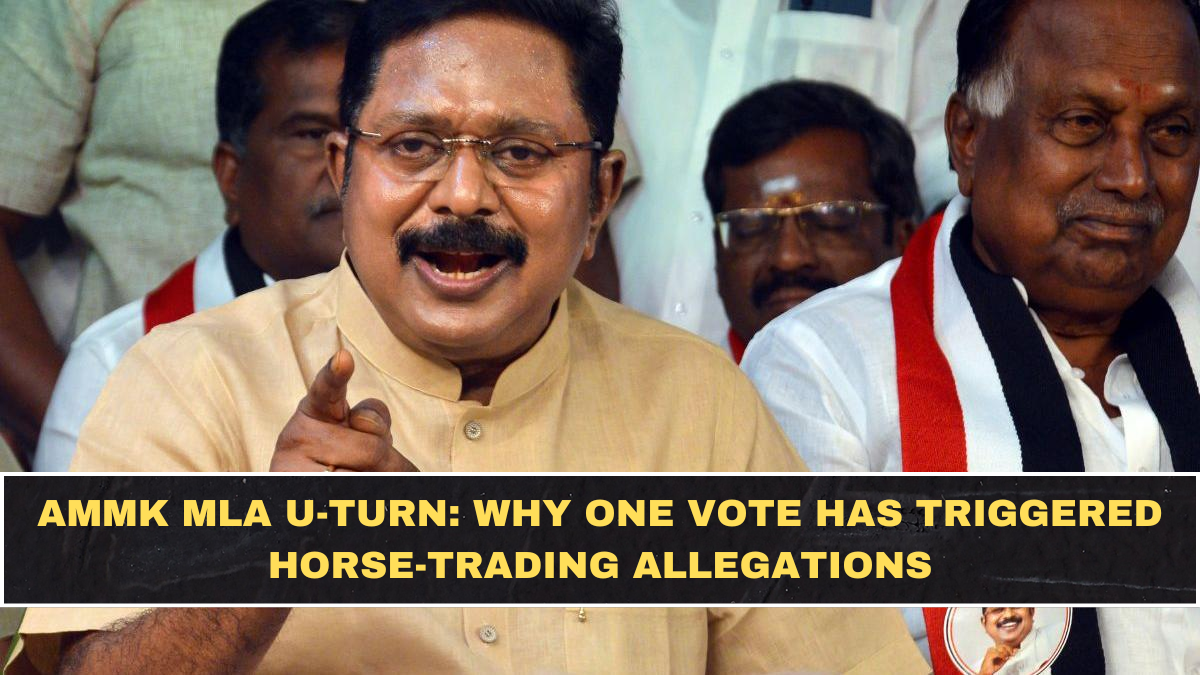
AMMK’s sole MLA S. Kamaraj has become the centre of Tamil Nadu’s latest political storm after publicly extending support to Vijay’s TVK government. The twist is that Kamaraj had earlier denied signing a support letter and claimed that the document was forged. His later declaration in favour of TVK created a dramatic U-turn that immediately raised questions about pressure, loyalty and political bargaining.
This is not just about one MLA changing sides. In a tight political environment, even a single legislator can become symbolically powerful. Kamaraj’s move came around the same time Vijay’s government was trying to prove strength in the Assembly, so the support looked politically valuable and controversial at the same time.
What Exactly Happened In The AMMK Row?
According to reports, AMMK chief TTV Dhinakaran had earlier alleged that Kamaraj had gone missing and accused TVK of horse-trading. NDTV reported that Dhinakaran claimed he was unable to contact his MLA and had raised concerns over the alleged support letter. The dispute then escalated when Kamaraj later came out in support of Vijay’s government.
After Kamaraj’s public stand, Dhinakaran expelled him from AMMK. The New Indian Express reported that the expulsion was announced because Kamaraj had acted independently against the party’s official position by supporting TVK in the Assembly. That turned the issue from a rumour-heavy controversy into an open party split.
| Key Point | What Happened? | Why It Matters? |
|---|---|---|
| MLA involved | S. Kamaraj | AMMK’s sole MLA |
| Earlier claim | Support letter allegedly denied | Raised forgery questions |
| Later action | Kamaraj backed TVK | Created political U-turn |
| AMMK response | Expelled by TTV Dhinakaran | Party discipline broke publicly |
| Main allegation | Horse-trading charge | Turned support into scandal |
Why Is TTV Dhinakaran Calling It Betrayal?
Dhinakaran’s anger is not difficult to understand. If a party has only one MLA, that MLA is not just a number; he is the party’s entire Assembly presence. When that legislator backs a rival government against the party’s line, it damages both political strength and public image. That is why the expulsion was framed as a discipline issue, not just a personal disagreement.
The Economic Times reported that Dhinakaran called Kamaraj’s move a betrayal of party workers and voters, and removed him from party posts and primary membership. This language matters because it shows AMMK wants to control the narrative before TVK turns the support into a legitimacy boost.
Did This Help Vijay’s TVK Government?
Yes, politically it helped Vijay, even if the number itself may not be huge. TVK’s larger floor-test win was already shaped by support beyond its own core strength, including cross-voting and outside support. ThePrint reported that AIADMK cross-voting helped push TVK’s Assembly tally to 144 amid wider allegations of horse-trading.
Kamaraj’s backing added to the same narrative: Vijay is pulling support from rival camps. That is powerful optics for a new government, but it also carries risk. If every support shift is seen as pressure politics or deal-making, TVK’s majority can start looking less like public mandate and more like political engineering.
What Are The Bigger Political Risks?
This episode is dangerous because it gives every side a weapon. TVK can claim that MLAs are supporting Vijay because they trust his leadership and youth appeal. AMMK can claim betrayal and horse-trading. Opposition parties can use the drama to question the moral basis of the new government’s majority.
The immediate risks are clear:
- AMMK may continue attacking TVK over political ethics
- Kamaraj may face pressure over loyalty and credibility
- TVK may be accused of building support through opportunism
- Rival parties may demand closer scrutiny of support letters
- The floor-test victory may stay surrounded by controversy
- Voters may start questioning whether mandate or management is driving politics
Is This Just One MLA Or A Bigger Warning?
Calling this a small issue would be naïve. One MLA does not change the entire state by himself, but his move exposes how fluid Tamil Nadu politics has become after Vijay’s rise. Parties that looked stable are suddenly dealing with defections, cross-voting, abstentions and public discipline battles.
The brutal truth is that Vijay’s entry has made old parties nervous, but TVK also needs to be careful. If the party becomes known for attracting rebels instead of delivering governance, the excitement around “new politics” can quickly turn into cynicism. Numbers win floor tests, but credibility wins long-term power.
What Is The Conclusion?
The AMMK MLA U-turn has become explosive because it combines everything voters distrust in politics: sudden loyalty shifts, forged-letter claims, horse-trading allegations and quick expulsions. Kamaraj’s support strengthened Vijay’s side, but it also gave opponents a fresh reason to question how TVK is building power.
For AMMK, losing its sole MLA’s loyalty is a serious humiliation. For TVK, the support is useful but politically risky. Vijay’s government now has to prove that its majority is not just a collection of angry rebels and tactical defectors, but a stable platform capable of governing Tamil Nadu seriously.
FAQs?
Who Is S. Kamaraj?
S. Kamaraj is AMMK’s sole MLA who publicly extended support to Vijay’s TVK government. His move became controversial because he had earlier denied signing a support letter and later changed his stand in favour of TVK.
Why Did AMMK Expel Kamaraj?
AMMK expelled Kamaraj because he supported TVK in the Assembly against the party’s official stand. TTV Dhinakaran described the move as a betrayal of party workers and voters.
What Is The Horse-Trading Allegation?
The horse-trading allegation refers to Dhinakaran’s claim that TVK was trying to influence or secure support from his MLA through questionable political methods. TVK’s side has benefited from the support, but the allegation keeps the issue politically sensitive.
Did Kamaraj’s Support Change Tamil Nadu Politics?
By itself, one MLA may not change everything, but the episode shows how unstable the post-election political environment has become. It adds to the wider story of rebel voting, party splits and Vijay’s TVK pulling support from rival camps.