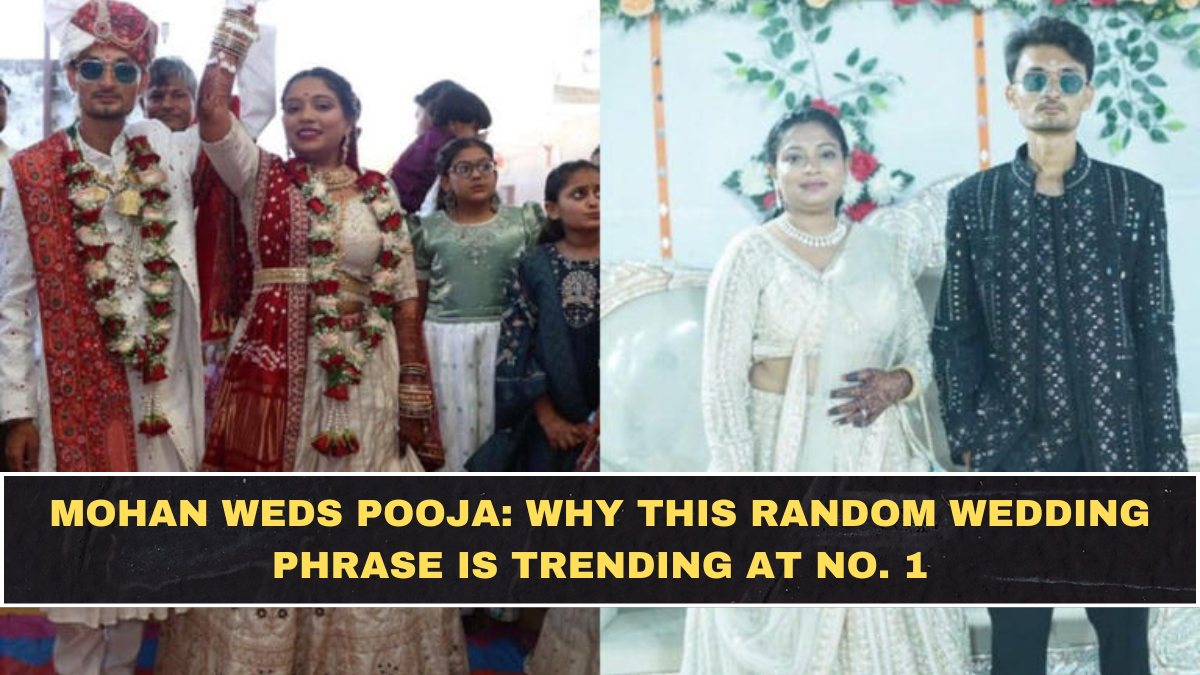
“Mohan Weds Pooja” suddenly became one of the strangest viral phrases on X, leaving users confused about why a simple wedding-style line was trending at the top. The phrase looked ordinary, almost like a wedding card title, but its unexplained rise made people curious. Times of India reported that the phrase had been trending at No. 1 on X over the past two days, with users questioning its origin and backstory.
The reason this trend worked is brutally simple: the internet loves confusion when it feels harmless, funny and easy to join. Nobody needed deep context to participate. People could post memes, jokes, fake theories and reactions around the phrase without knowing who Mohan or Pooja actually were.

What Made This Phrase Go Viral?
| Viral Factor | Why It Worked | User Reaction |
|---|---|---|
| Simple wording | Easy to read and repeat | Users copied it quickly |
| Wedding emotion | Feels familiar in India | Curiosity increased fast |
| No clear context | Mystery made it clickable | People started guessing |
| Meme potential | Easy to joke about | Funny posts multiplied |
| Trend ranking | No. 1 position created FOMO | More users searched it |
| Possible campaign angle | Some suspected marketing | Debate became louder |
The phrase became viral because it had just enough information to attract attention but not enough to satisfy curiosity. That gap is the fuel of modern social media. When people do not know the answer, they keep searching, reposting and asking the same question, which pushes the trend even higher.
Is It A Real Wedding Or A Meme?
That is the main question, and the answer is still not completely clean. Some reports described it as a mysterious trend without a clear confirmed origin, while others claimed it involved a real couple and a grand wedding story. Asianet Newsable reported that the hashtag became a top trend on X and linked the story to Mohan, described as a Delhi-based software expert, and Pooja, described as a Mumbai-based fashion professional.
But readers should be careful here. Viral stories often get decorated after they become popular, and not every romantic backstory published online is automatically verified. The safest position is this: “Mohan Weds Pooja” is definitely a viral X trend, but its exact origin still needs stronger confirmation before treating every claimed detail as fact.
Why Did Users Get So Curious?
People became curious because the phrase felt too random to be accidental and too normal to be ignored. A phrase like “Mohan Weds Pooja” does not look like a political hashtag, celebrity scandal, cricket trend or breaking news headline. That made users wonder whether it was a real wedding, a marketing stunt, a meme campaign or a social media experiment.
This is how viral curiosity works. When a trend gives users an unanswered question, they become part of the distribution engine. Every “Who are they?” post becomes free promotion. Every joke pushes the phrase further. Every confused reaction tells the algorithm that people are still engaging.
Why Do Random Trends Explode On X?
Random trends explode on X because the platform rewards speed, repetition and participation. If thousands of users post the same phrase within a short period, it can climb quickly even without a serious story behind it. Once it reaches the trending panel, more people see it, search it and add their own posts.
This creates a loop:
- A phrase starts appearing repeatedly.
- Users notice it and ask what it means.
- Meme pages and creators jump in.
- News sites cover the confusion.
- More users search the phrase.
- The trend becomes bigger than the original reason.
The uncomfortable truth is that many viral trends do not need meaning at the start. They get meaning later because people keep talking about them. “Mohan Weds Pooja” appears to fit that pattern perfectly.
Could This Be A Marketing Trick?
It could be, but there is no strong public proof yet that the trend was definitely a planned marketing campaign. Some users suspected a promotional stunt because the phrase rose so fast and had a neat, repeatable format. That suspicion is natural because brands, influencers and digital strategists often use curiosity-based trends to attract attention.
Still, calling it a confirmed marketing campaign would be premature. The smarter framing is that it has the structure of a possible viral campaign: simple phrase, emotional hook, mystery, repetition and meme value. Whether it started organically or was pushed strategically, it succeeded because people could not stop asking what it meant.
Conclusion?
“Mohan Weds Pooja” became viral because it turned a basic wedding phrase into an internet mystery. The trend had no obvious explanation at first, and that lack of clarity made people even more curious. Some reports suggest a couple-based backstory, while others treat it mainly as a strange X trend that users are still trying to decode.
The real lesson is not about Mohan or Pooja alone. It is about how easily the internet can turn confusion into traffic. A simple phrase, repeated enough times, can become a national conversation if it gives people one strong reason to click: “What is this?”
FAQs?
Why Is Mohan Weds Pooja Trending On X?
“Mohan Weds Pooja” is trending because users saw the phrase repeatedly on X without a clear explanation. Its mystery, wedding-style wording and meme potential pushed more people to search and post about it.
Is Mohan Weds Pooja A Real Wedding?
Some reports have linked the trend to a possible real couple, while others describe it mainly as a mysterious viral phrase. Until stronger verification appears, it is better to treat the exact backstory carefully.
Is Mohan Weds Pooja A Marketing Campaign?
There is no confirmed proof that it is a marketing campaign. However, the phrase has the style of a curiosity-driven viral trend, which is why many users suspect it may have been planned or amplified strategically.
Why Do Such Random Trends Go Viral?
Random trends go viral because people join the conversation before fully understanding it. The mystery itself becomes the hook, and every confused post helps the algorithm push the phrase to more users.