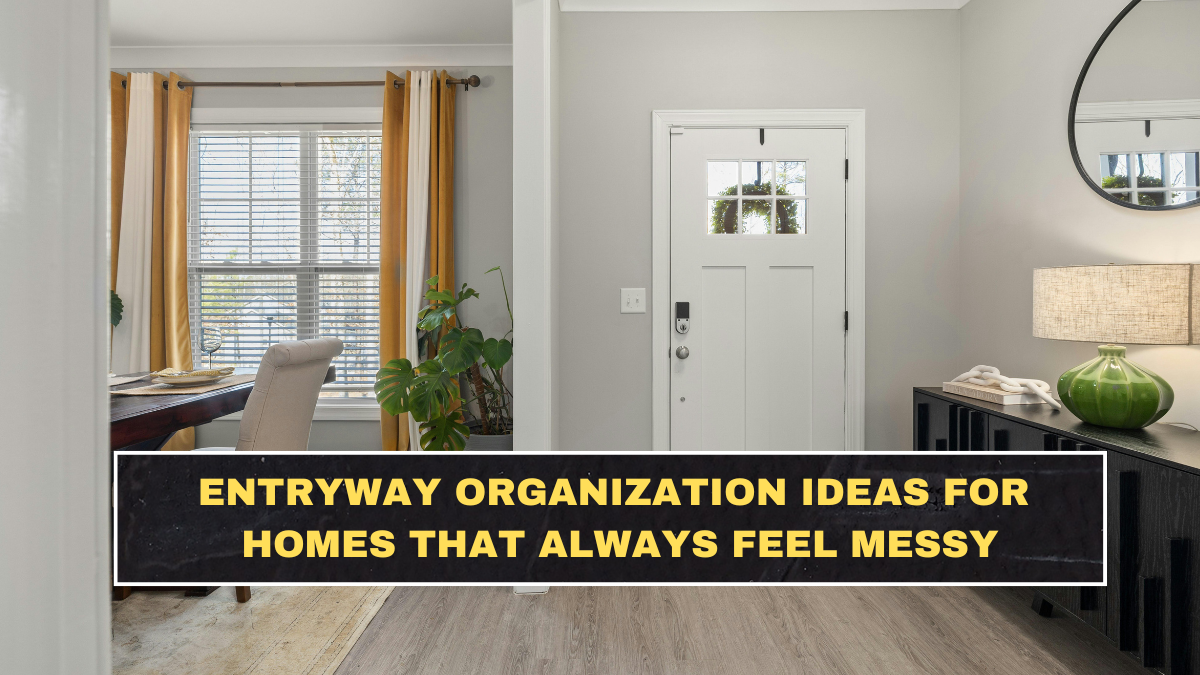
Entryways feel messy for a simple reason: too many daily-use items land there without a defined system. Shoes pile up, bags get dropped, keys disappear, and mail starts acting like decor. The fix is not buying random storage pieces and hoping for the best. The fix is building a small drop zone that matches what actually enters and exits the house every day. Recent organizing advice from Good Housekeeping and Real Simple keeps circling the same solutions: hooks, benches, baskets, contained shoe storage, and limits on what is allowed to stay in the entry at all.
There is also a real quality-of-life reason to care. A 2025 health explainer from Nuvance Health notes that disorganized environments can overwhelm the brain, impair focus, and increase anxiety and stress. A 2025 peer-reviewed study summary indexed on ScienceDirect also reports that home clutter is associated with lower well-being and more negative feelings. So an entryway that constantly looks chaotic is not just visually annoying. It can make the whole house feel more mentally noisy.
Why do entryways get messy faster than other parts of the house?
Because the entryway is a transition zone, not a destination room. Everything passes through it, and that makes it vulnerable to “temporary” clutter that becomes permanent. Real Simple says professional organizers recommend keeping only daily-use essentials there, such as frequently worn shoes, keys, and one bag per person, while moving off-season or rarely used items elsewhere. Good Housekeeping’s recent organizer advice says the same thing more bluntly: remove out-of-season gear, extra shoes, packaging, and mail buildup, because those items quickly turn a functional entry into a clutter trap.
A second reason is that most entryways are too small for the amount of stuff people expect them to hold. That is why compact-storage guidance matters more here than in other rooms. Houzz’s recent small-entryway coverage highlights hardworking features like benches, cubbies, hooks, baskets, and closed storage for off-season items, while Good Housekeeping points out that even a small corner can function as a drop zone if storage is layered well. The lesson is obvious: the space does not need to hold everything. It needs to hold the right things well.
What should every organized entryway include?
Most homes need five basics: a place for shoes, a place for coats and bags, a place for keys and small daily items, a place to sit if possible, and a hard rule about what does not belong there. Without those basics, the entryway becomes a dumping ground. Houzz’s 2025 entryway roundup repeatedly features combinations of a bench, hooks, cubbies, basket storage, and cabinets because that setup handles the most common clutter categories without wasting floor space.
The biggest blind spot is shoe storage. People act like shoes are harmless visual clutter, but they are usually the first thing making the entryway feel chaotic and cramped. Recent small-space organizing coverage from Real Simple and Homes & Gardens both emphasize containing shoes rather than letting them live loose on the floor. That means a narrow rack, shoe cabinet, cubby bench, or a strict “daily pairs only” rule near the door.
| Entryway problem | Smart fix | Why it works |
|---|---|---|
| Shoes all over the floor | Narrow shoe rack, cabinet, or bench cubbies | Clears walking space and reduces visual clutter |
| Bags and coats on chairs | Wall hooks or a hook rail | Uses vertical space instead of floor space |
| Lost keys and sunglasses | Small tray, bowl, or drawer | Creates one repeatable landing spot |
| Mail piles building up | Tiny command center or sorting tray | Stops paper from spreading |
| No place to sit | Storage bench | Adds function and hidden storage in one piece |
Which small-space entryway ideas work best?
Vertical storage is usually the smartest move. Hooks, narrow shelving, floating cabinets, and wall-mounted organizers do more than bulky furniture in tight spaces. Real Simple’s small-entryway organizer roundup specifically recommends using vertical space, and Good Housekeeping notes that even compact entries can work if you combine hooks, trays, benches, or slim storage pieces instead of filling the floor with random baskets.
A bench is worth considering only if it earns its footprint. That means it should either provide hidden storage, open cubbies underneath, or both. Homes & Gardens recently highlighted a storage bench precisely because it keeps shoes and everyday items contained while maintaining a clear floor policy in small, clutter-prone entryways. That is the right mindset. Furniture in a small entry should solve at least two problems, not just look nice for five minutes.
How should you handle shoes, bags, and mail without constant mess?
You need limits, not just storage. Real Simple says rarely used shoes, extra bags, spare keys, and piles of mail should not live in the entryway at all. Good Housekeeping adds that duplicate shoes, packaging, and out-of-season items should be removed so the space stays aligned with current daily use. So the brutal truth is this: if your entryway is always messy, the issue may not be lack of organization. It may be that you are storing too much of the wrong stuff at the door.
A good rule is one current-use bag per person, one hook per person, and only the shoes worn most often in that season. Everything else should move to a closet, bedroom, or secondary storage zone. Mail should go into a tray or sorter and be cleared regularly, not allowed to become a paper drift. Good Housekeeping specifically mentions trays, bowls, and baskets for daily essentials, and also points to command-station setups for paper and grab-and-go items.
What mistakes make entryway organization fail?
The biggest mistake is trying to make the entryway hold the whole household. The second is using open storage for everything, which often turns into visible clutter instead of controlled clutter. Houzz’s compact-entryway coverage repeatedly shows a mix of open and closed storage for a reason: open hooks and cubbies are useful for daily grab-and-go items, while closed cabinets hide overflow and off-season gear.
Another mistake is treating organization as a one-time setup instead of a usage rule. If every family member drops five random items near the door every day, no storage product will save the space. Real Simple’s organizer guidance is clear that designated homes, limits, and quick regular resets are what keep entryways functional over time.
Conclusion
The best entryway organization ideas are not complicated. They are specific. Contain shoes, use hooks, create one drop zone for keys and mail, keep only current-use items near the door, and stop forcing the entryway to store things that belong somewhere else. When the setup matches how people actually come and go, the whole house feels calmer. When it does not, the mess keeps winning.
FAQs
What is the most important thing to organize in an entryway?
Usually shoes. Loose shoes create visual clutter and eat up walking space faster than almost anything else in an entryway. Contained shoe storage is one of the most repeated recommendations in current organizing advice.
What should not be stored in an entryway?
Real Simple says rarely used shoes, out-of-season outerwear, extra bags, spare keys, and mail piles are some of the worst offenders because they make the space feel chaotic without helping daily routines.
Do small entryways need furniture?
Not always. In very tight spaces, hooks, narrow wall storage, and a tray may work better than bulky furniture. Good Housekeeping notes that even a tiny corner can function as a useful drop zone.
Can an organized entryway reduce stress?
It can help. Health and research sources indicate that cluttered home environments are associated with higher stress, more negative feelings, and reduced focus, so reducing chaos at the door can make the home feel calmer overall.