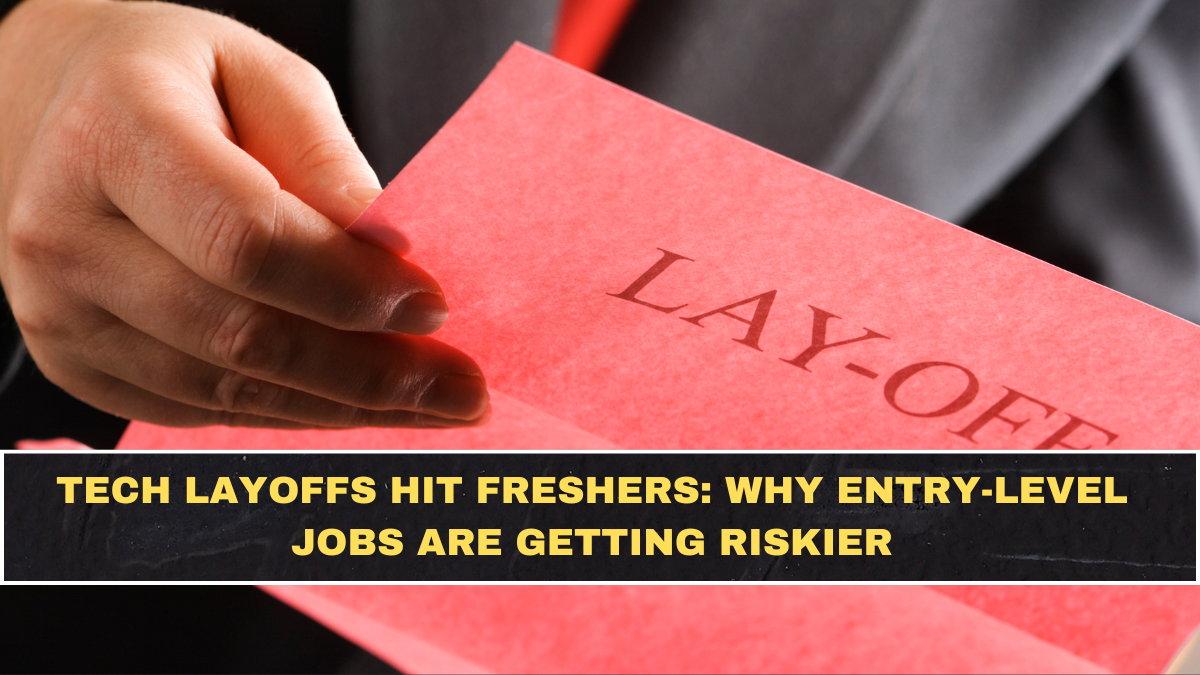
Tech layoffs are no longer hurting only experienced employees. Freshers are now feeling the pressure through delayed joining dates, reduced campus hiring, fewer entry-level roles and even revoked offers. The recent Oracle offer-revocation reports involving IIT and NIT students have made this fear real for many final-year engineering candidates.
The bigger problem is that freshers usually have the weakest bargaining power in the job market. They do not have years of experience, strong referral networks or multiple fallback options. When companies cut costs or restructure teams, entry-level hiring often becomes one of the first areas to slow down.
Why Are Freshers Getting Hit Now?
The tech industry is going through a tough reset where companies want leaner teams, faster output and more AI-supported productivity. Reports around Oracle’s revoked campus offers said the move followed restructuring and cost-cutting, with several IITs and NITs reportedly affected. That kind of decision sends a clear message: even top-campus offers are not completely safe until onboarding is done.
India’s tech hiring also started FY27 on a weak note. India Today reported that active tech job openings fell to around 1.10 lakh in April 2026, down 8% from March, making it one of the weakest starts in six years. For freshers, this means fewer openings, tougher competition and longer waiting periods.
| Problem | How It Hurts Freshers |
|---|---|
| Layoffs | Companies become cautious about new hiring |
| AI adoption | Basic coding and support roles face pressure |
| Revoked offers | Students lose time and backup opportunities |
| Fewer openings | More candidates compete for the same jobs |
| Delayed joining | Freshers stay stuck between college and career |
Is AI Making Entry-Level Jobs Riskier?
AI is not killing every fresher job, but pretending it has no impact is foolish. Companies are now asking whether one experienced employee with AI tools can do work that earlier required multiple junior employees. That directly affects basic coding, testing, documentation and support roles where freshers traditionally entered the industry.
Economic Times reported that over 1 lakh tech jobs had been cut in 2026 while demand remained strong for AI and machine-learning engineers. The signal is obvious: routine tech work is becoming weaker, while specialised AI-linked skills are becoming stronger. Freshers who ignore this shift are walking into the market blind.
What Should Freshers Stop Assuming?
Freshers need to stop assuming that a degree, college tag or campus offer is enough. That mindset is outdated. The market is not rewarding “I am ready to learn” as much as it rewards proof that you can already build, debug, analyse or support real systems.
Freshers should also stop depending only on mass hiring. Large IT hiring cycles are slower, and many companies now prefer candidates who can show project depth, internship output and role-specific skills. If your resume looks like thousands of other fresher resumes, recruiters have no strong reason to choose you.
What Skills Can Reduce Risk?
The safest fresher profile is not the one with the most certificates. It is the one with visible proof of useful work. Recruiters want to see whether you can solve real problems, work with tools and explain your decisions clearly.
Freshers should focus on:
- Building two or three strong projects with live demos or GitHub proof.
- Learning AI tools, prompt workflows and automation for real productivity.
- Strengthening one core track such as backend, data, cloud, cybersecurity or testing.
- Practising interview communication, not just coding questions.
- Creating a LinkedIn profile that clearly shows skills, projects and job targets.
Are There Still Opportunities For Freshers?
Yes, but they are not evenly distributed. Some companies are still hiring fresh graduates, especially for future-ready skills. For example, LTIMindtree reportedly increased fresher hiring by 40% in FY26 while also expanding AI usage internally. This shows that fresher hiring has not disappeared, but expectations are changing fast.
The harsh truth is that average freshers will struggle more. Strong freshers with projects, internships, AI awareness and communication skills will still find opportunities. The market is not closed, but it is less forgiving than before.
Conclusion
Tech layoffs have made entry-level jobs riskier, but not impossible. Freshers who rely only on campus placements, generic resumes and basic coding knowledge are taking a dangerous bet. The job market now expects proof, speed and adaptability from day one.
The best response is not panic. It is preparation. Freshers should keep applying even after getting an offer, build backup options, improve practical skills and stay alert until joining is complete. In today’s tech market, an offer letter is progress, not final security.
FAQs
Are Tech Layoffs Affecting Freshers In India?
Yes, freshers are being affected through fewer entry-level roles, delayed joining dates, reduced campus hiring and revoked offers. They may not always appear in layoff numbers, but hiring slowdowns directly reduce their opportunities.
Is AI The Main Reason Freshers Are Struggling?
AI is one major reason, but not the only one. Cost-cutting, global uncertainty, weak demand and restructuring are also affecting hiring. AI makes the situation harder because companies can automate or reduce some junior-level tasks.
Should Freshers Still Trust Campus Placements?
Campus placements are useful, but freshers should not treat them as guaranteed security. Until onboarding is complete, students should keep networking, applying off campus and improving skills to avoid being trapped by sudden offer changes.
Which Skills Are Best For Freshers In 2026?
Freshers should focus on practical skills in AI tools, backend development, data analytics, cloud, cybersecurity, testing automation and full-stack projects. Certificates help only when they are backed by real projects and clear problem-solving proof.