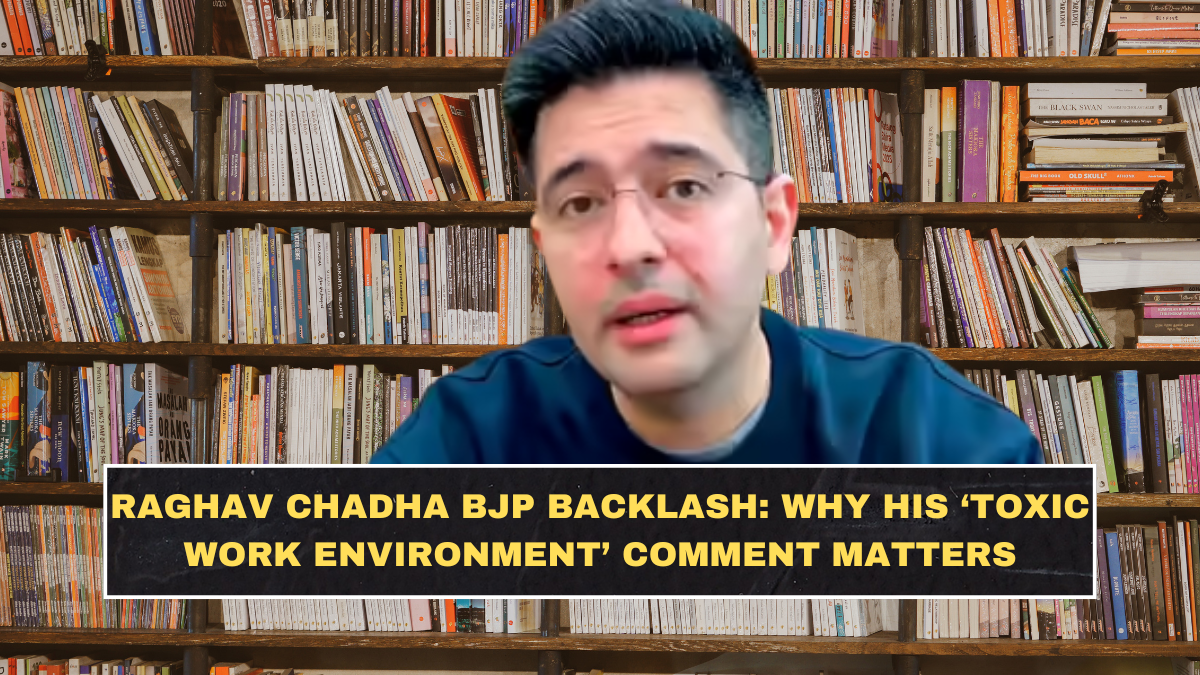
Raghav Chadha is facing backlash after defending his move from the Aam Aadmi Party to the BJP and citing what he described as a “toxic work environment” inside AAP. In a video posted on Instagram on April 27, 2026, he said he had received both congratulatory messages and questions about why he left AAP, and he tried to explain the decision publicly.
The controversy is getting attention because Chadha was not a casual party worker. He was one of AAP’s most visible young leaders, served as a Rajya Sabha MP, and was closely associated with the party’s public image for years. When such a leader leaves and then attacks the party’s internal culture, it naturally becomes more than a personal explanation.
But readers should separate two things clearly. One is Chadha’s claim about AAP’s internal environment. The other is the political value of making that claim after joining BJP. Both can exist at the same time, and both deserve scrutiny.
What Did Raghav Chadha Say About AAP?
Raghav Chadha said in his video that he had not entered politics only to build a career and claimed he gave his prime youth years to AAP. Reports said he described the party’s internal atmosphere as a “toxic work environment” and suggested that his decision came after disappointment with the party’s direction.
NDTV Profit reported that Chadha also alleged that AAP had been captured by “corrupt and compromised people” and argued that the departure of multiple people could not be dismissed as coincidence. That is a serious political charge because it questions not only leadership style but also the moral identity AAP has built since its anti-corruption movement roots.
Still, allegations are allegations unless backed by specific evidence. This is where politicians often get away with vague language. Words like “toxic,” “compromised,” and “corrupt” create strong headlines, but voters deserve details: who, what decisions, what internal processes, and what proof?
Why Does The ‘Toxic Work Environment’ Claim Matter?
The “toxic work environment” claim matters because political parties are also workplaces. They have hierarchies, pressure, internal competition, loyalty tests, burnout, and conflict. When a senior leader uses workplace language to describe a party, it turns a political defection into a discussion about organisational culture.
This also matters because AAP built its brand on clean politics, volunteer energy, and public accountability. If a former senior leader says the environment became unhealthy, it can damage the party’s image among urban voters who were attracted to AAP because it looked different from traditional parties.
| Issue | Why It Matters Politically | What Voters Should Ask |
|---|---|---|
| Toxic work culture claim | Raises questions about internal party functioning | Is there specific evidence? |
| BJP switch | Makes the timing politically sensitive | Is this principle or opportunity? |
| AAP criticism | Challenges AAP’s clean-politics image | How does AAP respond? |
| Public backlash | Shows emotional anger among supporters | Is criticism based on facts or loyalty? |
| Social media video | Controls the narrative directly | Is it explanation or damage control? |
Why Are AAP Supporters Angry?
AAP supporters are angry because they see Chadha’s move as a betrayal, especially given his long association with the party. Times of India reported that AAP workers protested outside his residence in Mumbai’s Khar area and some were detained by police. Protesters reportedly shouted slogans calling him a traitor.
This reaction shows how personal political loyalty can become in India. Many supporters do not see party switching as a normal career decision. They see it as ideological betrayal, especially when a leader moves to a rival party that AAP has fought against for years.
But anger alone is not analysis. Supporters should ask whether Chadha’s claims have substance, and Chadha should be expected to give specifics. Both sides are currently playing emotion: one side says betrayal, the other side says toxic environment. Neither is enough without evidence.
Is This A Political Damage-Control Video?
Yes, it looks partly like damage control. That does not automatically make every claim false, but the timing is hard to ignore. Chadha released the video after backlash over his BJP move, which means the video was clearly meant to explain, defend, and control public perception.
Navbharat Times reported that the video came while his Instagram followers were reportedly dropping quickly, and he said he had only three options before making the decision. This social media angle matters because modern political battles are not fought only in press conferences. They are fought through reels, short videos, follower counts, and emotional framing.
The blunt truth is this: politicians rarely release such videos only for transparency. They release them because they are losing control of the narrative. Chadha may have real grievances, but his video is also a political communication strategy.
What Does This Mean For AAP And BJP?
For AAP, this controversy creates another internal-image problem. The party has already faced pressure from legal cases, leadership challenges, and political attacks. A senior leader publicly calling the environment toxic gives opponents a ready-made talking point.
For BJP, Chadha’s entry and criticism of AAP can be politically useful. A former insider attacking AAP gives BJP a narrative advantage because it can say criticism is coming from someone who knew the party from inside. That is why defections are not only about adding one leader; they are about weakening the opponent’s credibility.
However, BJP also faces a credibility question. If leaders who once strongly opposed BJP suddenly join it, voters may ask whether ideology matters at all. Political switching can benefit parties in the short term, but it also deepens public cynicism about Indian politics.
Conclusion?
Raghav Chadha’s “toxic work environment” comment matters because it has turned a political defection into a debate about party culture, loyalty, opportunism, and internal pressure. His claims are serious, but they need details. AAP supporters’ anger is understandable, but emotional outrage cannot replace factual scrutiny.
The real story is not just that one leader joined BJP. The bigger story is how political parties handle internal dissent, how defectors justify their moves, and how voters are expected to choose between competing narratives. If Chadha wants people to take his claims seriously, he needs specifics. If AAP wants to dismiss him, it needs more than slogans.
FAQs
Why Is Raghav Chadha In The News?
Raghav Chadha is in the news because he released a video defending his move from AAP to BJP and claimed that AAP had a “toxic work environment.” His comments triggered backlash from AAP supporters and political debate.
What Did Raghav Chadha Say About AAP?
He said he left AAP after disappointment with the party’s internal environment and direction. Reports said he described the party culture as toxic and alleged that corrupt or compromised people had influenced the party.
Why Are AAP Workers Protesting Against Him?
AAP workers are protesting because many see his move to BJP as a betrayal after years of association with AAP. Some supporters protested outside his residence and shouted slogans against him.
Why Does This Controversy Matter?
The controversy matters because it raises questions about political loyalty, party culture, internal dissent, and how leaders justify switching sides. It also gives both AAP and BJP a new political narrative to use against each other.