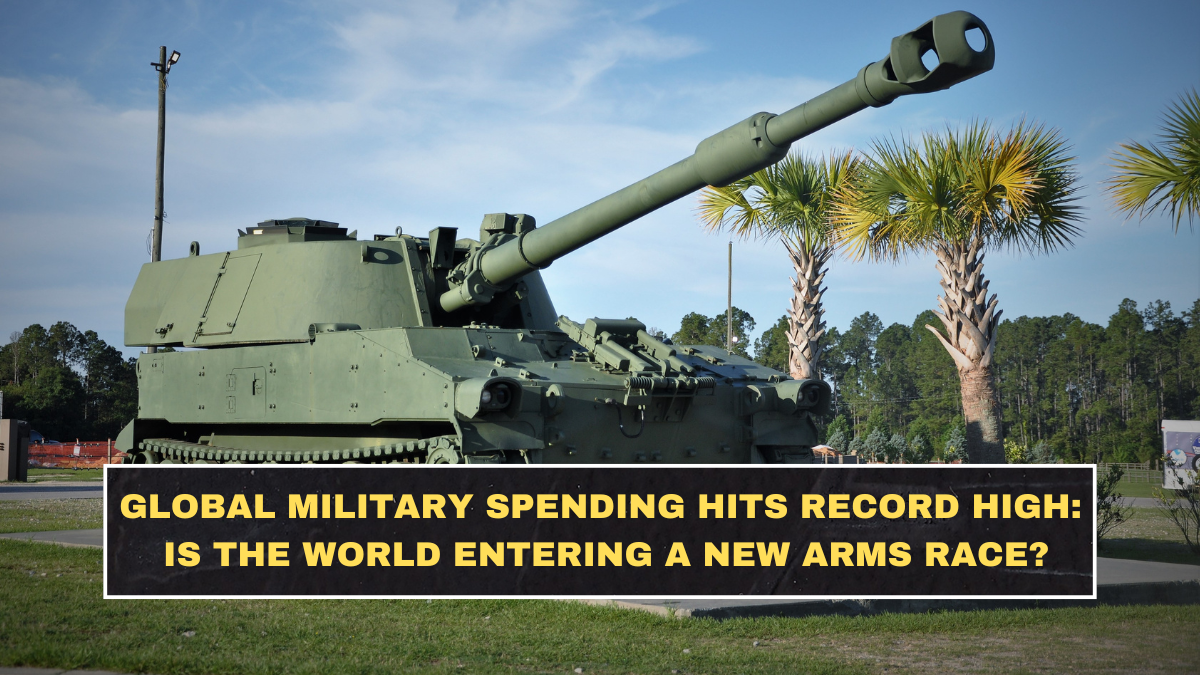
Global military spending reached a record $2.887 trillion in 2025, according to new data from the Stockholm International Peace Research Institute, known as SIPRI. This was a 2.9% real-terms increase from 2024 and marked the 11th consecutive year of rising military expenditure. The number is huge, but the trend is even more important: governments are no longer treating defence as a secondary budget issue.
The rise is being driven by war fears, regional rivalries, NATO pressure, Russia’s war in Ukraine, China’s military modernisation, Taiwan Strait tensions, and new defence spending across Asia and Europe. SIPRI also reported that global military spending has increased by 41% over the past decade, which shows this is not a one-year panic. It is a long-term shift toward a more militarised world.
Which Countries Are Spending The Most On Defence?
The biggest military spenders are still led by the United States, China, and Russia. SIPRI said the top three countries spent a combined $1.48 trillion, or 51% of total global military spending. That means more than half of the world’s military expenditure is concentrated in only three countries, which tells you where the real strategic power sits.
The top five spenders were the United States, China, Russia, Germany, and India. India became the world’s fifth-largest military spender in 2025, with spending rising 8.9% to $92.1 billion. China spent $336 billion, continuing its long military modernisation drive, while Russia remained heavily committed due to the war in Ukraine.
| Rank / Region | 2025 Military Spending Detail | Why It Matters |
|---|---|---|
| Global total | $2.887 trillion | Record high worldwide spending |
| United States | $954 billion | Still the largest spender |
| China | $336 billion | 31st straight year of increase |
| Europe | $864 billion | 14% annual rise |
| Asia & Oceania | $681 billion | 8.1% annual rise |
| India | $92.1 billion | 5th largest spender globally |
Why Is Europe Rearming So Fast?
Europe’s defence spending rose sharply because the Russia-Ukraine war has changed the continent’s security mindset. SIPRI reported that total military spending in Europe reached $864 billion in 2025, a 14% increase from 2024. Even more striking, European military spending has doubled over the decade from 2016 to 2025.
This is not just about Ukraine. European governments are worried about long-term Russian aggression, NATO readiness, ammunition shortages, air defence gaps, cyber threats, and dependence on the United States. Germany’s rise into the top five global spenders is especially symbolic because Europe’s largest economy is now moving much more aggressively on defence after years of hesitation.
Why Is Asia Also Increasing Military Budgets?
Asia and Oceania recorded $681 billion in military spending in 2025, up 8.1% from the previous year. SIPRI said this was the region’s largest annual rise since 2009. China’s rise is the biggest factor, but not the only one. Japan, Taiwan, India, Pakistan, South Korea, and Australia are all reacting to a more tense regional environment.
China increased spending by 7.4% to $336 billion, marking its 31st consecutive annual rise. Japan’s spending rose 9.7% to $62.2 billion, while Taiwan’s rose 14% to $18.2 billion, its largest annual increase since at least 1988. India’s spending also jumped, while Pakistan increased spending by 11% to $11.9 billion after renewed India-Pakistan tensions.
Is This Really A New Global Arms Race?
Yes, but not in the old Cold War style. This is not just two superpowers building weapons against each other. It is a multi-region arms race where several countries are increasing spending for different reasons. Europe is reacting to Russia. Asia is reacting to China, Taiwan tensions, North Korea, and India-Pakistan rivalry. The Middle East is reacting to Israel-Iran tensions and wider regional instability.
That makes the current arms race more complex and more dangerous. When many regions militarise at once, the risk of miscalculation rises. More missiles, drones, air defence systems, ships, submarines, and cyber tools do not automatically create security. Sometimes they create confidence, and confidence can make leaders more willing to take risks.
Why Did US Military Spending Fall In 2025?
One surprising detail is that US military spending declined in 2025. Reuters reported that US expenditure fell 7.5% to $954 billion, partly linked to President Donald Trump’s freeze on approving new military aid to Ukraine. Even after that fall, the US remained by far the world’s biggest military spender.
This decline should not be overread. The US still spends far more than any other country, and Reuters noted that US spending is expected to rise again, with 2026 expenditure likely moving above $1 trillion after congressional approval. So the bigger trend is not American retreat. It is a temporary dip inside a much larger defence machine.
What Does Rising Military Spending Mean For Ordinary People?
Rising defence spending affects ordinary people because government budgets are not unlimited. Money spent on weapons, ammunition, aircraft, ships, and military technology can mean less fiscal space for healthcare, education, housing, climate adaptation, or public welfare. That does not mean defence spending is always wrong, but it does mean citizens should ask what they are getting in return.
There is also an economic angle. Defence spending can create jobs and support advanced manufacturing, but it can also deepen global insecurity if countries begin treating military strength as the main solution to political problems. The danger is that governments normalise permanent emergency spending while avoiding the harder work of diplomacy, conflict prevention, and regional trust-building.
Could Higher Defence Spending Make The World Safer?
It can, but only in limited cases. For countries facing real threats, stronger defence can deter aggression. Ukraine’s experience has convinced many European governments that weak military readiness invites danger. Taiwan, Japan, and India also argue that military investment is necessary because the regional security environment is worsening.
But here is the uncomfortable part: every country says its own spending is defensive. Russia says it is defending itself. China says it is protecting sovereignty. NATO says it is deterring Russia. Iran, Israel, India, Pakistan, and North Korea all use security language. When everyone describes their own build-up as defensive and everyone else’s build-up as threatening, an arms race becomes self-feeding.
Conclusion
The world spent $2.887 trillion on the military in 2025, and that number should make people pause. Europe is rearming at record speed, Asia is accelerating, NATO spending is rising, and major powers are putting security above almost everything else. SIPRI’s data does not just show higher defence budgets. It shows a world losing confidence in peace as a stable default.
The blunt truth is that countries are preparing for a harsher world because they do not trust diplomacy to protect them anymore. Some of that fear is rational. Some of it is dangerous. If this trend continues, the world may not need one official arms race. It may already be living inside several at once.
FAQs
Why did global military spending reach a record high in 2025?
Global military spending reached a record high because of war fears, Russia-Ukraine tensions, China’s military modernisation, NATO rearmament, Taiwan Strait concerns, and rising defence budgets across Asia and Europe.
How much did the world spend on the military in 2025?
According to SIPRI, world military expenditure reached $2.887 trillion in 2025, a 2.9% real-terms increase from 2024 and the 11th consecutive year of growth.
Which country spends the most on defence?
The United States remains the world’s largest military spender, with spending of about $954 billion in 2025. China ranked second with $336 billion, followed by Russia, Germany, and India.
Is the world entering a new arms race?
The data strongly suggests a new type of arms race is already underway. It is not only between the US and China, but also across Europe, Asia, the Middle East, and other regions facing growing security fears.