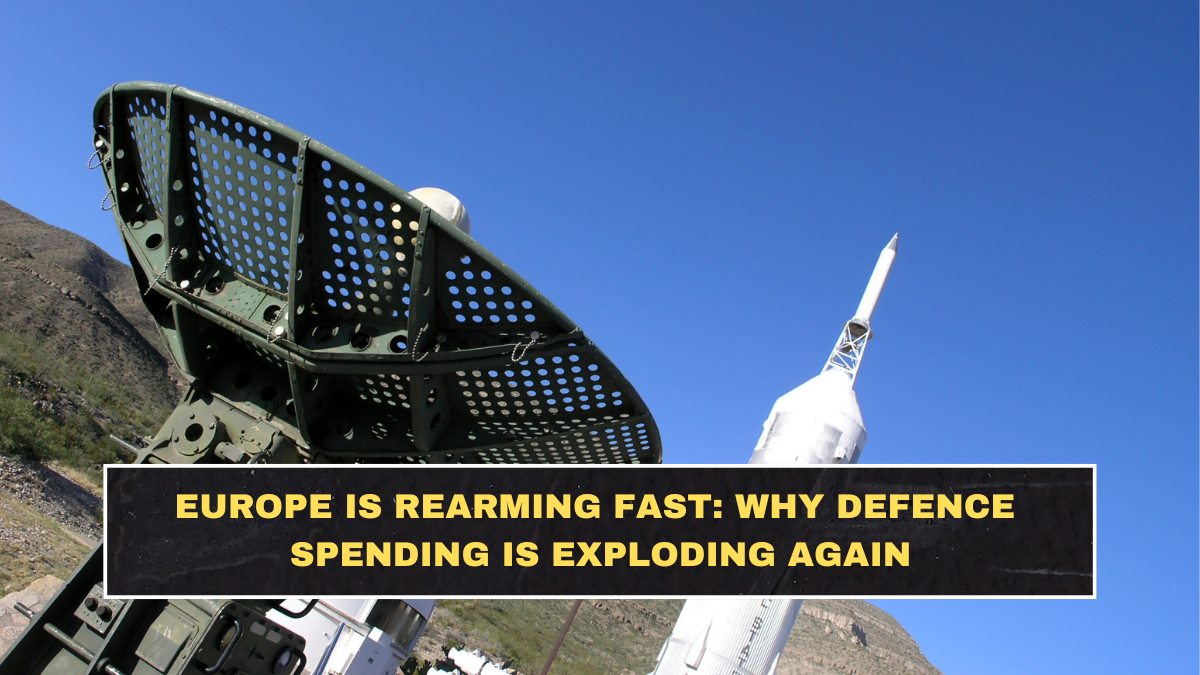
Europe is rearming because the continent no longer believes peace can be protected cheaply. Russia’s war in Ukraine, fears about future Russian aggression, pressure inside NATO, and uncertainty over long-term US security guarantees have pushed European governments into a new military spending cycle. This is not a temporary budget adjustment. It is a major shift in how Europe sees its own survival.
According to SIPRI, Europe’s military spending reached $864 billion in 2025, rising 14% in real terms from 2024. SIPRI also said European military spending has doubled over the decade from 2016 to 2025. That is the clearest proof that Europe’s rearmament is not just political talk; it is already showing up in national budgets, procurement plans, troop targets, and weapons imports.
What Is Driving Europe’s Rearmament?
The biggest driver is Russia. European governments watched Russia invade Ukraine, absorb huge battlefield losses, and still continue the war. That changed the security calculation for countries on NATO’s eastern flank, especially Poland, Finland, the Baltic states, Romania, and others close to Russia or Belarus. For them, higher defence spending is not an abstract policy debate. It is preparation for a possible future threat.
A second driver is doubt about America. European leaders know the United States remains NATO’s military backbone, but recent tensions with Washington have forced Europe to ask an uncomfortable question: what happens if US support becomes less reliable? SIPRI has previously noted that concerns about possible US disengagement have helped drive rapid spending increases among European NATO members.
| Key Factor | What It Means For Europe |
|---|---|
| Russia-Ukraine war | Europe sees conventional war as possible again |
| NATO pressure | Members are being pushed to spend more |
| US uncertainty | Europe wants less dependence on Washington |
| Ammunition shortages | Ukraine exposed weak stockpiles |
| Defence industry gaps | Europe needs faster weapons production |
| Eastern flank fears | Border states want stronger deterrence |
Which European Countries Are Moving Fastest?
Germany, Finland, Poland, the Baltic states, and Nordic countries are among the most visible movers. Germany has become especially important because it is Europe’s largest economy and wants to become a much stronger conventional military power. Reuters reported that Germany has unveiled a new military strategy while keeping a target of 260,000 active personnel and a broader force goal of 460,000, including reservists.
Finland is another clear example. Reuters reported that Finland plans to raise defence spending to 3.2% of GDP by 2030, despite austerity pressure at home. This is not symbolic spending. Finland is looking at recruitment, reservist training, drone defence systems, and explosives production after joining NATO in 2023 following Russia’s invasion of Ukraine.
Why Did Ukraine Expose Europe’s Weakness?
Ukraine exposed Europe’s weakness because modern war burns through ammunition, drones, air defence missiles, artillery shells, spare parts, and logistics capacity at shocking speed. Many European countries had capable armies on paper, but limited stockpiles and slow production lines. The war showed that buying advanced weapons is not enough if countries cannot replace them quickly.
This is why Europe’s defence conversation has shifted from “how much do we spend?” to “what can we actually produce?” A country may announce billions in defence funding, but if factories cannot deliver shells, missiles, drones, and armoured vehicles fast enough, the money does not immediately become military strength. That is the blind spot many politicians avoided for years.
Is Europe Becoming Less Dependent On The US?
Europe wants to become less dependent on the US, but it is not there yet. NATO still relies heavily on American intelligence, airlift, missile defence, nuclear deterrence, advanced aircraft, and command systems. That means Europe can increase spending sharply and still remain dependent on Washington for critical capabilities.
SIPRI reported that European NATO members’ arms imports grew strongly in recent years, with the United States supplying 58% of those imports in 2021–25. That is awkward for Europe’s strategic autonomy argument. Europe says it wants more independence, but much of its rearmament still depends on American weapons, systems, and supply chains.
What Role Is NATO Playing In This Spending Surge?
NATO is both the pressure machine and the security umbrella. European countries are spending more because NATO’s threat assessment has become darker, but also because allies are under pressure to meet higher defence commitments. The old 2% of GDP target is no longer seen as enough by many governments, especially after years of underinvestment.
Reuters reported that NATO allies agreed in 2025 to raise their collective spending goal to 5% of output over the next decade, citing Russia’s long-term threat and the need to strengthen both military and civil resilience. That target is politically difficult, but it shows how far the debate has moved. A decade ago, many European governments struggled to justify 2%. Now the argument is shifting toward much higher levels.
Could Rearmament Damage Europe’s Economy?
Yes, and pretending otherwise is dishonest. Defence spending has to come from somewhere. If governments spend much more on weapons, they may face harder choices on healthcare, pensions, social support, infrastructure, debt, and taxes. Finland’s case already shows the tension, with higher defence spending coming alongside austerity pressure and public-finance concerns.
But the opposite argument is also real. If Europe underinvests in defence and faces a larger war later, the economic cost could be far worse. This is the uncomfortable trade-off: rearmament is expensive, but military weakness can be even more expensive. The serious debate is not whether defence costs money. It is whether Europe can spend wisely instead of throwing money at slow, fragmented, politically protected defence systems.
Is Europe Entering A New Arms Race?
Yes, Europe is entering a new arms race, but not the simple Cold War version. This is a capability race driven by Russia, NATO commitments, drone warfare, missile defence, cyber threats, and uncertainty about US protection. The danger is not only higher spending. The danger is that every country starts preparing for worst-case scenarios, making the whole region feel less secure.
Russia claims Europe’s rearmament is provocative, while European governments argue it is defensive. That is exactly how arms races become self-feeding. Each side says it is protecting itself. Each side sees the other’s spending as proof of danger. The result is more weapons, more suspicion, and less room for diplomatic trust.
Conclusion
Europe’s defence spending is exploding because the continent has woken up late to a harsh reality: security cannot be outsourced forever. Russia’s war in Ukraine, uncertainty over US reliability, weak ammunition stockpiles, and NATO pressure have forced European governments to spend more and move faster. The numbers prove it, with European military expenditure reaching $864 billion in 2025 and doubling over the past decade.
The blunt truth is that Europe is not rearming because it suddenly loves military spending. It is rearming because its old assumptions collapsed. The real test now is whether Europe can turn bigger budgets into real capability without wrecking public finances or deepening the arms-race cycle it is trying to survive.
FAQs
Why is Europe increasing defence spending so quickly?
Europe is increasing defence spending because Russia’s war in Ukraine has changed threat perceptions across the continent. NATO pressure, ammunition shortages, and doubts about long-term US reliability have also pushed governments to invest more heavily in defence.
How much did Europe spend on defence in 2025?
SIPRI data shows that Europe’s military spending reached about $864 billion in 2025, a 14% real-terms increase from 2024. European military spending has also doubled over the decade from 2016 to 2025.
Which countries are rearming fastest in Europe?
Germany, Finland, Poland, the Baltic states, and Nordic countries are among the most visible rearmament cases. Germany is expanding its military strategy, while Finland plans to raise defence spending to 3.2% of GDP by 2030.
Is European rearmament good or bad?
It depends on execution. Stronger defence can deter aggression, but reckless spending can damage public finances and fuel an arms race. Europe’s real challenge is not just spending more; it is building useful capability quickly and efficiently.