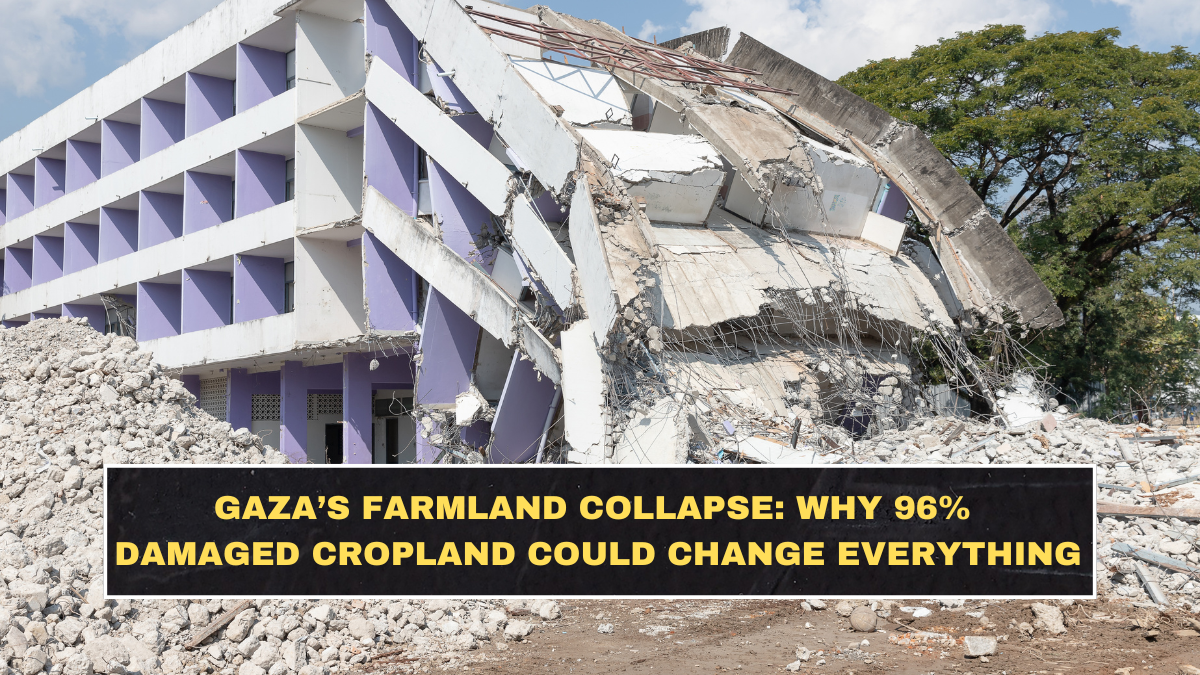
Gaza’s food crisis is no longer only about blocked aid trucks or empty markets. It is now about the destruction of the land that once helped feed people locally. Reports from humanitarian and UN-linked assessments show that almost all of Gaza’s cropland is either damaged, inaccessible, or unusable, which means even a future ceasefire will not automatically restore food security.
Mercy Corps reported that approximately 98% of cropland in Gaza is damaged, inaccessible, or both, while FAO warned in August 2025 that 98.5% of cropland was unavailable for cultivation as famine risks intensified. The user-provided batch mentions 96%, but the stronger recent figures from humanitarian and UN sources show the damage may be even worse. That is not a small data difference; it changes the scale of the disaster.
What Does 96% Or More Damaged Cropland Actually Mean?
When people hear “cropland damaged,” they may imagine a few broken farms. That is far too soft. In Gaza, this means fields have been bombed, bulldozed, contaminated, cut off by military zones, or made unreachable because roads, wells, greenhouses, and irrigation systems have collapsed. A field that technically exists on a map may still be useless if farmers cannot safely reach it.
FAO reported that only 1.5% of Gaza’s cropland remained both undamaged and accessible in its 2025 assessment. That means local food production has been pushed close to total breakdown. Before the war, agriculture was not enough to feed Gaza fully, but it still provided food, income, and survival options for thousands of families. Now even that limited cushion has been crushed.
| Gaza Food System Indicator | What The Data Shows | Why It Matters |
|---|---|---|
| Cropland damaged/inaccessible | About 98% or more | Local farming is almost impossible |
| Cropland still usable | Around 1.5% | Too small to support food recovery |
| Main impact | Food production collapse | Gaza becomes more dependent on aid |
| Infrastructure damage | Wells, greenhouses, roads, irrigation | Farming cannot restart quickly |
| Long-term risk | Famine and livelihood loss | Recovery may take years, not weeks |
Why Is This Worse Than A Short-Term Food Shortage?
A short-term food shortage can improve if aid access opens, markets restart, and supply routes stabilise. Cropland collapse is different because it destroys the local ability to produce food. If Gaza’s farmland, orchards, wells, livestock, and greenhouses are gone, people remain dependent on external aid even after fighting slows down.
That is the real danger here. Food aid can prevent immediate starvation, but it cannot replace an entire agricultural system forever. If farmers lose land, tools, seeds, animals, irrigation, and market access, they lose both food and income. This is how a war turns into a long-term hunger trap where families cannot recover even when headlines move on.
How Did Gaza’s Agriculture Break Down So Badly?
Gaza’s agriculture has been hit from multiple directions. Bombing and ground operations have damaged farmland, orchards, wells, storage sites, greenhouses, and roads. Restricted movement has prevented farmers from reaching their land. Fuel shortages have made irrigation and transport harder. Market collapse has made it difficult to buy seeds, repair equipment, or sell produce.
FAO said food production cannot restart without major improvements in access, safety, investment, and support for local communities. That line matters because it proves the solution is not only “send more food.” Gaza also needs restored farming capacity, safe land access, water systems, livestock recovery, and functioning local markets.
Why Does Cropland Damage Increase Famine Risk?
Famine risk rises when three things happen together: people cannot buy food, aid is not enough, and local production collapses. Gaza is facing all three pressures. When cropland becomes unusable, even families who once grew vegetables, kept animals, or earned money from farming lose one of their last survival systems.
Al Jazeera reported in 2025 that UN agencies warned more than 95% of Gaza’s agricultural land had become unusable, with attacks on land, wells, and greenhouses worsening the famine risk. This shows the crisis is not only about calories entering Gaza today. It is also about whether Gaza can ever feed itself again without total dependence on aid.
Why Should The World Care About Farmland, Not Just Aid Trucks?
Aid trucks matter because people need food immediately. But farmland matters because it decides whether people can rebuild their lives. A society cannot recover if it loses the land, water, animals, and tools that support its food system. If Gaza’s farmland remains unusable, then emergency aid becomes permanent dependence.
There is also a political and humanitarian risk. Food insecurity can deepen displacement, increase disease, weaken children’s development, and destroy family income for years. The collapse of agriculture also makes future reconstruction more expensive because the world will not only need to rebuild homes and hospitals; it will also need to rebuild Gaza’s food economy.
What Will It Take To Restore Gaza’s Food System?
Restoring Gaza’s food system will require far more than a ceasefire announcement. Farmers need safe access to land, cleared roads, functioning wells, seeds, tools, livestock support, greenhouses, fuel, and working markets. They also need confidence that rebuilt farms will not be destroyed again. Without that, people cannot seriously invest in planting, repairing, or rebuilding.
International agencies will also need updated damage mapping and long-term funding. Cropland recovery is slow because soil, irrigation systems, trees, and animal herds cannot be replaced overnight. Orchards can take years to return to full production. Livestock herds need time to recover. Water systems need engineering work. This is why Gaza’s farmland collapse is a long disaster, not a one-week emergency.
Conclusion
Gaza’s farmland crisis is one of the clearest signs that the war has damaged more than buildings. It has damaged the basic systems people need to survive. Humanitarian reporting shows nearly all cropland is damaged, inaccessible, or unavailable for cultivation, with FAO placing the figure at 98.5% in 2025 and Mercy Corps reporting about 98% damaged or inaccessible.
The harsh truth is that food aid alone cannot fix this. Gaza needs safe access, rebuilt agriculture, water systems, livestock recovery, and long-term investment. If that does not happen, today’s hunger crisis could turn into years of food dependency, poverty, and famine risk.
FAQs
Why is Gaza’s cropland damage important?
Gaza’s cropland damage matters because it destroys local food production. When farmland, wells, greenhouses, roads, and irrigation systems are damaged or inaccessible, people become more dependent on aid and less able to recover economically.
How much of Gaza’s cropland is damaged or inaccessible?
Recent humanitarian and UN-linked reporting shows the damage is around 98% or higher. Mercy Corps reported about 98% of cropland damaged or inaccessible, while FAO said 98.5% was unavailable for cultivation in August 2025.
Can Gaza’s food crisis be solved with aid trucks only?
No. Aid trucks are essential for immediate survival, but they cannot rebuild local food production. Gaza also needs restored farmland, water systems, seeds, livestock, farming tools, fuel, safe access, and functioning markets.
How long could Gaza’s agricultural recovery take?
Recovery could take years because farmland, orchards, wells, greenhouses, and livestock systems take time to repair or replace. Even after fighting stops, Gaza’s food system will need long-term reconstruction and protection.