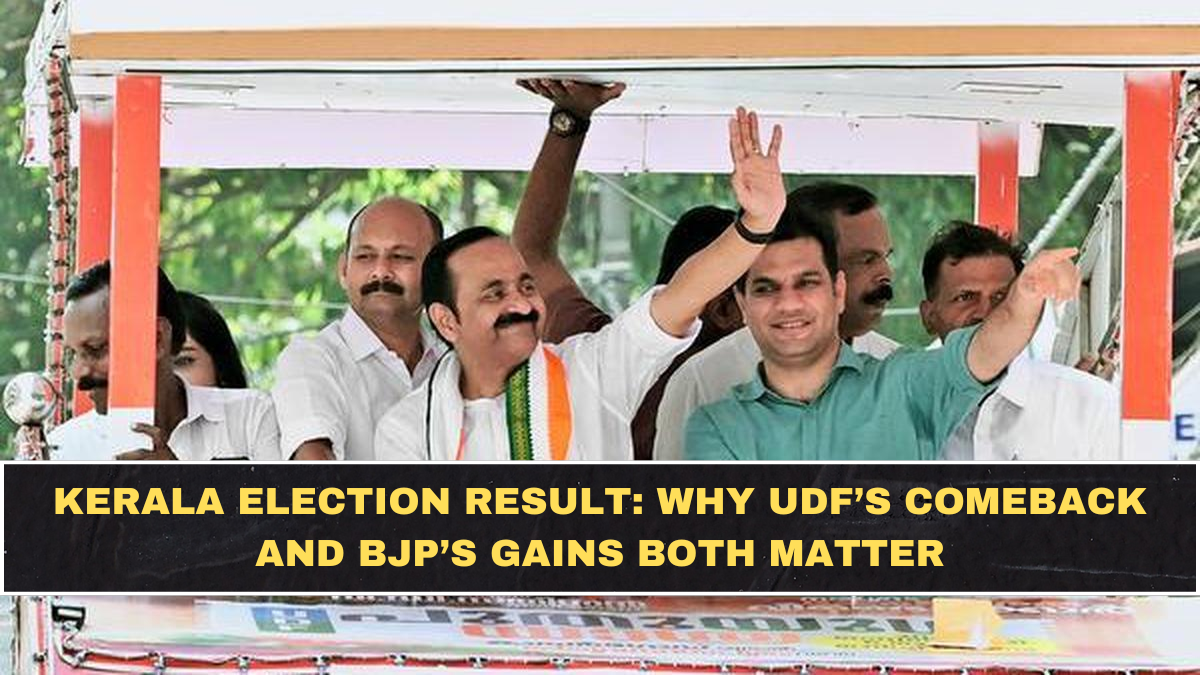
Kerala has delivered a sharp political message in the 2026 Assembly election, with the Congress-led UDF returning to power after defeating the ruling LDF. NDTV reported that UDF won 102 seats, while LDF was reduced to 35 in the 140-member Assembly. That is a clear majority and a strong rejection of the Left government after two consecutive terms in power.
This result matters because Kerala usually votes with strong political awareness, not random emotion. The UDF comeback shows that anti-incumbency, local anger and the desire for political rotation still matter deeply in the state. At the same time, BJP’s three-seat breakthrough has created a separate story because Kerala has traditionally been one of the hardest states for the party to crack.

Why Did UDF Win Big?
The UDF’s victory was not just a Congress comeback; it was an alliance-level recovery. Election Commission trends showed Congress emerging as the single-largest party with 63 seats, while IUML won 22 seats and became one of the strongest alliance performers. This gave UDF both numerical strength and social reach across different regions of Kerala.
The bigger point is that UDF looked more united than many expected. Times of India reported that UDF’s “Indira Guarantee” manifesto, minority consolidation and internal cohesion helped it sweep the state. LDF, on the other hand, failed to read public dissatisfaction despite pushing its welfare and infrastructure record.
What Do The Numbers Say?
| Alliance/Party | Seats Reported | Why It Matters |
|---|---|---|
| UDF | 102 | Clear majority and return to power |
| LDF | 35 | Major fall after two terms |
| BJP | 3 | Rare breakthrough in Kerala |
| Congress | 63 | Single-largest party |
| IUML | 22 | Best-ever tally and major UDF strength |
These numbers show two stories happening together. UDF has clearly won the main mandate, but BJP has also made a symbolic breakthrough by winning Nemom, Kazhakoottam and Chathannoor. Onmanorama reported BJP’s three-seat win along with UDF’s 102 and LDF’s 35, making this election important beyond the usual UDF-versus-LDF cycle.
Why Did LDF Collapse?
LDF’s defeat is serious because it was not a small correction; it was a heavy fall. Times of India reported that LDF dropped from 99 seats in the previous term to 35, calling it the front’s worst defeat since its formation. That tells us voters were not merely unhappy in a few pockets; the anger had spread widely across the state.
The Left tried to campaign on development, welfare and Pinarayi Vijayan’s leadership, but that pitch appears to have backfired in several regions. Voters may have respected some achievements, but they also seemed tired of the same power structure. Kerala’s result proves a simple political truth: welfare delivery helps, but it cannot fully hide public fatigue.
Why Do BJP’s Seats Matter?
BJP winning only three seats may look small compared with UDF’s 102, but in Kerala politics, even three seats carry symbolic weight. Kerala has long resisted BJP’s expansion because of strong Left-Congress rivalry, minority voting blocs and the state’s secular political culture. That is why the party’s wins in Nemom, Kazhakoottam and Chathannoor are being watched closely.
The real question is whether this is a one-time crack or the beginning of a wider shift. Times of India’s analysis said BJP’s three-seat breakthrough may signal a possible long-term change in Kerala’s political alignments. That does not mean BJP is close to power, but it does mean both UDF and LDF can no longer dismiss the party as fully irrelevant.
What Changed This Election?
- UDF looked more united: Congress and IUML performed strongly within the alliance.
- LDF faced fatigue: Voters appeared unwilling to extend the Left’s rule again.
- IUML gained sharply: The party won 22 of 27 seats it contested, its best tally.
- BJP found openings: Three seats gave the party a rare Kerala breakthrough.
- Minority votes mattered: Reports suggest consolidation helped UDF in key regions.
The most important lesson is that Kerala’s electorate did not vote in only one direction for one reason. Some voters wanted a change from LDF, some backed UDF’s promises, some consolidated behind alliance identities, and some gave BJP a new opening. That layered result is what makes Kerala’s verdict politically rich.
Can UDF Govern Smoothly?
UDF has the numbers to govern comfortably, but comfort can become arrogance quickly. The alliance must now manage expectations on jobs, welfare, education, health, infrastructure and minority confidence. A big mandate does not mean voters will wait patiently if the government looks slow or internally divided.
The Congress also has to handle alliance balance carefully because IUML’s strong performance gives it greater weight inside UDF. If Congress ignores allies, internal friction can grow. If it shares power smartly, UDF can turn this comeback into a stable five-year government.
What Is The Final Takeaway?
Kerala’s 2026 verdict is important because it brings UDF back to power with a clear majority, pushes LDF into a major crisis and gives BJP a rare symbolic breakthrough. UDF’s 102-seat win shows strong public desire for change, while LDF’s 35-seat result exposes deep voter fatigue after two consecutive terms.
The BJP’s three seats should not be exaggerated, but they should not be ignored either. Kerala remains a UDF-LDF battlefield, but the political map has become slightly more complicated. The blunt truth is this: UDF has won power, LDF has lost its rhythm, and BJP has finally found a small but serious opening.
Frequently Asked Questions
Who won the Kerala election 2026?
The Congress-led UDF won the Kerala Assembly election 2026 with 102 seats, according to reports. The ruling LDF was reduced to 35 seats, while BJP won three seats. This gives UDF a clear majority in the 140-member Assembly and marks its return to power in the state.
How many seats did Congress win in Kerala?
Election Commission data showed Congress as the single-largest party with 63 seats in Kerala. IUML, a key UDF ally, won 22 seats and recorded its best-ever tally. Together with other alliance partners, UDF crossed the majority mark comfortably and reached 102 seats.
Why did LDF lose Kerala in 2026?
LDF appears to have lost because of anti-incumbency, voter fatigue and failure to read public dissatisfaction. Reports said the alliance fell from 99 seats in the previous term to just 35. Its campaign around welfare, infrastructure and leadership did not stop voters from choosing political change.
Why are BJP’s three Kerala seats important?
BJP’s three seats are important because Kerala has traditionally been very difficult for the party. Winning Nemom, Kazhakoottam and Chathannoor gives BJP a symbolic breakthrough. It does not make BJP a major power in Kerala yet, but it gives the party a base to build from.