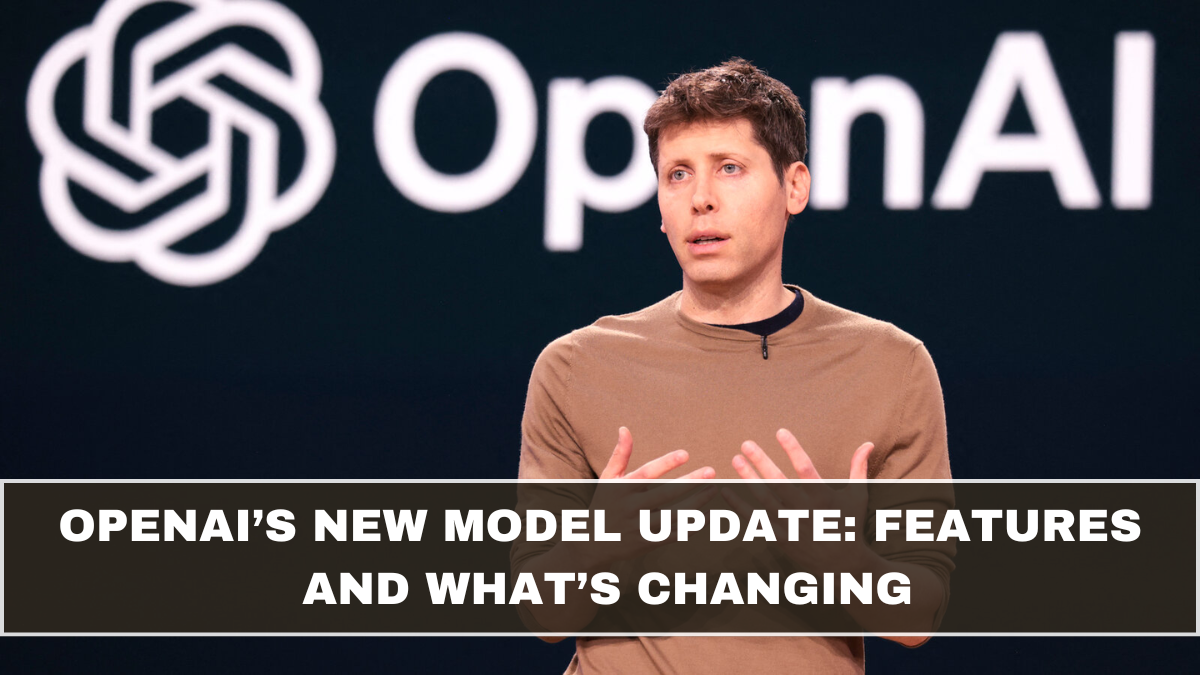
The OpenAI new model update has quickly become one of the most talked-about developments in the technology world. As artificial intelligence continues to shape industries, communication, and creativity, every major release carries enormous implications. This latest AI breakthrough signals not just an upgrade—but a significant leap in capability, efficiency, and real-world application.
From smarter reasoning to faster response times, the new model powering ChatGPT reflects OpenAI’s broader push toward practical, scalable AI. Businesses, students, developers, and everyday users are already exploring what this upgrade means for productivity and innovation. In this detailed breakdown, we examine new features, performance improvements, safety enhancements, and the broader impact of this OpenAI new model update.
What’s New in the OpenAI New Model Update
The headline feature of the OpenAI new model update is improved reasoning ability. The model demonstrates stronger contextual understanding, better multi-step logic handling, and more accurate information processing.
Key improvements include:
-
Enhanced long-form content generation
-
Better instruction following
-
More precise coding assistance
-
Improved multilingual understanding
-
Faster response times
These upgrades make interactions feel more natural and efficient. Compared to earlier iterations like GPT-4, the latest version shows measurable gains in clarity and depth. Users report that complex prompts yield more structured and coherent outputs, particularly in professional writing and technical explanations.
Another major improvement is memory handling. The model is better at maintaining context within longer conversations, reducing the need for repeated clarifications.
Performance Boost: Speed and Efficiency
One of the most noticeable aspects of the OpenAI new model update is performance optimization. Faster processing reduces latency, especially during detailed responses or code generation tasks.
Performance enhancements include:
-
Lower response delay
-
More efficient computation
-
Reduced hallucination rates
-
Improved fact consistency
These changes are particularly valuable for enterprise users integrating AI into workflows. Companies using AI tools for data analysis, customer support automation, or content production benefit from both speed and reliability.
The latest update also improves handling of structured data and formatted outputs, making it more adaptable for technical documentation and reporting tasks.
Smarter Coding and Developer Tools
Developers are among the biggest beneficiaries of the OpenAI new model update. The upgraded model offers stronger debugging capabilities, better understanding of multiple programming languages, and clearer code explanations.
It can now:
-
Generate cleaner syntax
-
Identify logical errors more accurately
-
Provide step-by-step debugging guidance
-
Translate between programming languages
For teams building AI-driven applications, this means faster development cycles. The improved integration potential strengthens OpenAI’s position in the broader tech innovation ecosystem.
The coding enhancements also align with industry demand for AI-assisted software engineering, where productivity gains are becoming measurable and scalable.
Safety, Alignment, and Responsible AI
As AI systems grow more powerful, safety and ethical safeguards become critical. The OpenAI new model update includes refinements in content moderation, bias reduction, and response filtering.
Enhancements focus on:
-
Safer outputs in sensitive contexts
-
Clearer boundaries around misinformation
-
Reduced harmful or misleading responses
-
Stronger alignment with user intent
Responsible AI deployment remains a priority in the tech industry, and OpenAI continues refining guardrails without limiting useful capabilities. This balance between innovation and safety is essential for long-term trust.
Impact on Businesses and Professionals
The practical implications of the OpenAI new model update extend beyond casual use. Organizations across sectors—education, finance, marketing, healthcare, and software development—are evaluating how upgraded AI tools can optimize operations.
Key business benefits:
-
Automated report drafting
-
Advanced data summarization
-
Enhanced research assistance
-
Scalable customer interaction systems
For content creators and marketers, improved language fluency enhances storytelling quality. Analysts benefit from sharper summarization of complex datasets. The broader AI breakthrough reshapes workflows by reducing manual effort and increasing efficiency.
This evolution reflects the growing role of AI as a collaborative assistant rather than a standalone tool.
What It Means for Everyday Users
For regular users, the OpenAI new model update translates into smoother, more intuitive conversations. Whether drafting emails, studying for exams, or brainstorming ideas, users experience:
-
More accurate answers
-
Better conversational flow
-
Enhanced creativity support
-
Clearer explanations of complex topics
Students gain structured study help. Professionals receive refined drafts. Hobbyists enjoy creative writing assistance. The upgrade makes advanced AI more accessible and practical in daily life.
Importantly, the system now handles nuanced instructions with greater precision, reducing misinterpretation.
Competitive Landscape and AI Innovation
The AI sector remains highly competitive, with major technology firms investing heavily in research and deployment. The OpenAI new model update reinforces OpenAI’s leadership in generative AI development.
Innovation trends shaping the market include:
-
Multimodal AI systems
-
Real-time collaboration tools
-
Edge computing integration
-
Enterprise AI customization
By strengthening reasoning and performance capabilities, OpenAI ensures its platform remains relevant in a rapidly evolving tech environment. Continuous iteration is key in a space where breakthroughs happen quickly.
Long-Term Vision: Where AI Is Heading
Beyond immediate improvements, the OpenAI new model update hints at broader ambitions. The trajectory points toward AI systems that can:
-
Understand complex workflows
-
Collaborate in professional environments
-
Personalize responses based on long-term interaction
-
Support decision-making with higher accuracy
The evolution from simple text generation to advanced contextual intelligence marks a turning point in digital productivity tools.
As AI systems become more integrated into everyday applications, the focus will shift toward reliability, customization, and seamless integration.
Conclusion: A Significant Step Forward
The OpenAI new model update represents more than incremental improvement—it reflects a maturing AI ecosystem. With enhanced reasoning, faster performance, improved coding support, and stronger safety measures, this release strengthens the foundation for future innovation.
For businesses, developers, students, and creators alike, the upgrade offers measurable benefits. As artificial intelligence continues advancing, updates like this redefine expectations and expand possibilities.
In a technology landscape driven by rapid evolution, OpenAI’s latest AI breakthrough signals both progress and potential. The real impact will unfold as users worldwide integrate these new capabilities into daily workflows and creative pursuits.
FAQs
What is included in the OpenAI new model update?
The update includes improved reasoning, faster performance, enhanced coding capabilities, better context handling, and strengthened safety systems.
Is ChatGPT upgraded with the new model?
Yes, ChatGPT benefits from the new model’s improvements, offering smarter responses and more accurate outputs.
Does the update improve coding assistance?
Yes, the model now provides better debugging help, cleaner syntax generation, and improved multi-language programming support.
Is the OpenAI new model update safer than previous versions?
The update includes refined content moderation and stronger alignment systems to reduce harmful or misleading responses.
How does this update affect businesses?
Businesses gain faster processing, improved automation, better data summarization, and enhanced workflow integration through AI-powered tools.