A badly organized pantry does more than look messy. It slows down cooking, hides what you already bought, increases duplicate purchases, and can even create food-safety problems. The worst part is that many common pantry “upgrades” make this worse, not better. A pantry is not supposed to be a showroom. It is supposed to help you find food quickly, rotate it properly, and store it safely. FDA guidance says proper food storage helps prevent foodborne illness, while USDA guidance on shelf-stable foods makes clear that storage conditions matter for both safety and quality.
Why is organizing for looks instead of use a mistake?
This is probably the biggest pantry mistake people make. They buy matching bins and decant everything into pretty containers before they even figure out how they actually cook. That is backward. Better Homes & Gardens’ pantry-organization expert guidance says people should organize based on their own habits, keep frequently used items accessible, and choose practical products instead of purely aesthetic ones. Real Simple’s 2026 organizing guide also emphasizes taking stock first and creating a system around how the pantry is actually used.
A functional pantry usually looks better in the long run because it is easier to maintain. If breakfast foods, baking staples, snacks, canned goods, and dinner ingredients are grouped by real usage, the kitchen becomes faster to work in. If everything is arranged mainly for visual symmetry, you end up searching for ingredients and shuffling containers around every week. That is not organization. That is storage theater.
What happens when you keep expired or duplicate food?
You waste space, waste money, and make meal planning harder. Better Homes & Gardens specifically recommends regularly removing expired products and using a first-in, first-out system so older items get used before newer ones. Good Housekeeping’s recent pantry advice also highlights making expiration dates visible instead of burying them behind prettier packaging or crowded shelves.
There is also a food-labeling problem people misunderstand. USDA explains that date labels on shelf-stable foods are generally about quality rather than safety, except infant formula, but that does not mean pantry items should sit forgotten forever. Older products can lose flavor, texture, and usefulness, and once the pantry gets crowded with old stock, it becomes much easier to buy duplicates because you cannot see what you already have.
Why does overbuying make pantry organization worse?
Because an overflowing pantry is not a storage problem first. It is often a buying problem. The Spruce’s 2026 organizer guidance says overflowing bins and repeated duplicates are signs that the storage system is no longer working, and it specifically points to overbuying pantry items as a source of clutter and waste. If shelves are crammed, containers are stacked on top of each other, and nothing can be pulled out easily, the answer is usually not “buy more bins.” The answer is “stop storing more than the pantry can support.”
This is where people fool themselves. They treat the pantry like a backup warehouse for bulk deals, then complain that the kitchen feels chaotic. Unless your household truly uses the volume, overbuying creates friction. You lose visibility, reduce airflow, make older items harder to reach, and turn simple meals into scavenger hunts. A smaller, clearer pantry is often far more useful than a packed one.
| Pantry mistake | Why it causes problems | Better fix |
|---|---|---|
| Organizing for looks only | Harder to maintain and find items | Group food by use and frequency |
| Keeping expired or stale items | Wastes space and hides usable food | Check dates and rotate stock |
| Overbuying duplicates | Crowds shelves and increases waste | Buy to realistic household use |
| Using the wrong containers | Creates spills, confusion, or waste | Use containers only where they help |
| Mixing food and chemicals | Raises contamination risk | Store cleaning products elsewhere |
Are too many containers actually a problem?
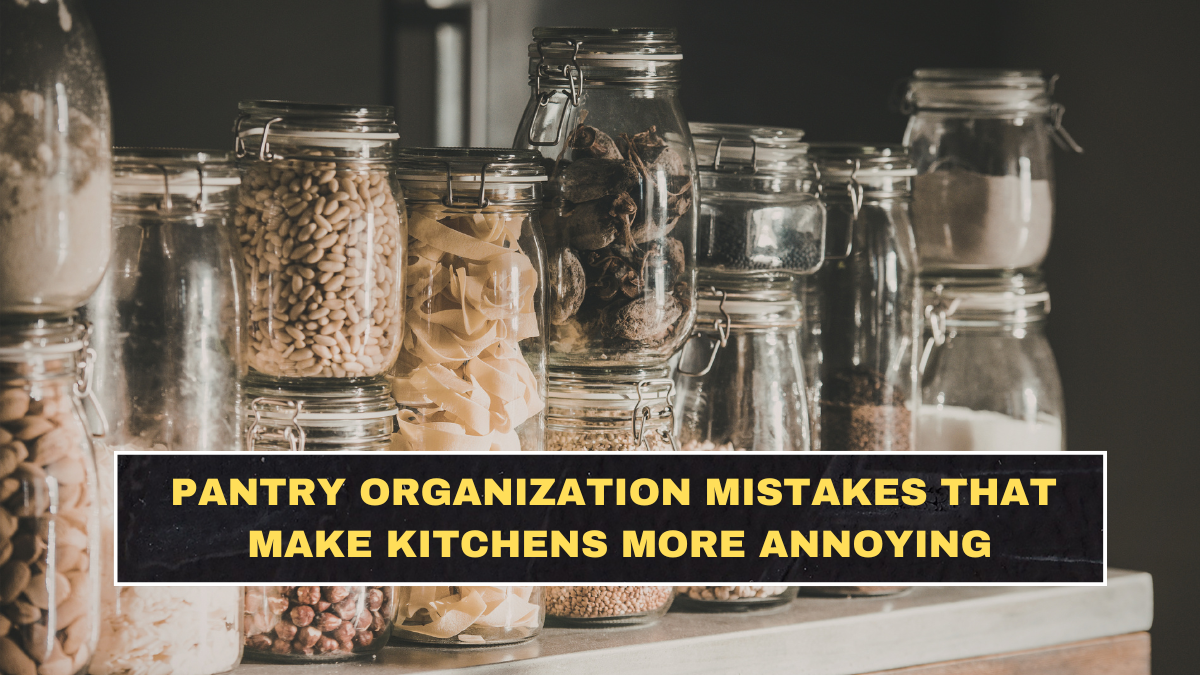
Yes, sometimes. Containers help when they improve visibility, protect dry goods, and make access easier. They become a problem when you decant everything without labeling it properly or when the original packaging had important prep instructions, dates, or allergy information. Real Simple advises labeling decanted items, and Better Homes & Gardens also stresses clear labeling so food can be identified quickly and used correctly.
The smarter approach is selective decanting. Flour, rice, pasta, cereal, and snacks may benefit from containers if they are clearly labeled and easy to pour. But not every item needs to be transferred. Some foods are easier and safer to keep in their original packaging, especially when the package includes cooking directions, expiration info, or sealing features that still work well. FDA’s food-storage guidance is about safe, proper storage, not making every shelf look uniform.
Why is storing cleaning products in the pantry a bad idea?
Because it is a basic contamination risk. Good Housekeeping’s 2026 organizer advice explicitly says cleaning products should never be stored in the same place as food, noting the risk from spills, leaks, or fumes. That should be obvious, but apparently it is not. If the pantry is a food zone, chemicals should not be in it. Period.
This is one of those mistakes that proves aesthetics can override common sense. People want all household supplies hidden in one neat area, so they tuck cleaners next to dry goods and call it efficient. It is not efficient. It is careless. If there is any chance of contamination, the setup is wrong no matter how organized it looks. FDA’s general food-storage advice exists for a reason: safe storage matters as much as neat storage.
How does poor shelf placement make kitchens more annoying?
Poor placement turns everyday cooking into repetitive friction. Better Homes & Gardens recommends putting frequently used items within easy reach, and Real Simple’s updated pantry guide focuses on systemizing the pantry so daily cooking staples are easy to find. If heavy appliances or bulk overflow are on the best shelves while the foods you use every day are buried, the pantry is organized badly even if it looks tidy from the outside.
Good Housekeeping also highlights tools like tiered shelving and visible expiration-date placement because hidden products get forgotten. That is the real enemy in pantry organization: invisibility. Once cans, jars, packets, and boxes disappear behind one another, you stop using what you own efficiently. Then the pantry becomes more annoying every week until someone finally empties the whole thing out in frustration.
Conclusion
The pantry mistakes that make kitchens more annoying are not complicated. Organizing for appearance instead of use, keeping expired food, overbuying, misusing containers, mixing food with chemicals, and hiding frequently used items behind clutter all create daily friction. A good pantry should help you cook faster, waste less, and store food safely. If the system looks nice but makes the kitchen harder to use, it is not a good system. It is just a prettier problem.
FAQs
Should everything in a pantry be decanted into matching containers?
No. Containers can help with some dry goods, but not everything needs to be transferred. Labeling matters, and some original packages include useful instructions or date information that should not be lost.
Is it okay to keep cleaning supplies in the pantry?
No. Good Housekeeping’s 2026 organizer advice says cleaning products should not be stored with food because of spill, leak, and fume risks.
What is the easiest pantry fix that helps immediately?
Removing expired items and duplicates is one of the fastest improvements because it opens space and makes the remaining food easier to see and use. Better Homes & Gardens and Good Housekeeping both support this approach.
Why does my pantry still feel messy after I bought organizers?
Because organizers do not fix overbuying, poor grouping, hidden expiration dates, or unrealistic storage habits. If the system does not match how your household actually cooks and shops, it will keep failing.