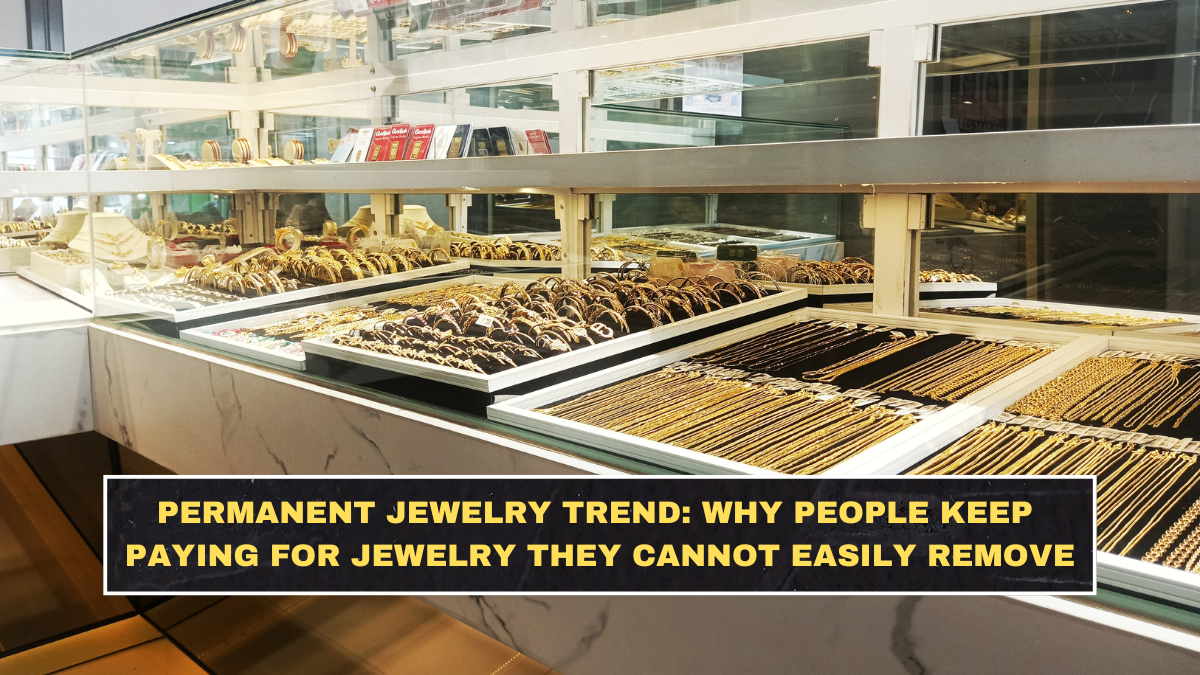
Permanent jewelry usually means a bracelet, anklet, necklace, or ring that is custom-fitted and then welded closed instead of secured with a clasp. It is called “permanent,” but that word is more marketing than literal truth. The jewelry can still be removed with scissors or wire cutters if needed, and many brands openly say that it may need to come off for medical procedures, repairs, or personal choice. Catbird, one of the best-known names in the category, describes its welded pieces as clasp-less jewelry that is custom fit and then welded on in-store.
That matters because the whole trend is built on emotional language. People hear “permanent” and imagine deep commitment, identity, friendship, or ritual. In practice, the product is a small welded chain. The symbolism is real because people assign meaning to it, but the permanence is partial, not absolute. If buyers do not understand that, they are already starting from a fantasy instead of a product reality.
Why is permanent jewelry still growing in 2026?
The trend is still growing because it works as both jewelry and experience. Buyers are not just paying for a bracelet. They are paying for an appointment, a memory, a bonding ritual, and a piece of content that photographs well. That is why it has spread across local boutiques, event pop-ups, and social media-friendly retail spaces. Yelp said searches on its platform for permanent jewelry businesses rose 4,030% year over year in 2024, which is not small noise. That is explosive consumer curiosity.
The broader jewelry market also helps explain the staying power. Grand View Research estimated the global jewelry market at $353.26 billion in 2023 and projected it could reach $482.22 billion by 2030, while personalization and experiential retail continue to attract buyers. Permanent jewelry fits that shift perfectly because it turns a low-profile minimalist accessory into a service-based purchase with social meaning attached.
Why do people like jewelry they cannot easily remove?
The simple answer is that people like symbols more than they admit. Permanent jewelry is attractive because it feels intentional. It can mark friendships, relationships, birthdays, milestones, or just a specific version of someone’s personal style. Retailers like Catbird explicitly position welded jewelry around ritual and connection, which is smart because it transforms a small chain into something emotionally bigger than its material weight.
There is also a convenience angle. People who already wear minimalist jewelry daily may like not dealing with clasps, repeated removal, or styling decisions. A simple gold chain that stays on can feel effortless. That is practical enough. But let’s not pretend the entire category is driven by practicality. A big part of the appeal is emotional theater in a tasteful form. Unlike tattoos, it feels lower-risk. Unlike ordinary jewelry, it feels more meaningful. That middle ground is exactly why it sells.
What should buyers know before getting it?
The first thing to know is that not all permanent jewelry is equal. Material matters a lot. Reputable brands often use solid gold or higher-quality gold-filled materials because these hold up better against water, daily wear, and skin contact. Catbird says its chains are 14k solid gold, which helps justify the premium and explains why the pieces are meant for long-term wear.
The second thing is that “permanent” does not mean maintenance-free. Chains can break, stretch, snag, or need repair. TSA says travelers can generally keep jewelry on through security unless it triggers additional screening, but hospitals and imaging centers may have different requirements depending on the procedure. Cleveland Clinic notes that medical imaging and surgery can require removing jewelry, especially in cases involving MRI or other procedures where metal becomes a concern.
How does permanent jewelry compare with regular jewelry?
| Factor | Permanent Jewelry | Regular Jewelry |
|---|---|---|
| Closure | Welded, no clasp | Clasp or removable design |
| Main appeal | Symbolism, ritual, low-effort daily wear | Flexibility, variety, easier removal |
| Maintenance reality | Can still break or need removal | Easier to clean, repair, swap, or store |
| Best fit | People who like minimalist pieces and meaning-based purchases | People who want options and practicality |
| Biggest downside | Less convenient when you need it off | Less novelty and less emotional theater |
That is the real comparison buyers should use. Permanent jewelry is not objectively better. It is better only for people who value continuity, symbolism, and low-effort styling more than flexibility. Anyone who changes jewelry often, works in environments where metal removal is common, or gets irritated by daily wear should stop romanticizing this trend and skip it.
Is permanent jewelry worth the money?
It can be, but only if the buyer values the experience as much as the object. This is not the smartest category for pure value shoppers because part of the price goes toward fitting, welding, service, and the “moment” itself, not just raw material. That is not a scam. It is just the truth of experiential retail. You are paying for memory and ritual, not only metal weight. (catbirdnyc.com)
Where people fool themselves is when they pretend the emotional story does not matter. It absolutely does. If someone does not care about symbolism, shared experience, or daily sentimental wear, permanent jewelry is just a welded chain with added inconvenience. For that buyer, regular jewelry is usually the smarter choice.
Why has social media helped this trend last longer?
The category survives online because it is visual, intimate, and easy to package into a small emotional story. A welding spark, a close-up chain shot, two friends getting matching bracelets, or a couple marking an occasion all translate perfectly into short-form content. Yelp’s trend data shows the search demand surge, and local business coverage keeps reflecting the same thing: permanent jewelry works well as a service that is both giftable and shareable.
That does not make it empty. It just means the marketing logic is strong. The product becomes more durable as a trend when it is both wearable and narratable. Permanent jewelry is exactly that.
Conclusion
Permanent jewelry is still trending in 2026 because it sells more than adornment. It sells continuity, ritual, symbolism, and a clean minimalist look that fits current fashion preferences. The business side supports that momentum, and the social-media-friendly service model explains why small local retailers keep leaning into it.
But buyers should be honest with themselves. The appeal is emotional first, practical second. If that emotional value matters to you, the price can make sense. If it does not, then permanent jewelry is just a stylish inconvenience marketed as something deeper.
FAQs
Is permanent jewelry really permanent?
No, not in a literal sense. It is designed to stay on, but it can still be removed when necessary, usually by cutting the chain.
Can you wear permanent jewelry through airport security?
Usually yes. TSA says jewelry is generally allowed through security screening, though additional screening can still happen in some cases.
Do you ever have to remove permanent jewelry?
Yes. Some medical procedures, imaging requirements, repairs, or comfort issues may mean it needs to come off.
Who should skip the permanent jewelry trend?
People who need flexible accessories, dislike constant wear, work in environments where jewelry removal is common, or do not care about the symbolic part of the experience should probably skip it.
Click here to know more