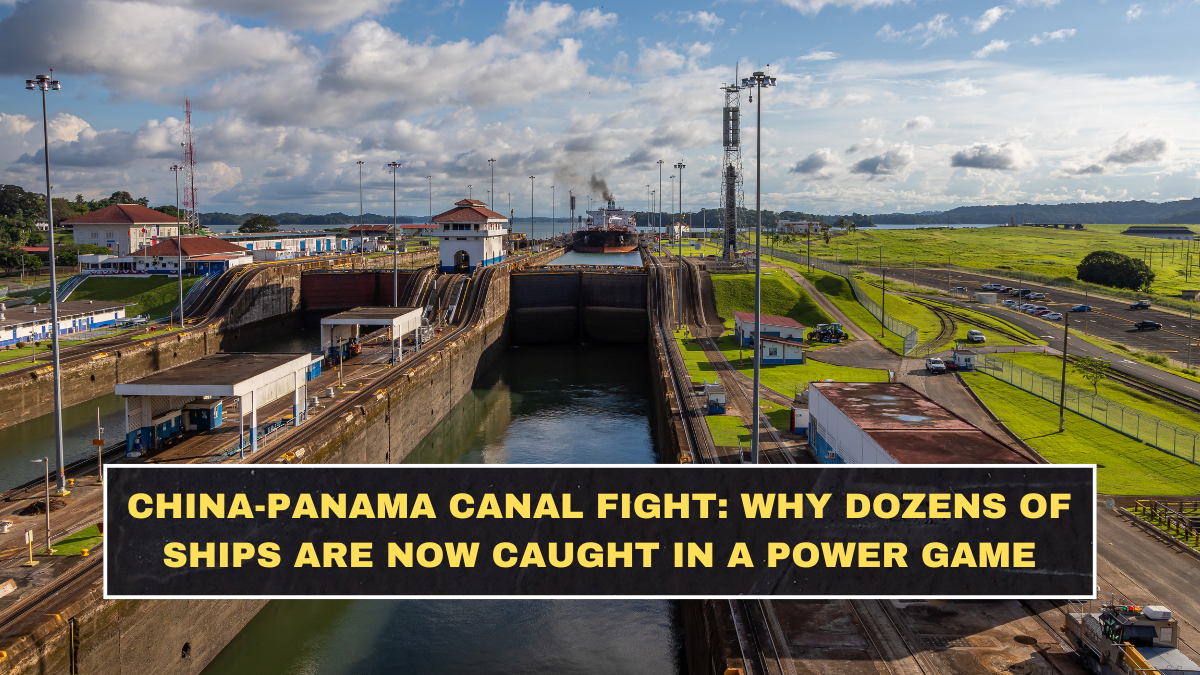
The China-Panama Canal fight has become a global story because it is no longer just about one court ruling or one port operator. It has turned into a direct test of Chinese economic pressure, US influence in Latin America and control over one of the world’s most important trade routes. Reuters reported that the US and several Latin American and Caribbean countries issued a joint statement supporting Panama’s sovereignty after recent Chinese actions affected Panama-flagged vessels.
The issue exploded after Panama’s Supreme Court moved against port concessions linked to Hong Kong-based CK Hutchison at key terminals near the Panama Canal. China denies wrongdoing, while US officials say Beijing has responded by increasing inspections and detentions of Panama-flagged ships. That is why this story matters: ships are now becoming bargaining chips in a fight over strategic infrastructure.
What Triggered The Dispute?
The dispute was triggered by Panama’s Supreme Court decision involving the Balboa and Cristóbal terminals, two important port facilities at opposite ends of the Panama Canal. Reuters reported that the court ruling annulled the legal framework of a 1997 concession that had allowed CK Hutchison-linked operations at the terminals. After the ruling, Panama moved to place the facilities under new management.
This did not happen in a political vacuum. Washington has been pushing back against Chinese influence around the canal, which is central to global trade and US strategic interests. China sees the move as political and unfair to a Chinese-linked business. Panama says its legal process and sovereignty must be respected. That clash created the perfect storm.
| Key Issue | Simple Explanation |
|---|---|
| Panama Canal | One of the world’s most important trade routes |
| Court ruling | Panama’s Supreme Court moved against CK Hutchison-linked concessions |
| China’s response | US officials say Chinese inspections and detentions increased |
| Ships affected | Nearly 70 Panama-flagged vessels reportedly detained or inspected |
| US position | Washington says China is using economic pressure |
| China’s position | Beijing denies retaliation and blames US politicisation |
How Many Panama-Flagged Ships Were Reportedly Detained?
US officials and maritime monitors have reported a sharp rise in detentions and inspections of Panama-flagged ships in Chinese ports. Al Jazeera reported that China has detained nearly 70 Panamanian-flagged ships after the Panama Canal ruling, according to US officials. Reuters also reported that the US Federal Maritime Commission was monitoring an unusual rise in detentions believed to be linked to the court decision.
AP reported an even sharper March figure, saying 92 out of 124 Panama-flagged ships were detained that month, around 75%. That difference shows why readers should be careful with exact numbers: reports vary depending on time period and classification. But the pattern is clear enough. Panama-flagged vessels have faced unusual pressure in Chinese ports.
Why Would China Target Panama-Flagged Ships?
China would target Panama-flagged ships because Panama’s shipping registry is one of the most important in the world. Many global ships sail under Panama’s flag, even if they are not owned by Panamanian companies. That gives Beijing a way to create economic pressure without directly blocking the Panama Canal or openly sanctioning Panama.
This is the classic pattern of economic coercion. Instead of issuing a dramatic public punishment, a country can increase inspections, slow paperwork, detain ships or create uncertainty at ports. China says the actions are not retaliation. But US officials argue the timing and scale make the pressure hard to dismiss as routine.
Why Is The Panama Canal So Important?
The Panama Canal is important because it connects the Atlantic and Pacific oceans and saves ships from taking much longer routes around South America. It is critical for container shipping, energy cargoes, agricultural exports and supply chains between Asia, the Americas and Europe. Control around the canal is therefore not just commercial. It is strategic.
This is why the United States is watching so closely. Washington does not want China gaining too much influence over infrastructure near the canal. Beijing, meanwhile, does not want Chinese-linked companies pushed out under US pressure. Panama is stuck between two powers, trying to defend its legal authority while avoiding economic retaliation.
Why Did The US And Latin American Countries React?
The US and several countries including Bolivia, Costa Rica, Guyana, Paraguay, and Trinidad and Tobago backed Panama’s sovereignty in a joint statement. Reuters reported that the statement criticised China’s targeted economic pressure and described recent actions affecting Panama-flagged vessels as an attempt to politicise maritime trade.
This matters because the statement turned a bilateral commercial dispute into a regional diplomatic issue. The message was clear: if China can pressure Panama over a court ruling, other smaller countries could face similar pressure later. That is why Latin American governments have a reason to care even if they are not directly involved in the canal ports.
What Does China Say About The Accusations?
China rejects the accusations and says the United States is politicising the Panama Canal issue. AP reported that Beijing denied retaliatory intent and argued that Washington is trying to gain control over the canal. China has also defended its interests and criticised what it views as unfair treatment of Chinese-linked businesses.
This is not surprising. China rarely admits economic retaliation directly, especially when regulatory or port inspections can be explained as legal procedures. That denial is part of the power game. The target feels pressure, but the source of pressure remains officially disputed. This makes the dispute harder to resolve because both sides can claim they are defending law and sovereignty.
What Could This Mean For Global Shipping?
The immediate impact may be delays, higher uncertainty and extra costs for Panama-flagged vessels entering Chinese ports. If shipping companies fear detention or inspection risk, they may reconsider registry choices, route planning or insurance assumptions. That can affect Panama’s reputation as a major ship registry.
The bigger risk is precedent. If powerful countries begin targeting ship registries to punish political decisions, maritime trade becomes less predictable. Shipping depends on trust, standard rules and smooth port access. Once ships become tools of geopolitical pressure, global trade becomes more expensive and fragile.
What Is The Bottom Line?
The China-Panama Canal dispute is not just about port contracts. It is about power. Panama made a legal move involving canal-linked terminals. China-linked business interests were hit. US officials say China then applied pressure through Panama-flagged vessels. Beijing denies retaliation and accuses Washington of politicising the canal.
The blunt truth is that Panama is caught in a great-power fight it cannot fully control. The canal is too important for the US to ignore and too strategically valuable for China to walk away from quietly. If this dispute escalates, global shipping could become another battlefield in US-China competition.
FAQs
Why Are China And Panama Fighting Over The Canal?
The dispute began after Panama’s Supreme Court moved against the legal framework behind CK Hutchison-linked port concessions at key terminals near the Panama Canal. China sees this as unfair, while Panama and its supporters frame it as a sovereignty and rule-of-law issue.
Did China Detain Panama-Flagged Ships?
US officials and maritime monitors say Chinese authorities sharply increased detentions and inspections of Panama-flagged ships after the court ruling. Al Jazeera reported nearly 70 ships were detained, while AP reported 92 out of 124 Panama-flagged ships were detained in March.
Why Are Panama-Flagged Ships Important?
Panama has one of the world’s most important ship registries. Many international vessels sail under Panama’s flag, so targeting those ships can create pressure on Panama and global shipping companies.
What Is The US Position?
The US says China’s actions raise serious concerns and amount to economic pressure against Panama. Washington and several regional allies issued a statement backing Panama’s sovereignty.
What Does China Say?
China denies that it is retaliating and accuses the US of politicising the Panama Canal dispute. Beijing says it is defending its legitimate interests and rejects outside pressure.