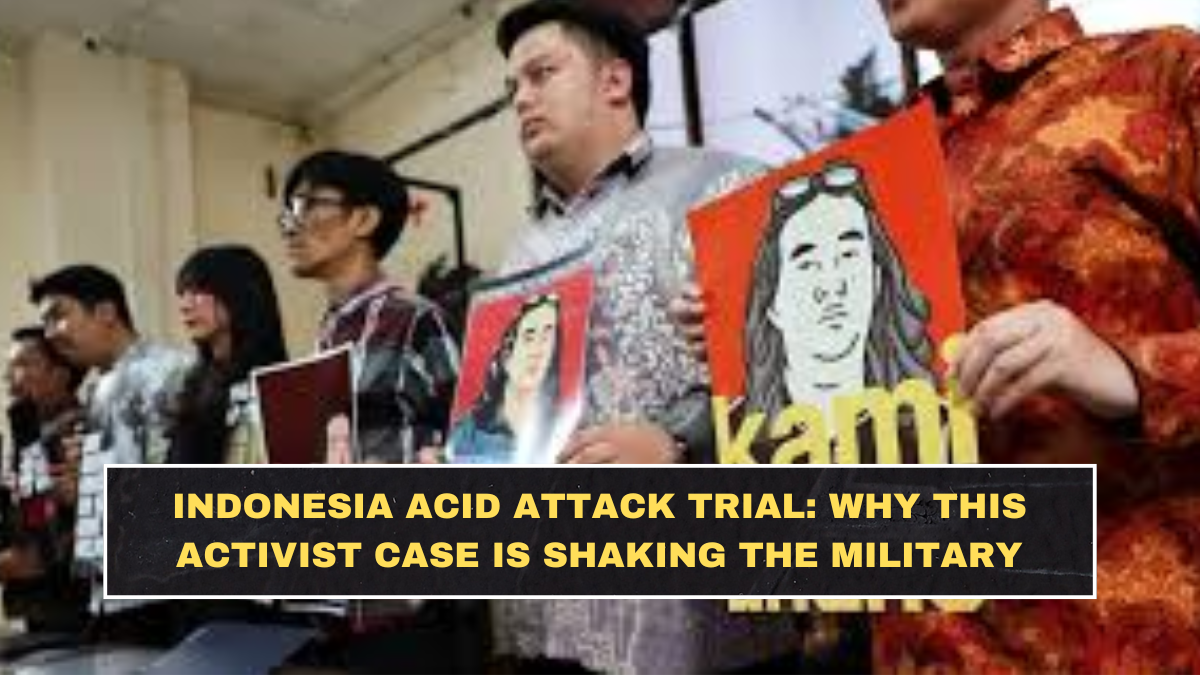
The Indonesia acid attack trial is getting global attention because it involves four military personnel accused of attacking a prominent human rights activist, Andrie Yunus. AP reported that three navy marines and one air force officer have gone on trial in a Jakarta military court over the March 12, 2026 acid attack. Yunus suffered severe injuries, including burns over around 20% of his body and permanent damage to his eyesight.
This is not just a criminal case. It is a test of military accountability in Indonesia. Yunus is linked to KontraS, the Commission for the Disappeared and Victims of Violence, a human rights group known for criticising military impunity. If soldiers can attack a rights activist and receive only weak punishment, the message to civil society would be terrifying. That is why activists are watching the case so closely.
Who Is Andrie Yunus?
Andrie Yunus is a human rights defender and senior figure at KontraS, an organisation that works on enforced disappearances, violence, military abuse and state accountability. Reuters described him as a deputy coordinator at KontraS and reported that he had recently spoken against legal changes expanding the military’s role in civilian government before the attack.
That context matters because the attack did not happen to a random victim. It happened to someone publicly involved in sensitive criticism of the military. Human rights groups argue that this makes the case politically serious, not merely personal. If the motive was linked to his activism, then the attack becomes an assault on civic space and free expression in Indonesia.
| Key Detail | What Happened? |
|---|---|
| Victim | Human rights activist Andrie Yunus |
| Date of attack | March 12, 2026 |
| Location | Central Jakarta, Indonesia |
| Accused | Four Indonesian military personnel |
| Injuries | Burns to around 20% of body and serious eye damage |
| Court | Military court in Jakarta |
| Maximum sentence | Up to 12 years if convicted |
What Happened During The Acid Attack?
The attack took place on March 12, 2026 in Central Jakarta. Front Line Defenders said Yunus was attacked after taking part in a podcast on “Remilitarism and Judicial Review in Indonesia,” a topic directly connected to his human rights work. The attackers allegedly threw a corrosive chemical at him while he was travelling by motorcycle.
Reuters reported that prosecutors alleged the attackers used a mixture of car battery acid and rust remover. The attack left Yunus with permanent facial scars and severe injury to his right eye. That detail is important because acid attacks are not just physical assaults. They are meant to disfigure, intimidate and send a message beyond the victim.
Who Has Been Charged In The Case?
Four Indonesian service members are on trial. AP identified them as Sgt. Edi Sudarko, First Lt. Budhi Hariyanto Widhi Cahyono, Capt. Nandala Dwi Prasetya and First Lt. Sami Lakka. They face charges linked to premeditated assault and could face up to 12 years in prison if convicted.
Reuters reported that prosecutors say the officers were connected to military intelligence units and allegedly targeted Yunus because of anger over his activism against the military’s growing role in civilian government. That alleged motive is explosive because it links the attack to political dissent, not a private dispute.
Why Are Activists Worried About A Military Court?
Activists are worried because the case is being heard in a military court, not a civilian court. Military courts often raise concerns about transparency, independence and public accountability, especially when the accused are soldiers. Critics fear the process may protect the institution rather than fully expose who planned and ordered the attack.
AP reported that human rights groups, including Amnesty International Indonesia, have questioned the official motive and called for more transparency and civilian proceedings. Their concern is blunt: if state resources or chains of command were involved, trying only a few service members inside the military justice system may leave bigger questions unanswered.
Why Does This Case Raise Bigger Questions About Indonesia’s Military?
This case raises bigger questions because Indonesia has been debating the military’s expanding role in civilian affairs. Reuters reported that the attack happened after Yunus criticised the military’s growing influence under President Prabowo Subianto’s administration. Prabowo, a former general, called the incident an act of terrorism and promised a full investigation.
Indonesia has a difficult history with military power, disappearances and human rights abuses. That is why any violent attack on a rights activist linked to military personnel triggers serious alarm. It revives fears that democratic space is shrinking and that critics of military influence may face intimidation.
What Did Human Rights Groups Demand?
Human rights groups have demanded an independent investigation and full accountability for everyone involved, not only the attackers physically present at the scene. Human Rights Watch called for President Prabowo to create an independent fact-finding team to investigate the attack and ensure all responsible parties are brought to justice.
This demand is reasonable because acid attacks are rarely treated as isolated street violence when the victim is a high-profile activist and the accused include military personnel. The key question is not only who threw the acid. The deeper question is whether anyone planned, ordered, enabled or protected the attack.
Why Does The Motive Matter So Much?
The motive matters because prosecutors and rights groups appear to frame the case differently. Prosecutors have presented anger over Yunus’s criticism as a factor, while some rights groups reject any narrow “personal” explanation and argue the attack must be investigated as political violence. AP reported that Amnesty International Indonesia questioned the use of state resources and called for greater transparency.
This distinction is important. If the attack is treated as a personal dispute, the system may punish a few individuals and move on. If it is treated as a coordinated attack on a human rights defender, then investigators must examine command responsibility, institutional culture and whether the military tolerated threats against critics.
What Is The Bottom Line?
The Indonesia acid attack trial matters because it is about more than one horrific assault. It is about whether activists can criticise the military without fearing disfigurement, intimidation or violence. Four service members are now on trial, but the real test is whether the investigation reaches everyone involved.
The blunt truth is that Indonesia cannot claim strong democracy while activists are attacked and the process stays mostly inside military justice. If the trial becomes narrow, quiet and lenient, it will look like damage control. If it becomes transparent, independent and serious, it could become a rare moment of accountability.
FAQs
Who Is Andrie Yunus?
Andrie Yunus is a human rights activist and senior figure at KontraS, the Commission for the Disappeared and Victims of Violence. He has worked on issues involving military accountability and human rights abuses.
What Happened To Andrie Yunus?
He was attacked with acid in Central Jakarta on March 12, 2026. The attack caused burns over around 20% of his body and serious damage to his eyesight.
Who Is On Trial In The Case?
Four Indonesian military personnel are on trial in a Jakarta military court. They include three navy marines and one air force officer, according to AP.
Why Are Human Rights Groups Concerned?
Human rights groups are concerned because the case is being handled in a military court and may not fully reveal whether higher-level planning, command responsibility or institutional involvement existed.
What Sentence Could The Accused Face?
The accused face charges linked to premeditated assault and could receive up to 12 years in prison if convicted.