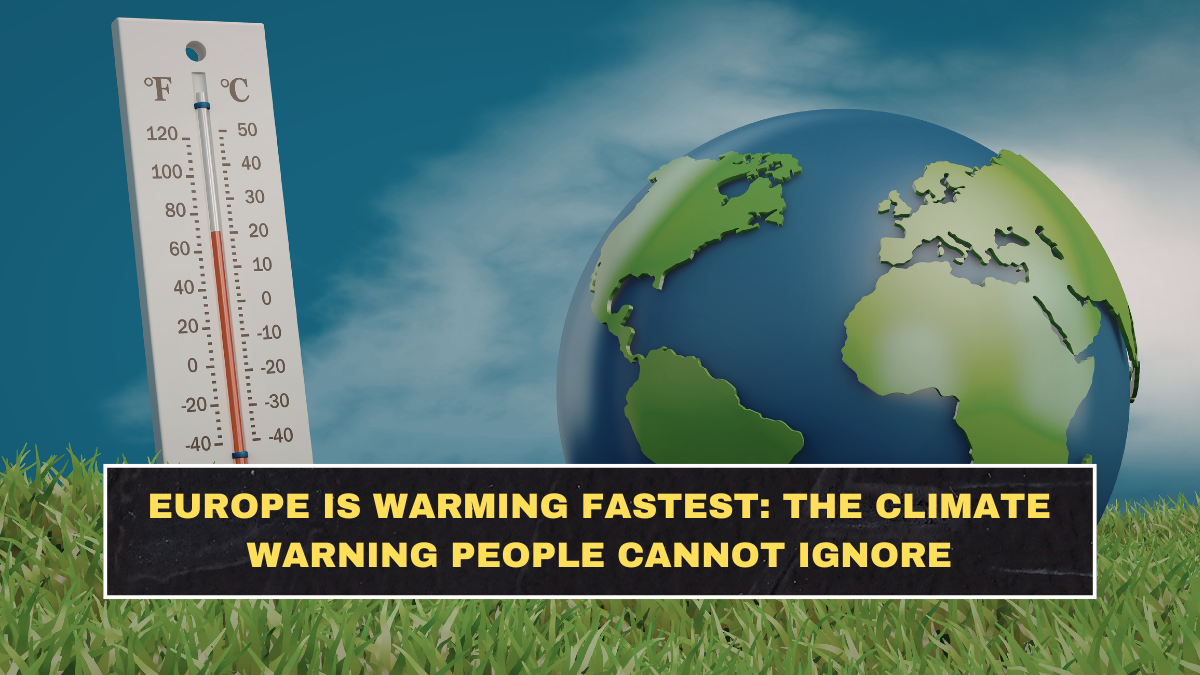
Europe is being called the fastest-warming continent because its temperatures are rising much faster than the global average. The European State of the Climate 2025 report, produced by the World Meteorological Organization and the EU’s Copernicus Climate Change Service, says Europe has warmed by about 0.56°C per decade over the last 30 years. That is more than twice the global average rate.
This is not a distant climate warning anymore. It is already visible through record heatwaves, shrinking glaciers, lower snow cover, drought stress, marine heatwaves and destructive wildfires. The problem is simple but brutal: Europe’s climate is changing faster than many governments, cities and communities are adapting. That gap between warming and preparation is where the real danger sits.
What Did The Latest Climate Report Find?
The report found that 2025 was another extreme year for Europe. Reuters reported that at least 95% of the continent experienced above-average heat, with climate records falling across land, oceans, rivers and ice. Wildfires burned more than 1 million hectares, the highest area recorded, while sea temperatures reached record levels.
The WMO and Copernicus report also highlighted that 70% of European rivers had below-average annual flows, which points to serious water stress. That matters because river flow affects drinking water, farming, hydropower, transport and ecosystems. Climate change is not only making Europe hotter. It is also making water systems more unstable.
| Climate Signal | What Happened In Europe? |
|---|---|
| Warming rate | Around 0.56°C per decade over the last 30 years |
| Above-average heat | At least 95% of Europe affected in 2025 |
| Wildfires | More than 1 million hectares burned, a record area |
| Rivers | 70% had below-average annual flows |
| Sea temperatures | Highest on record in European waters |
| Ice loss | Glaciers and snow cover continued shrinking |
Why Is Europe Warming Faster Than Other Regions?
Europe is warming faster because of geography, Arctic influence, land-sea patterns and feedback loops from melting snow and ice. Parts of Europe extend into the Arctic, which is warming at several times the global average. When snow and ice melt, darker land and ocean surfaces absorb more sunlight, which accelerates warming further.
There is also a harsh irony in Europe’s cleaner air. Reduced air pollution has improved public health, but fewer reflective particles in the atmosphere can also allow more sunlight to reach the surface. That does not mean pollution was “good.” It means climate systems are complicated, and cutting greenhouse gases must happen alongside serious adaptation planning.
How Are Heatwaves Changing Life In Europe?
Heatwaves are becoming longer, hotter and more geographically widespread. The latest report found record heatwaves stretching from the Mediterranean to the Arctic. In July 2025, temperatures exceeded 30°C inside the Arctic Circle during a historic Nordic heatwave, a shocking sign of how far extreme heat has moved north.
This affects daily life directly. Heatwaves increase deaths among elderly people, outdoor workers, infants and those with chronic illness. They also raise electricity demand, damage roads and rail lines, reduce labour productivity and increase pressure on hospitals. Europe cannot treat heat as a summer inconvenience anymore. It is becoming a public-health emergency.
Why Are Wildfires Becoming A Bigger Threat?
Wildfires are becoming a bigger threat because heat, drought and dry vegetation create dangerous burning conditions. Reuters reported that Europe saw record wildfire damage in 2025, with more than 1 million hectares burned. The Guardian reported that the Iberian Peninsula was especially affected, and four volunteer firefighters died during the wildfire season.
The real problem is that wildfire risk is spreading beyond places traditionally seen as fire-prone. Southern Europe remains highly exposed, but hotter summers and drier soils can push fire danger into new regions. That means countries must invest in forest management, firefighting capacity, evacuation planning and early-warning systems before disasters hit, not after.
Why Does Shrinking Ice Matter So Much?
Shrinking ice matters because it is both a symptom and accelerator of climate change. When glaciers shrink and snow cover declines, Europe loses natural water storage. That affects rivers, farming, hydropower and alpine ecosystems. It also reduces the reflective white surface that helps cool the planet.
The 2025 climate report highlighted widespread glacier melt, with Iceland seeing its second-highest glacier loss on record. Sky News also reported that Greenland shed 139 billion tonnes of ice, underlining how northern ice systems remain under heavy pressure. This is not just a mountain tourism problem. It is a water, sea-level and climate-stability problem.
How Does This Affect Food, Water And The Economy?
Europe’s climate stress affects food, water and the economy through droughts, river flows, crop damage, heat stress and disaster costs. When rivers run low, transport becomes harder, hydropower weakens and irrigation becomes more difficult. When heatwaves hit farms, crop yields can fall and livestock can suffer.
Reuters reported earlier this year that EU climate advisers warned the bloc is still poorly prepared for worsening climate change, with annual climate-related economic damages already around €45 billion. That is five times the level seen in the 1980s. This is the part politicians avoid: adaptation is expensive, but not adapting is more expensive.
Is Europe Doing Enough To Prepare?
No, not enough. Europe has stronger climate policies than many regions, but the pace of warming is exposing serious gaps in adaptation. Cities are still too hot, forests are still too vulnerable, water planning is still too fragmented, and many homes are not built for extreme heat. Only reacting after floods, fires and heat deaths is not a strategy.
The EU’s own advisers have warned that adaptation planning is still too weak and poorly coordinated. If Europe is warming faster than the rest of the world, then it cannot afford average-level preparation. It needs faster building upgrades, stronger heat-health systems, better water storage, wider insurance coverage and serious wildfire planning.
What Is The Bottom Line?
Europe being the fastest-warming continent is not just a climate statistic. It is a warning that daily life, public health, food systems, water supplies, forests, cities and economies are already under pressure. The latest WMO-Copernicus report shows record heat, record wildfires, record sea temperatures and continuing ice loss.
The blunt truth is that Europe has no excuse left. The data is clear, the damage is visible, and the risks are accelerating. Climate change is not waiting for political comfort. Europe either adapts faster and cuts emissions harder, or it will keep paying through fires, floods, heat deaths, crop losses and rising economic damage.
FAQs
Why Is Europe The Fastest-Warming Continent?
Europe is warming fastest because it is heating at more than twice the global average, partly due to Arctic influence, shrinking snow and ice cover, and regional climate feedbacks. The latest Copernicus report says Europe has warmed by about 0.56°C per decade over the last 30 years.
How Much Of Europe Had Above-Average Heat In 2025?
Reuters reported that at least 95% of Europe experienced above-average heat in 2025, according to the WMO and Copernicus climate report.
How Bad Were Europe’s Wildfires?
Europe recorded its largest wildfire-burned area in 2025, with more than 1 million hectares burned across the continent.
Why Are Glaciers Important For Europe?
Glaciers store freshwater, support river flows and reflect sunlight. When they shrink, Europe faces more water stress, ecosystem damage and warming feedback effects.
Is Europe Prepared For Faster Climate Change?
Not fully. EU climate advisers have warned that Europe is poorly prepared for worsening climate impacts, with annual climate-related economic damage already around €45 billion.