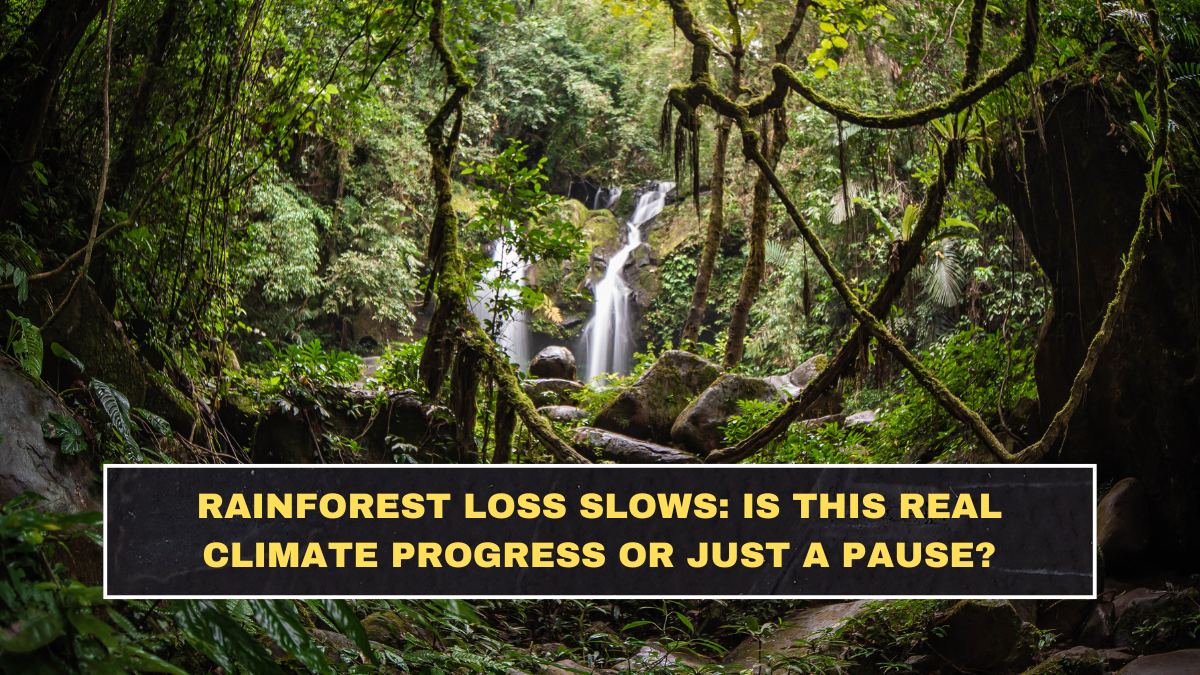
The slowdown in rainforest loss is being called encouraging because the world finally saw a major drop after a record year of destruction. Reuters reported that tropical forest loss fell by 36% in 2025, dropping to 4.3 million hectares from the previous year’s record high. The decline was driven largely by Brazil, where stronger anti-deforestation policies under President Luiz Inacio Lula da Silva helped reduce forest clearing.
That is real progress, and it should not be dismissed. Rainforests store carbon, regulate rainfall, protect biodiversity and support Indigenous communities. When forest loss slows, the climate gets a little more breathing space. But anyone treating this as “problem solved” is fooling themselves. The rate of forest destruction remains dangerously high and still far above what the world needs to meet its 2030 deforestation pledge.
What Did The Latest Rainforest Report Show?
The latest Global Forest Watch analysis from World Resources Institute showed that tropical primary forest loss dropped 36% in 2025, mainly because Brazil reduced forest clearing. The report said forests remain under pressure from agriculture, fires and a warming climate, even though the headline number improved.
The key number is 4.3 million hectares. That is lower than 2024, but it is still an enormous area of forest. To make it simple, the world is losing tropical forest at a pace that may be slower than last year, but still far too fast for climate stability, wildlife protection and water security.
| Key Finding | What It Means? |
|---|---|
| Tropical forest loss fell 36% | 2025 improved after a record-loss year |
| 4.3 million hectares lost | Destruction remains extremely high |
| Brazil drove the decline | Lula-era enforcement helped reduce clearing |
| Loss still above target | Current pace is too high for 2030 forest goals |
| Agriculture remains main driver | Commodity and subsistence farming keep pressure high |
| Fires are rising threat | Climate change is making forests more fragile |
Why Did Brazil Make Such A Big Difference?
Brazil made such a big difference because the Amazon is one of the world’s most important rainforests, and policy changes there can shift global numbers. Reuters reported that Brazil’s Amazon deforestation fell 11.08% in the 12 months through July 2025 to around 5,796 square kilometres, the lowest level since 2014. That decline was linked to stronger environmental enforcement and Lula’s pledge to end deforestation by 2030.
This proves something important: policy works when governments enforce it. Satellite monitoring, fines, protected areas and anti-illegal logging operations can reduce destruction. The lazy excuse that deforestation is “too hard to stop” does not hold up. Brazil’s numbers show that political will can produce measurable results, even in a massive and complex forest system.
Why Is This Not Enough To Celebrate Too Much?
This is not enough to celebrate too much because the remaining level of forest loss is still unacceptable. Reuters reported that even after the 36% decline, tropical forest loss remains 70% higher than the level needed to meet the global pledge to halt and reverse deforestation by 2030.
That means the world is still off track. A drop from a record high is good, but it does not automatically mean the trend is safe. Think of it like a fever going from dangerously high to still high. It is better, but the patient is not healthy. Forest loss must keep falling year after year, not just temporarily after one extreme year.
What Is Still Driving Rainforest Destruction?
Agricultural expansion remains the biggest driver of tropical forest loss. Reuters noted that commodity farming in Brazil, Bolivia and Indonesia, along with subsistence farming in the Democratic Republic of Congo, continues to push into forests. That means demand for land, crops, cattle, soy, palm oil and other commodities is still putting pressure on ecosystems.
This is where consumers and companies enter the story. Deforestation is not only caused by people with chainsaws in remote forests. It is also connected to global supply chains, food demand, cattle ranching, soy production, palm oil, mining and weak land governance. If buyers keep rewarding cheap products with dirty supply chains, forests will keep disappearing.
Why Are Fires Becoming A Bigger Threat?
Fires are becoming a bigger threat because climate change is making forests hotter and drier. WRI warned that fires threaten global progress even as tropical forest loss dropped in 2025. A forest weakened by drought becomes easier to burn, and once fires spread, they can turn living carbon sinks into carbon sources.
Canada’s severe fire seasons show that forest loss is not only a tropical issue. Reuters reported that climate change is worsening forest degradation beyond the tropics, with Canada suffering its second-worst fire season. When forests burn at that scale, they release carbon, destroy habitats and damage air quality.
What Role Does Indonesia Play In The Warning?
Indonesia matters because it is one of the world’s key tropical forest countries, and its policy choices can influence global forest trends. Reuters reported that deforestation concerns have risen around President Prabowo Subianto’s food estate programme, which has been linked to increased forest pressure.
This is the uncomfortable trade-off governments often face. Food security is important, but clearing forests for large agricultural projects can create long-term climate, biodiversity and water risks. If countries try to solve food problems by destroying forests, they may create bigger environmental and economic problems later.
Why Are Rainforests So Important For Climate?
Rainforests are important because they absorb carbon dioxide, support rainfall patterns, store biodiversity and protect local communities. When they are cut or burned, stored carbon enters the atmosphere and makes climate change worse. Forests also help regulate water cycles, which affects farming, hydropower and drought risk.
This is why rainforest loss is not just an environmental story. It is an economic and survival story. Destroying forests can damage agriculture, water supplies, public health and climate stability. The short-term profit from clearing land can be tiny compared with the long-term cost of losing a functioning ecosystem.
What Needs To Happen Next?
The next step is not complicated, but it is politically hard. Countries need stronger enforcement, better land rights for Indigenous communities, transparent supply chains, tougher rules on illegal clearing and more financial support for forest protection. Brazil’s progress shows that action works, but it also shows that progress depends on leadership staying serious.
Companies also need to stop hiding behind vague sustainability claims. If their supply chains include cattle, soy, palm oil, timber or minerals linked to deforestation, they are part of the problem. Consumers cannot fix this alone. Governments and corporations need to remove deforestation from the market, not simply ask people to shop more carefully.
What Is The Bottom Line?
The slowdown in rainforest loss is real progress, especially because Brazil’s enforcement helped drive a 36% decline in tropical forest loss in 2025. But it is not a victory lap moment. The world still lost 4.3 million hectares of tropical forest, and the pace remains far above what is needed to meet 2030 goals.
The blunt truth is this: 2025 was a warning and an opportunity. It proved deforestation can fall when governments act seriously. But if enforcement weakens, fires worsen or agriculture keeps expanding unchecked, this improvement could become just a pause before the next surge in forest destruction.
FAQs
How Much Did Tropical Forest Loss Fall In 2025?
Tropical forest loss fell by 36% in 2025, dropping to 4.3 million hectares after a record high the previous year, according to a Global Forest Watch report cited by Reuters.
Why Did Rainforest Loss Slow In 2025?
The slowdown was driven largely by Brazil, where stronger anti-deforestation enforcement under President Lula helped reduce forest clearing.
Is The World On Track To Stop Deforestation By 2030?
No. Even after the 2025 decline, tropical forest loss remains around 70% higher than the level needed to meet the 2030 pledge to halt and reverse deforestation.
What Is The Main Cause Of Rainforest Loss?
Agricultural expansion remains the main driver, including commodity farming in countries such as Brazil, Bolivia and Indonesia, and subsistence farming in the Democratic Republic of Congo.
Why Are Fires A Growing Forest Threat?
Fires are becoming more dangerous because climate change makes forests hotter and drier. WRI warned that fires are a rising threat to global forest progress even as tropical forest loss dropped in 2025.